
Billy Joel – Just The Way You Are
An evening pause: Performed live in Tokyo, 2006.
Hat tip Phil Berardelli.
An evening pause: Performed live in Tokyo, 2006.
Hat tip Phil Berardelli.
Cassini has begun its last year at Saturn, making its first close fly-by of the gas giant’s rings yesterday.
Cassini’s imaging cameras obtained views of Saturn about two days before crossing through the ring plane, but not near the time of closest approach. The focus of this first close pass was the engine maneuver and observations by Cassini’s other science instruments. Future dives past the rings will feature some of the mission’s best views of the outer regions of the rings and small, nearby moons.
Each of Cassini’s orbits for the remainder of the mission will last one week. The next pass by the rings’ outer edges is planned for Dec. 11. The ring-grazing orbits — 20 in all — will continue until April 22, when the last close flyby of Saturn’s moon Titan will reshape Cassini’s flight path. With that encounter, Cassini will leap over the rings, making the first of 22 plunges through the 1,500-mile-wide (2,400-kilometer) gap between Saturn and its innermost ring on April 26.
On Sept. 15, the mission will conclude with a final plunge into Saturn’s atmosphere. During the plunge, Cassini will transmit data on the atmosphere’s composition until its signal is lost.
Now for a bit of reality: When Cassini’s mission ends on September 15, 2017, it will likely be a minimum of 20 years before another spacecraft returns.

On Christmas Eve 1968 three Americans became the first humans to visit another world. What they did to celebrate was unexpected and profound, and will be remembered throughout all human history. Genesis: the Story of Apollo 8, Robert Zimmerman's classic history of humanity's first journey to another world, tells that story, and it is now available as both an ebook and an audiobook, both with a foreword by Valerie Anders and a new introduction by Robert Zimmerman.
The print edition can be purchased at Amazon or any other book seller. If you want an autographed copy the price is $60 for the hardback and $45 for the paperback, plus $8 shipping for each. Go here for purchasing details. The ebook is available everywhere for $5.99 (before discount) at amazon, or direct from my ebook publisher, ebookit. If you buy it from ebookit you don't support the big tech companies and the author gets a bigger cut much sooner.
"Not simply about one mission, [Genesis] is also the history of America's quest for the moon... Zimmerman has done a masterful job of tying disparate events together into a solid account of one of America's greatest human triumphs."--San Antonio Express-News
Russian authorities in Siberia have located and identified several bits of wreckage from the Soyuz-U rocket and Progress freighter that failed to reach orbit last week.
Two pieces, including a large spherical object, were found by herders over the weekend, while another was discovered in the courtyard of a residential house on Monday, said the region’s head Sholban Karaa-ool, warning people not to touch any metal debris.
Regional sanitation officials “inspected the spot where two pieces of the spacecraft were found in the Ulug-Khem district, on the side of the mountain and near a yurt,” Kara-ool said on his official website. “Another small piece was found in the yard of a house in the Eilig-Khem village,” he said.
Whether this debris can help them pinpoint the cause of the failure remains unknown.
Russian authorities have arrested the chief operating officer from a Roscosmos aircraft division that apparently builds the MiG airplane.
Evdokimov faces up to 10 years of imprisonment under large scale fraud charges if found guilty. The investigation has found that Evdokimov has committed fraud, stealing more than $3 million from the Russian Aircraft Corporation MiG.
…Earlier, the investigators arrested Alexei Ozerov, a former CEO of MiG subsidiary, and deputy CEO of another Russian aircraft manufacturer Tupolev Yegor Noskov in connection with this case. The detainees are suspected of having illegally acquired a development site in northeastern Moscow that was later resold and then sublet to the subsidiaries of the United Aircraft Corporation (UAC) among other clients.
I am increasingly surprised the Russians have been able to build anything that works. Their management teams generally appear more interested in robbing the company than making sure the company does what it is hired to do.

Now available in hardback and paperback as well as ebook!
From the press release: In this ground-breaking new history of early America, historian Robert Zimmerman not only exposes the lie behind The New York Times 1619 Project that falsely claims slavery is central to the history of the United States, he also provides profound lessons about the nature of human societies, lessons important for Americans today as well as for all future settlers on Mars and elsewhere in space.
“Zimmerman’s ground-breaking history provides every future generation the basic framework for establishing new societies on other worlds. We would be wise to heed what he says.” —Robert Zubrin, founder of the Mars Society.
All editions are available at Amazon, Barnes & Noble, and all book vendors, with the ebook priced at $5.99 before discount. All editions can also be purchased direct from the ebook publisher, ebookit, in which case you don't support the big tech companies and the author gets a bigger cut much sooner.
Autographed printed copies are also available at discount directly from the author (hardback $29.95; paperback $14.95; Shipping cost for either: $6.00). Just send an email to zimmerman @ nasw dot org.
The competition heats up: Arianespace’s Vega rocket today successfully launched a Turkish commercial smallsat.
The satellite itself, at 1,000 kilograms or about 2,200 pounds, is at the large end of the smallsat range, which means Vega is not likely competitive with the newer smaller rockets now being designed by a host of new companies to lift even smaller payloads.
Interviews with one of the planners of the September 11 attacks on the United States has revealed how the initial quick and harsh response by the Bush administration caught them off guard and prevented further attacks.
Khalid Sheik Mohammed, one of the masterminds in the 9/11 attack, said that “the ferocity and swiftness” of former U.S. President George W. Bush’s reprisal to the terrorist attacks on U.S. soil astonished Al Qaeda. The new revelation was found in psychologist James E. Mitchell’s new memoir, “Enhanced Interrogation: Inside the Minds and Motives of the Islamic Terrorists Trying To Destroy America.”
Mitchell wrote, “How was I supposed to know that cowboy George Bush would announce he wanted us ‘dead or alive’ and then invade Afghanistan to hunt us down? Khalid explained that if the United States had treated 9/11 like a law enforcement matter, he would have had time to launch a second wave of attacks.” Khalid said they were unable to re-attack because the whole al-Qaeda was stunned by the “ferocity and swiftness” of Bush’s reaction, wrote the psychologist.
These interviews also reveal indirectly why both the Bush and Obama administrations failed in later years to put these terrorists out of business. The U.S., after hitting them hard initially, then eased the attack. First Bush limited his effort to Iraq, allowing the Islamic terrorists to develop safe havens in Iran, Syria, Afghanistan, and other Arab countries. Then, Obama left Iraq too quickly, while focusing his entire effort only half-heartedly in Afghanistan. The result was that these groups could re-organize and rebuild, taking advantage of the power vacuums left by these weak American leaders.
The correct approach would have been a variation of what Bush did initially, which in itself was a variation of the military philosophy first demonstrated by Grant in the Civil War and followed by every American general since. You do not retreat, you do not let up, you demand total victory, and do not stop the attack until you win, entirely. Eisenhower epitomized this approach in World War II, and it worked. Had Bush been in charge in World War II he would have stopped the war effort after Normandy and the recapture of France, allowing Hitler to remain in power in Germany. And this would have failed miserably, as did the efforts of Bush and Obama have failed in the past decade.
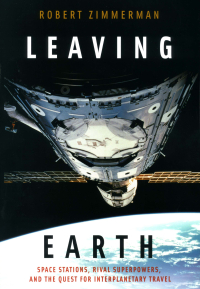
Leaving Earth: Space Stations, Rival Superpowers, and the Quest for Interplanetary Travel, can be purchased as an ebook everywhere for only $3.99 (before discount) at amazon, Barnes & Noble, all ebook vendors, or direct from my ebook publisher, ebookit.
If you buy it from ebookit you don't support the big oppressive tech companies and I get a bigger cut much sooner.
"Leaving Earth is one of the best and certainly the most comprehensive summary of our drive into space that I have ever read. It will be invaluable to future scholars because it will tell them how the next chapter of human history opened." -- Arthur C. Clarke
According to Buzz Aldrin his health problems in Antarctica last week was caused by altitude sickness.
Because of the thick ice that blankets Antarctica, the South Pole sits at an elevation of 2,835 meters (9,300 feet). Aldrin said in a statement he still has some congestion in his lungs and so has been advised to rest in New Zealand until it clears up and to avoid the long flight back to the U.S. for now. Aldrin, his son Andrew and manager Christina Korp had been visiting Antarctica as tourists on a trip organized by the White Desert tour company. They left last Tuesday from South Africa. “South Pole here I come!” Aldrin wrote on Twitter at the time.
He said the trip began well, and that he’d been planning to spend time with scientists who were studying what it would be like to live on Mars because the conditions in Antarctica were similar. “I had been having a great time with the group at White Desert’s camp before we ventured further south,” he said. “I started to feel a bit short of breath so the staff decided to check my vitals. After some examination they noticed congestion in my lungs and that my oxygen levels were low, which indicated symptoms of altitude sickness.” Aldrin said he was put on the next flight, a ski-equipped LC-130 cargo plane that took him to McMurdo Station, a U.S. research center on the Antarctic coast. “Once I was at sea level I began to feel much better,” he said.
Virgin Galactic’s second SpaceShipTwo, Unity, yesterday successfully completed its first glide test flight.
SpaceShipTwo, named VSS Unity, and its carrier aircraft, WhiteKnightTwo, took off from the Mojave Air and Space Port in California at about 9:50 a.m. Eastern. The spaceplane separated from WhiteKnightTwo at 10:40 a.m. Eastern, gliding back to a runway landing in Mojave ten minutes later, according to updates provided by the company.
Congratulations to Virgin Galactic. They need to start making these flights quickly and frequently, and they need to ramp up to powered flight, to quash the skepticism that has built up about the company and its effort. More important, they need to do this because, unlike a decade ago, they are no longer the only game in town. They now have some serious competition.
Link here. The post provides an excellent selection of some of the more memorable and egregious performances by the arrogant press, insulting and attacking and making fun of the tea party protesters. As the author notes,
Dear Media. Psst. Pay deadly-close attention here, for this is nearly the whole game that lost it for you:
1) pols made statements about a new policy to help it pass.
2) policy passed.
3) public discovered the policy was not as described. In a really bad way.
4) pols laughed at the public for believing them in the first place.
5) public learned its lesson, and acted accordingly.
Media: remember who was cheerleading and protecting the politicians who were enacting ACA? Remember who was vilifying those making good faith arguments against it? Defaming them as racists? It was you. And we all remember being lied to by you, too.
When you weren’t simply mocking us.
And this is how you got Trump.
The post ends with a few links to just a few of the Obama administration’s worst power grabs and fascist attacks on citizens, including the Gibson guitar raid and the IRS harassment, both of which the mainstream press either ignored or worked to embargo so that no one would know they happened.
NASA is considering changing the first Orion crewed mission so that, instead of orbiting the Moon, the spacecraft will merely whip past it on a course that will take it directly back to Earth.
In a presentation to a Nov. 30 meeting of the NASA Advisory Council in Palmdale, California, Bill Gerstenmaier, NASA associate administrator for human exploration and operations, discussed what he described as a new proposal for Exploration Mission 2 (EM-2) that would last eight days. The concept, called the multi-translunar injection free minimum mission, would initially place the Orion spacecraft and its Exploration Upper Stage (EUS) into an elliptical orbit around the Earth with an apogee of 35,000 kilometers. After spending one day in that orbit, the spacecraft would separate from the EUS and use its service module engine for a final burn to send the spacecraft towards the moon. Orion would fly on a “free return” trajectory around the moon without going into orbit and without requiring another engine burn. The mission would end with a return to Earth eight days after launch, but with an option to extend the mission to up to 21 days.
The entire SLS/Orion project is idiotic and incredibly dangerous, not because it is going to the Moon but in how they plan on doing it, with literally no preparation flights beforehand. With Apollo, NASA was very careful to test each part of the package first, then proceed with a more ambitious mission. The only exception to this process was Apollo 8, which went to the Moon without a Lunar Module. That happened because they were in an intense space race with the Soviets and were under pressure to achieve Kennedy’s commitment to land before the end of the decade.
With SLS/Orion there is no such pressure. What is driving their lack of testing is a lack of money, caused by the project’s ungodly cost. They not only can’t afford to build multiple rockets to fly a variety of missions building up to the Moon, Congress hasn’t given them the money. Right now all they have allocated is enough to fly one unmanned mission in 2018, and this one manned flight in 2021 (which by the way is almost certainly going to be delayed until 2023).
The worst aspect of SLS/Orion is its stuntlike nature. They aren’t building anything that will have any permanence or allow for future colonization. It costs too much. Instead, SLS/Orion is designed to do one or two PR missions that will look good on some politician’s resume, but will do little to further the colonization of the solar system by the U.S.
Link here. The article does a nice job of outlining, with videos, what will happen as the spacecraft makes multiple dives inside rings.
Cassini’s final acts, which will play out over the next year. That pass placed Cassini in a high-inclination orbit tilted 60° relative to the ring plane. Cassini will perform 20 passes just 620 miles (1000 kilometers) outside the F ring of Saturn in a phase known as the Ring-Grazing Orbits, which runs from late November 2016 through April 2017.
Cassini already reached apoapse, or its farthest point from Saturn, on Wednesday, November 30th. The first ring crossing is coming right up this weekend on Sunday, December 4th, at 7:09 a.m. EST / 13:09 UT. During the first periapse pass on Sunday, Cassini will also burn its main engine for the 183rd and final time for the mission. All later fine course corrections will be made using thrusters only.
Things get even more interesting after April, when the series of Grand Finale Orbits will begin, taking the spacecraft through the 1240-mile-wide (2000-kilometer-wide) gap between the planet’s cloud tops and rings for 22 final orbits. The Grand Finale Orbits start with the spacecraft’s 126th and final pass near Titan, which will set the spacecraft up for much tighter final orbits.
Not good: Sources in the Russian press say that it will likely be impossible to pinpoint precisely the cause of the Progress failure this week because of a lack of telemetry or data.
The causes of Thursday’s loss of the Progress cargo spacecraft are unlikely to be established, because neither telemetry data nor debris of the Soyuz-U rocket that was taking the cargo vehicle in orbit are available. “Telemetry transmission from the rocket was disrupted instantly, so it is practically impossible to establish the sequence of events to identify the causes of the emergency. As for material evidence, such as debris of the rocket’s third stage that might provide some clues, it is not available, either,” the source said.
They are still searching for debris but have so far come up empty.
Lacking data, they are now beginning to use computer modeling to try to figure out what happened. The prime suspect is the third stage engine.
An evening pause: Performed live in Berlin, 2007.
Hat tip Insomnius.
Despite the failure of the Schiaparelli lander on ExoMars 2016, the European Space Agency today approved funds to build and fly the ExoMars 2020 rover mission.
At a meeting of European government ministers in Lucerne, Switzerland, on 1 and 2 December, ESA member states agreed to provide an extra €339 million for ExoMars 2020. ESA also announced that it will find a further €97 million by moving funds internally. Speaking at a press briefing after the meeting, ESA director-general Jan Wörner said this would be done “without detriment” to ESA’s wider science budget.
But not all projects were so fortunate. Member states did not commit the €250 million needed to fund a plan for ESA to participate in a mission to deflect the moon of an asteroid, although they left door open to future, similar projects.
I am not at present sure how they are going to divide up the work between Europe and Russia. Earlier it was my understanding that Russia would provide the roving technology, but right now I am very unsure about this.
One side note: At this same meeting ESA committed to sticking with ISS through 2024.
This article provides a good summary and analysis of comments by vice-president-elect Mike Pence describing the initial plans of the Trump administration.
The new administration’s first priorities would include curbing illegal immigration, abolishing and then replacing Mr. Obama’s signature health-care system, nominating a justice to fill a vacancy on the Supreme Court, and strengthening the military, said Mr. Pence, whose wife, Karen Pence, sat nearby during the interview.
…By springtime, the Trump administration would work with congressional leaders “to move fundamental tax reform” meant to “free up the pent-up energy in the American economy,” he said. Pillars of the tax overhaul would include lowering marginal tax rates, reducing the corporate tax rate “from some of the highest in the industrialized world” to 15%, and repatriating corporate cash held overseas, he said.
Overall, if they do what Pence says (some of which was confirmed by Trump in his remarks at the Carrier plant yesterday), they will move the government in the right direction.
Hampshire College, faced with intense criticism over its decision to stop flying the American flag, has ended the ban.
Hampshire President Jonathan Lash says the flag was not removed to make a political statement or to offend, but to facilitate dialogue. He says the flag has been raised again “as a symbol of … freedom, and in hopes for justice and fairness for all.”
Yeah, right, dialogue is always facilitated by banning something. What I think really happened here is that Lash suddenly discovered that his anti-American ban had really facilitated the end of all donations from alumni, and thus he suddenly discovered that he really is a loyal American who loves his country.
Personally, I think donations should continue to dry up until the college replaces Lash and the rest of its academic personnel that initially supported this ban.
After cancelling a planned first glide test of Virgin Galactic’s Unity spaceship in early November, the company completed a second captive carry flight on November 30.
“As part of our ground and flight testing, we made a few tweaks to the vehicle,” Virgin Galactic tweeted before the Nov. 30 flight. “We’ll test those in a captive carry flight today.” Virgin Galactic has not announced when the next test flight will take place or if it will include a glide test.
They apparently found some issues both from the first captive carry flight as well as ground tests that required them to make some changes to the spaceship and do another captive carry flight.
This update into Buzz Aldrin’s health condition says that his condition is stable and appears to recovering. Apparently the problem was “fluid in his lungs”, which suggests pneumonia.
The competiion heats up: A private Japanese company is developing a sub-orbital mini-shuttle capable of carrying up to eight people, and hope to fly it by 2023.
An unmanned trial run of the prototype to an altitude of 100 kilometers is scheduled for 2018, and if a manned mission is successfully achieved by 2020, the company hopes to commence its space travel enterprise by the end of 2023. The price of a trip into space is aimed to be about 14 million yen — which is approximately 70 percent of that announced by American company Virgin Galactic. PD Aerospace aims to take passengers to an altitude of 100 kilometers, where they will be able to enjoy a “zero-gravity floating experience” for about 5 minutes, before returning to Earth.
They are entering this competition very late. Considering how slowly Virgin Galactic has moved, though, they still might beat them into orbit.
The competition heats up: Canon has joined a new project by the Japanese space agency JAXA to develop a small rocket for commercial smallsats.
The three-stage rocket is an upgrade to JAXA’s two-stage SS-520, which carries instruments for research observations. Measuring 52cm in diameter and less than 10 meters in length, the new version will cost less than one-tenth as much to launch as leading rockets and is expected to be used to lift microsatellites in orbit. An initial launch is slated for early next year from the Uchinoura Space Center in Kagoshima Prefecture.