
Man charged after baby was found abandoned in an Occupy DC tent
Man charged after a baby was found abandoned in an Occupy DC tent.
Which immediately makes me think of this video comedy sketch:
Man charged after a baby was found abandoned in an Occupy DC tent.
Which immediately makes me think of this video comedy sketch:
An evening pause: Some important engineering.

On Christmas Eve 1968 three Americans became the first humans to visit another world. What they did to celebrate was unexpected and profound, and will be remembered throughout all human history. Genesis: the Story of Apollo 8, Robert Zimmerman's classic history of humanity's first journey to another world, tells that story, and it is now available as both an ebook and an audiobook, both with a foreword by Valerie Anders and a new introduction by Robert Zimmerman.
The print edition can be purchased at Amazon or any other book seller. If you want an autographed copy the price is $60 for the hardback and $45 for the paperback, plus $8 shipping for each. Go here for purchasing details. The ebook is available everywhere for $5.99 (before discount) at amazon, or direct from my ebook publisher, ebookit. If you buy it from ebookit you don't support the big tech companies and the author gets a bigger cut much sooner.
"Not simply about one mission, [Genesis] is also the history of America's quest for the moon... Zimmerman has done a masterful job of tying disparate events together into a solid account of one of America's greatest human triumphs."--San Antonio Express-News
Another space tourism company, Xcor, has announced its test flight schedule for 2012.
Taxi tests are scheduled to begin in October or November, which will be quickly followed by a short hop and finally a brief first flight by the end of the year.
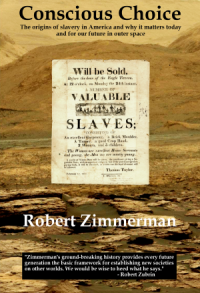
Now available in hardback and paperback as well as ebook!
From the press release: In this ground-breaking new history of early America, historian Robert Zimmerman not only exposes the lie behind The New York Times 1619 Project that falsely claims slavery is central to the history of the United States, he also provides profound lessons about the nature of human societies, lessons important for Americans today as well as for all future settlers on Mars and elsewhere in space.
“Zimmerman’s ground-breaking history provides every future generation the basic framework for establishing new societies on other worlds. We would be wise to heed what he says.” —Robert Zubrin, founder of the Mars Society.
All editions are available at Amazon, Barnes & Noble, and all book vendors, with the ebook priced at $5.99 before discount. All editions can also be purchased direct from the ebook publisher, ebookit, in which case you don't support the big tech companies and the author gets a bigger cut much sooner.
Autographed printed copies are also available at discount directly from the author (hardback $29.95; paperback $14.95; Shipping cost for either: $6.00). Just send an email to zimmerman @ nasw dot org.
Touching our lives every day: In 2011 the EPA fined companies millions because they didn’t use a fuel that doesn’t exist.
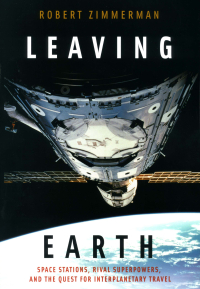
Leaving Earth: Space Stations, Rival Superpowers, and the Quest for Interplanetary Travel, can be purchased as an ebook everywhere for only $3.99 (before discount) at amazon, Barnes & Noble, all ebook vendors, or direct from my ebook publisher, ebookit.
If you buy it from ebookit you don't support the big oppressive tech companies and I get a bigger cut much sooner.
"Leaving Earth is one of the best and certainly the most comprehensive summary of our drive into space that I have ever read. It will be invaluable to future scholars because it will tell them how the next chapter of human history opened." -- Arthur C. Clarke
Obama today: “The EPA touches on the lives of every single American every single day.”
Truer words were never spoken, but not in the way the President intended. He was speaking to a gathering of EPA employees in Washington, DC, and was praising them for their work. To the rest of the nation, however, the EPA’s effort is increasingly seen as a terrible burden that is squelching both the economy and the freedom of Americans.
The dead, mostly Democratic, get to vote in the New Hampshire primary.
The story includes video of election workers handing out the voter ballots for deceased voters to whomever asks and telling them they didn’t need to show id to use those ballots to vote.
Kepler has found two more planets orbiting double star systems.
The data also suggests that there will be millions of planets in the galaxy orbiting double stars.
FYI, all this astronomy news is because the American Astronomical Society is having its conference this week in Texas, and today is releasing has what I consider the best news stories.
Billions and billions! Astronomers have concluded that the stars in the Milky Way must average at least one planet per star. More importantly, the data says the galaxy should have billions of habitable planets.
[According to astronomer Uffe Gråe Jørgensen], a statistical analysis … shows that out of the Milky Way’s 100 billion stars, there are about 10 billion stars with planets in the habitable zone. This means that there may be billions of habitable planets in the Milky Way.
New data has found that the crash of two white dwarf stars not only caused the nearest supernova in 25 years, but appear to be the prime cause for these types of supernovae.
The data also says that there are no white dwarf primary systems in the Milky Way that are candidates to go supernova in this way. Thus, we can all sleep easy tonight!
The most distant supernova discovered so far.
SN Primo is the farthest Type Ia supernova whose distance has been confirmed through spectroscopic observations. The supernova was discovered as part of a three-year Hubble program to survey faraway Type Ia supernovae, enabling searches for this special class of stellar explosion at greater distances than previously possible. The remote supernovae will help astronomers determine whether the exploding stars remain dependable distance markers across vast distances of space in an epoch when the cosmos was only one-third its current age of 13.7 billion years.
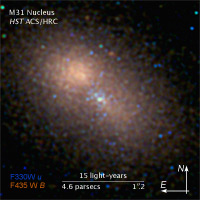
The Hubble Space Telescope has taken a close up of the double nucleus of the Andromedea galaxy, and found an interesting cluster of hot blue stars in between the two clusters.
Click on the image for the full resolution version of the image.
Forget about the Republican primary. I think this tidbit is far more instructive: Obama got only 82% of the Democrat vote in New Hampshire – running unopposed.
The Supreme Court looks hard at the EPA and doesn’t like what it sees.
This case is about the EPA’s ongoing effort to steal property from private landowners.
The Sacketts wanted to build a home on a 0.63-acre lot near Priest Lake in the Idaho panhandle that they bought for $23,000. But after three days of bringing in fill dirt and preparing for construction in 2007, officials from the EPA and the U.S. Army Corps of Engineers ordered the activity stopped and said they suspected the land contained wetlands.
Months later, the agency sent the Sacketts a “compliance order” that said the land must be restored as a wetlands before the couple could apply for a building permit. The government acknowledged Monday that fines for failure to comply with the orders could be as much as $75,000 a day.
A slap on the wrist: Two TSA workers who pleaded guilty to stealing $40,000 from a passenger’s luggage were each sentenced to six months in prison today.
I wonder if the TSA will give them their jobs back when they get out. They seem perfectly qualified for the work the TSA does.
A fitting honor: The National Radio Astronomy Observatory (NRAO) has renamed the recently upgraded thirty-one year old Very Large Array (VLA) after Karl Jansky, the man who invented radio astronomy.
Karl Guthe Jansky joined Bell Telephone Laboratories in New Jersey in 1928, immediately after receiving his undergraduate degree in physics. He was assigned the task of studying radio waves that interfered with the recently-opened transatlantic radiotelephone service. After designing and building advanced, specialized equipment, he made observations over the entire year of 1932 that allowed him to identify thunderstorms as major sources of radio interference, along with a much weaker, unidentified radio source. Careful study of this “strange hiss-type static” led to the conclusion that the radio waves originated from beyond our Solar System, and indeed came from the center of our Milky Way Galaxy.
His discovery was reported on the front page of the New York Times on May 5, 1933, and published in professional journals. Jansky thus opened an entirely new “window” on the Universe. Astronomers previously had been confined to observing those wavelengths of light that our eyes can see. “This discovery was like suddenly being able to see green light for the first time when we could only see blue before,” said Lo.
An evening pause:
NASA is in negotiations with ESA to have them provide the service module for Orion.
Orion is costing billions, yet NASA hasn’t the ability or budget to build its service module?