
Monteverdichor Würzburg Orchestra – Finale from Handel’s Israel in Egypt
An evening pause: Performed live 2009. A good rousing way to start the week.
Hat tip James Street.
An evening pause: Performed live 2009. A good rousing way to start the week.
Hat tip James Street.
Courtesy of BtB’s stringer Jay. This post is also an open thread. I welcome my readers to post any comments or additional links relating to any space issues, even if unrelated to the links below.
The smallsats will form a communications satellite constellation called Kaon for the French startup Space Network Services.
ULA desperately needs this launch to go off without a hitch so that it can begin launching satellites for the military.
The company is going to try to land its first stage and reuse it from the very first flight.
More details about this launch here.
The black hole has essentially driven all the gas from the galaxy, ending all star formation.
I did not see much in this article that was new, though the summary was worthwhile.
Details about its final orbits here.

On Christmas Eve 1968 three Americans became the first humans to visit another world. What they did to celebrate was unexpected and profound, and will be remembered throughout all human history. Genesis: the Story of Apollo 8, Robert Zimmerman's classic history of humanity's first journey to another world, tells that story, and it is now available as both an ebook and an audiobook, both with a foreword by Valerie Anders and a new introduction by Robert Zimmerman.
The print edition can be purchased at Amazon or any other book seller. If you want an autographed copy the price is $60 for the hardback and $45 for the paperback, plus $8 shipping for each. Go here for purchasing details. The ebook is available everywhere for $5.99 (before discount) at amazon, or direct from my ebook publisher, ebookit. If you buy it from ebookit you don't support the big tech companies and the author gets a bigger cut much sooner.
"Not simply about one mission, [Genesis] is also the history of America's quest for the moon... Zimmerman has done a masterful job of tying disparate events together into a solid account of one of America's greatest human triumphs."--San Antonio Express-News

An earlier example of the Democratic Party’s
reasonablity, that time against Abraham Lincoln
They’re coming for you next: The words couldn’t have made it clearer. When asked by a reporter of the Daily Mail what he thought of his father’s actions, the son of attempted Trump assassin Ryan Routh said that his father hates Trump as “every reasonable person does. I don’t like Trump either.”
The problem is that reasonable people don’t hate. Reasonable people think about the differing opinions of others and decide as rationally as possible what they think might be the right answer. And if reasonable people are faced with true evil, they don’t act with hatred. They instead follow the biblical mantra, don’t condemn the sinner, only the sin.
Routh’s son however illustrates the contrasting attitude of the base as well as the leadership of today’s Democratic Party. They don’t simply disagree, they hate. Worse, they think that hatred is “reasonable,” and that everyone “reasonable” agrees with it.
Thus you get two assassination attempts in just over two months against Donald Trump, whose only crime — according to Democrats — is that he is running for president against them, and has said he will change the governmental policies they believe in. “Reasonable Democrats” can’t tolerate such a possibility, so therefore these “reasonable Democrats” appear out of nowhere, over and over again, attempting to kill the source of their hatred.
It is this same mindless hatred that allowed Kamala Harris as well as the Democratic Party operatives running the Trump-Harris debate last week to repeat slanderous lie after slanderous lie. The list below is only a sampling:
» Read more
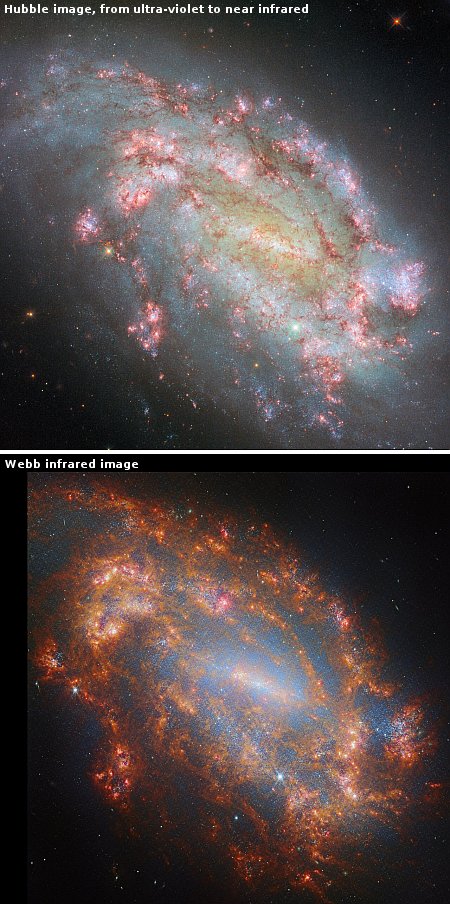
For the original images go here and here.
Cool image time! The two pictures to the right, taken respectively by the Hubble and Webb space telescopes of the same galaxy, shows us many different features of a barred galaxy, located about 35 million light years away. From the caption for the Hubble image:
This picture is composed of a whopping ten different images taken by the Hubble Space Telescope, each filtered to collect light from a specific wavelength or range of wavelengths. It spans Hubble’s sensitivity to light, from ultraviolet around 275 nanometres through blue, green and red to near-infrared at 1600 nanometres. This allows information about many different astrophysical processes in the galaxy to be recorded: a notable example is the red 656-nanometre filter used here. Hydrogen atoms which get ionised can emit light at this particular wavelength, called H-alpha emission. New stars forming in a molecular cloud, made mostly of hydrogen gas, emit copious amounts of ultraviolet light which is absorbed by the cloud, but which ionises it and causes it to glow with this H-alpha light.
Therefore, filtering to detect only this light provides a reliable means to detect areas of star formation (called H II regions), shown in this image by the bright red and pink colours of the blossoming patches filling NGC 1559’s spiral arms.
The Z-shaped blue indicates the stars and its most distinct spiral arms. Astronomers presently believe that the Milky Way is also a barred spiral like this, though its star-forming regions are thought to be far less extensive and distinct.
The Webb infrared image matches the Hubble data, with the false color blue indicating the near-infrared and the false color red the mid-infrared. As with the Hubble picture, the red indicates the galaxy’s extensive star forming regions.

Now available in hardback and paperback as well as ebook!
From the press release: In this ground-breaking new history of early America, historian Robert Zimmerman not only exposes the lie behind The New York Times 1619 Project that falsely claims slavery is central to the history of the United States, he also provides profound lessons about the nature of human societies, lessons important for Americans today as well as for all future settlers on Mars and elsewhere in space.
“Zimmerman’s ground-breaking history provides every future generation the basic framework for establishing new societies on other worlds. We would be wise to heed what he says.” —Robert Zubrin, founder of the Mars Society.
All editions are available at Amazon, Barnes & Noble, and all book vendors, with the ebook priced at $5.99 before discount. All editions can also be purchased direct from the ebook publisher, ebookit, in which case you don't support the big tech companies and the author gets a bigger cut much sooner.
Autographed printed copies are also available at discount directly from the author (hardback $29.95; paperback $14.95; Shipping cost for either: $6.00). Just send an email to zimmerman @ nasw dot org.
The Ariane-6 rocket investigation team, including people from the European Space Agency (ESA), CNES (France’s space agency), ArianeGroup (which built and owns the rocket), and Arianespace (which presently manages the rocket), has identified the issue that caused the rocket’s upper stage failure during the rocket’s first launch in July.
In a 16 September update, the Task Force announced that the investigation had identified a single temperature measurement that “exceeded a predefined limit” as the root cause of the anomaly. The tripped limit caused the software to trigger a shutdown of the APU which ensured the rocket’s Vinci upper stage engine could not be restarted for the final burn.
In order to remedy this issue and ensure a similar shutdown does not occur in the future, the ignition preparation sequence, specifically the APU chill-down sequence, has been changed. The updated flight software is already being tested as teams prepare for the rocket’s first commercial flight which is set to take place before the end of the year.
Because of that incorrect temperature, the upper stage did not do its final burn, thereby stranding the stage and two demonstration return capsules in the wrong orbit. This prevented the test return of both capsules, as well as the test planned de-orbit of the stage over the ocean.
Russian astronauts Oleg Kononenko and Nikolay Chub today marked the one year anniversary of their launch in 2023, thus marking another Russian yearlong mission in space.
The two cosmonauts were sent to the orbit aboard the Soyuz MS-24 manned spacecraft, which blasted off from the Baikonur space launch center on September 15, 2023. The third crew member on board was NASA astronaut Loral O’Hara, who returned to the Earth on April 6, 2024. Kononenko and Chub, as well as NASA astronaut Tracy Dyson, will travel back aboard the Soyuz MS-25 spacecraft, whose departure is scheduled for September 23.
Their return next week will not mark a record for the longest flight in space. That belongs to Valeri Polykov, who occupied the Soviet-built Mir space station in the mid-1990s for one year, two months, and two weeks in the mid-nineties, or 438 days. The second longest flight was by Sergey Avdeev, 380 days on Mir in 1998-1999, with the third longest flight by Sergey Prokopyev, Dmitry Petelin, and Franco Rubio, 371 days in 2022-2023.
When Kononenko and Chub return on September 23rd, their flight will 373 days long, passing the 2022-2023 mission.
Note that only one American is on this list. A few have flown almost a year, but only Rubio has made it, and that was forced on him unplanned because of problems with the Soyuz capsule that brought him into orbit. He was forced to stay up an extra six months and come down on the next Soyuz.
The reason for this lack of long American flights is entirely NASA’s fault. It has consistently resisted doing such long missions, even holding the Russians back during the first two decades of ISS’s operation. The Russians no longer follow NASA’s timidity, and have been doing more such missions, because such missions will be the only way to gather the necessary medical data needed for future missions to Mars.
Meanwhile, NASA hesitates, and sometimes touts eleven-month missions (such as Scott Kelly’s) as year-long missions, a blatant lie that our propaganda press repeats mindlessly. I fully expect the first planned year-long American mission will be done privately, outside of our government, once Starship begins flying regularly.

Leaving Earth: Space Stations, Rival Superpowers, and the Quest for Interplanetary Travel, can be purchased as an ebook everywhere for only $3.99 (before discount) at amazon, Barnes & Noble, all ebook vendors, or direct from my ebook publisher, ebookit.
If you buy it from ebookit you don't support the big oppressive tech companies and I get a bigger cut much sooner.
"Leaving Earth is one of the best and certainly the most comprehensive summary of our drive into space that I have ever read. It will be invaluable to future scholars because it will tell them how the next chapter of human history opened." -- Arthur C. Clarke

According to Iran’s state-run press and now confirmed by independent sources, Iran yesterday completed its third orbital launch in 2024, its new solid-fueled three stage Qaem-100 rocket lifting off on its second launch from Iran’s interior Semnan spaceport. No word on where the rocket’s lower stages crashed.
The payload was an engineering test satellite, which according to the Iranian press is operating as planned.
At the moment Iran appears to aggressively accelerating its civilian space program. It now has two functioning rockets, the Simorgh rocket, which placed three satellites in orbit in January, and the Qaem-100, its first launch taking place also in January. The country is also building a coastal spaceport near the town of Chabahar, as shown on the map to the right. Moreover, this third launch is the most the country has ever achieved in a single year. Until 2024, Iran had never launched more than once in any year.
And while these rockets and satellites do not appear to be military in nature, the technology development will certainly result in advances in Iran’s missile capabilities. The Qaem-100’s solid-fueled design is exactly what most ballistic missiles use, since it allows the missile to be stored fueled for long periods.
The leader board in the 2024 launch race remains unchanged.
91 SpaceX
38 China
10 Rocket Lab
10 Russia
American private enterprise still leads the rest of the world combined in successful launches 106 to 59, while SpaceX by itself leads the entire world, including American companies, 91 to 74.
SpaceX’s Resilience capsule has just splashed down safely in the Gulf of Mexico, ending the five-day Polaris Dawn private manned orbital mission, commanded by billionaire and jet pilot Jared Isaacman.
As of posting the capsule is still in the water with divers and boats on the way.
This completes the first mission in Isaacman’s planned three mission Polaris program. It was a complete success, doing a great deal of medical research on the effects of high orbit radiation on the human body as well as the first private spacewalk using SpaceX’s first EVA spacesuits. For Isaacman’s next mission he has already proposed doing a Hubble repair mission. NASA has had mixed feelings about this idea, but after this success it will be interesting if that attitude changes.
I must comment that the coverage by SpaceX employees on this mission was somewhat annoying. For the first time, they spent a lot of time giggling and focusing on PR and how “cool” and “incredible” and “wonderful” everything was, from amusing new decals in the capsule to the spacewalk to Sarah Gillis’ violin performance.
All of this was as great as they kept saying, which is why they didn’t need to say it, over and over and over and over and over again. It would have been better if they had done what SpaceX has generally done on previous broadcasts and missions, focused on describing the technical aspects and then staying silent otherwise. Gushing like this is more like a NASA or Blue Origin broadcast, and does not do SpaceX credit.
Embedded below the fold in two parts.
To listen to all of John Batchelor’s podcasts, go here.
» Read more
An evening pause: The music is by John Williams. The lead violinist is space-walking Sarah Gillis, playing from the Resilience capsule in orbit right now.
Hat tip Gary.
HARMONY OF RESILIENCE: Recorded in space and sent to Earth via @SpaceX’s @Starlink constellation, Polaris Dawn crewmember and violinist @Gillis_SarahE invites you to enjoy this music moment in support of @StJude & @ElSistemaUSA → https://t.co/My8cUwAWzg pic.twitter.com/OoxTllCZNP
— Polaris (@PolarisProgram) September 13, 2024

The results of COVID policy decisions
for our medical community
Several stories in the past week illustrate how the medical community dug itself a deep hole with its dishonest panic and over-reaction to COVID and its response to it.
First the background from 2020: Rather than follow past very successful policies involving new epidemics, whereby only the sick and aged were quarantined while everyone else went about their normal lives, intentionally spreading the new respiratory virus to those with which it was relatively harmless so that the entire population could quickly get herd immunity and thus quickly choke the virus out, our modern medical community, in conjunction with government health officials who had political motives, chose to quarantine everyone, destroying the economy and the livelihoods of millions while actually allowing the disease time to spread to the aged and sick, killing many more than were necessary.
Numerous studies have confirmed the failure of the lockdown and mandate policies during COVID. Sweden for example essentially followed those traditional policies, never locking down or mandating masks or shots. It was blasted for that decision, with many in the health community predicting massive deaths from COVID. Instead, studies have now proven that Sweden had the lowest mortality in Europe from 2020–2022.
That’s the background. The new stories this week illustrate the consequences. First, a recent peer-reviewed study found that trust in doctors has crashed since 2020. The numbers are quite shocking:
» Read more

Click for original image.
Cool image time! The picture above, cropped to post here, was taken on September 9, 2024 by the left navigation camera on the Mars rover Perseverance, looking east and back along the route from which the rover had come.
The view is somewhat more spectacular than most Perseverance images because the rover took it during its on-going climb up unto the rim of Jezero Crater, as shown by the overview map below. The blue dot marks Perseverance’s present position, while the yellow lines indicate the area covered by the picture above, taken several days earlier.
The haze in the picture also suggests that the local dust storm first noted in late August might be clearing somewhat. This isn’t certain, however, as the previous picture was using the rover’s high resolution camera to look at distant hills (thus more obscured), while the picture above was taken by the left navigation camera looking more widely and at nearer objects.

Click for interactive map.
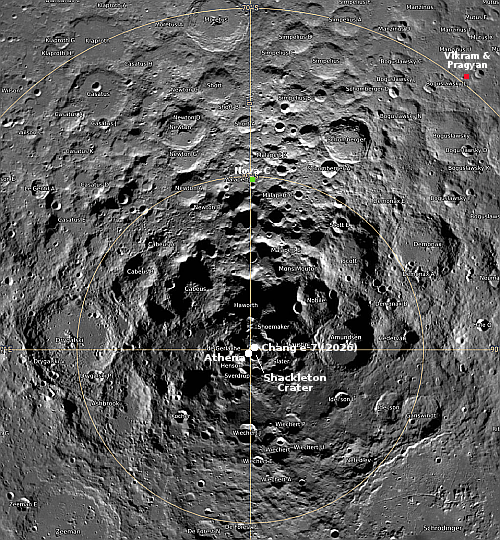
The landers either at or targeting the Moon’s south pole
The company Intuitive Machines is now aiming to launch its second Nova-C lunar lander, dubbed Athena, during a January 1-5, 2025 launch window.
The landing site is indicated on the map to the right, on the rim of Shackleton crater and almost on top of the south pole. While Chang’e-7 is targeting the same crater rim, it is not scheduled for launch until 2026.
The lander will not only include a drill for studying the surface below it, it will release a small secondary payload, the Micro-Nova Hopper, which will hopefully hop down into the permanently shadowed craters nearby.
The launch will also carry a lunar orbiter, dubbed Lunar Trailblazar, which will not only do spectroscopy of the lunar surface, looking for water, it will also be used as a communications relay satellite with Athena. That orbiter, designed to demonstrate the ability to build a smallsat at low cost, was previously threatened with cancellation because its builder, Lockheed Martin, went way over budget.

Click for original image.
Using both seismological data compiled over four years by the InSight Mars lander as well tiny changes in the orbits of Martian satellites, scientists have now created a global gravity map of the red planet, indicating the regions below the surface that are either low or high density.
That map is above, annotated by me to indicate some of Mars’ major surface features.
The density map shows that the northern polar features are approximately 300-400 kg/m3 denser than their surroundings. However, the study also revealed new insights into the structures underlying the huge volcanic region of Tharsis Rise, which includes the colossal volcano, Olympus Mons.
Although volcanoes are very dense, the Tharsis area is much higher than the average surface of Mars, and is ringed by a region of comparatively weak gravity. This gravity anomaly is hard to explain by looking at differences in the martian crust and upper mantle alone. The study by Dr Root and his team suggests that a light mass around 1750 kilometres across and at a depth of 1100 kilometres is giving the entire Tharsis region a boost upwards. This could be explained by huge plume of lava, deep within the martian interior, travelling up towards the surface.
I once again note that the largest impact basin on Mars, Hellas Basin, sits almost exactly on the planet’s far side from Tharsis, and appears to have a light density. This contrast once again makes me wonder if the origin of that impact and the Tharsis Bulge are linked.
In another blow to the company, Boeing’s employees have gone on strike after overwhelming voting to reject a new deal their union officials had negotiated with the company that had called for a 25% salary increase across the board.
Members of the International Association of Machinists District 751, which represents about 33,000 Boeing workers in Washington state, walked off the job when their contract expired at midnight on Thursday night. Almost 95 per cent rejected the deal endorsed by their bargaining team on Sunday and 96 per cent voted to strike, easily exceeding the two-thirds majority needed to trigger a walkout.
Many of the union’s members expressed anger on social media, criticising the deal and accusing IAM leaders of settling for too little. Many had been ready to strike, partly fuelled by residual anger from a 2014 deal that eliminated defined-benefit pensions.
Boeing on Thursday said it was ready to renegotiate a deal to halt a crippling strike.
Right now Boeing’s credit rating is “one notch above junk” and if the strike isn’t settled quickly that rating could drop more. It will also prevent the company from taking any action to recover from its numerous problems that are limiting sales of its airplanes and its military and space products.
SpaceX last evening successfully placed another 21 Starlink satellites into orbit, its Falcon 9 rocket lifting off from Vandenberg in California.
The first stage completed its eighteenth flight, landing on a drone ship in the Pacific.
The leaders in the 2024 launch race:
91 SpaceX
38 China
10 Rocket Lab
10 Russia
American private enterprise now leads the rest of the world combined in successful launches 106 to 58, while SpaceX by itself leads the entire world, including American companies, 91 to 73.
Like yesterday, reader Gary has stepped in to cover for BtB’s stringer Jay, who is off on a work trip this week. This post is also an open thread. I welcome my readers to post any comments or additional links relating to any space issues, even if unrelated to the links below.
I am sure this is so, but I am also sure there was little Russia could do, without requiring a lot of cash from NASA as part of the deal.
For a more sane discussion of this research, which was really only about the increased sensitivity of modern instruments, go here. That some are using it for political purposes to whack SpaceX is disgraceful.
But then, Israel has generally been a head-in-the-sand fool for more than a decade when it comes to reusability and commercial space. His insistence ten years ago that it made no financial sense to make Ariane-6 reusable resulted in that rocket being overpriced in today’s market, which is why Europe is right now pushing Arianespace and Stephen Israel out and replacing both with private commercial rocket companies competing for business. All he does here is provide proof that getting him out of the way is the best thing the European Space Agency has done in years.

Click for interactive map.
In an effort to find at least two universities in every state that are focused not on leftist and queer indoctrination but instead on free expression and open inquiry, the conservative Heritage Foundation has now put together an interactive map and guide that parents and high school students can use to choose a quality college to attend.
The image to the right is a screen capture of that map, located here. You can click on each dot to get more detailed information about why Heritage recommends or not recommends it. For example, for Thomas Aquinas College in California the guide says the following in explaining why it lists it as a “great option.”
The mission of Thomas Aquinas College (TAC) is to renew “what is best in the Western intellectual heritage and to [conduct] liberal education under the guiding light of the Catholic faith.” TAC has an impressive “A+” rating from the American Council of Trustees and Alumni. It does not have a bias response team, nor does it require diversity statements for hiring. It has an impressive 80 percent four-year graduation rate. Thomas Aquinas College also accepts the Classical Learning Test for admission.
Meanwhile, the guide says the following in giving Cornell University, Duke, Brown, Harvard, and Tufts a “not recommended” status:
» Read more

Click for original image.
Cool image time! The picture to the right, cropped, reduced, and sharpened to post here, was taken on July 9, 2024 by the high resolution camera on Mars Reconnaissance Orbiter (MRO). It shows what the science team labels a “silica-rich mound”, as indicated by the bright streaks on all the high ridge points.
The flat-topped mesa on the right drops about 200 feet to the valley floor. The rims of that depression to the west rise about 50+ feet higher, while mesa nose in the upper left rising another 50+ feet more.
Was the depression caused by an impact? If so, the landscape has changed radically since that impact occurred, with most of the surrounding terrain eroded away. The two flat-topped mesas hint at the ancient surface when that impact occurred.
A wider view however raises questions about this impact theory.
» Read more

