ESA signs deal with Vast to use its Haven-1 space station

Vast Haven-1 station inside Falcon-9 fairing

The European Space Agency (ESA) and the commercial space station startup Vast today signed an agreement that sets the initial terms for ESA to use Vast’s first space station, Haven-1, as well as any space stations to follow.

The agreement outlines the parties’ intention to foster human spaceflight, science, technology and commercialisation development and explore collaboration in low Earth orbit destinations other than the International Space Station. The collaboration will initially focus on exploring opportunities for access to space for Europe through the Vast Space Stations. These could include:

  • Access to the Vast Space Stations for ESA and its Member States, for astronaut missions and research activities as well as commercial business development.
  • Supporting European industry to supply subsystems and equipment for future Vast Space Stations.
  • Vast making use of future qualified European LEO cargo and/or crew transportation services, at market rates and commercially viable terms and conditions, also as a means for offsetting future ESA Astronaut Missions.
  • Vast and ESA jointly supporting European industry in getting certified for docking to future Vast Space Stations.

This deal is actually a very big deal, as Vast’s Haven-1 space station is the only one under construction that does not have a deal with NASA. It is being financed privately and will at first simply be a one module habitat set to launch as early as August 2025 on a Falcon 9 rocket, with the first 30-day 4-person manned mission to follow almost immediately on a Dragon capsule. Vast’s work is closely linked with SpaceX, as its station also has a deal to use Starlink for communications.

The plan is to add more modules in the coming years to build up to a full station.

This deal not only indicates that this independent station is going to give the NASA-supported stations some real competition, it indicates that Europe is committed to doing the same. Now that Europe has abandoned the government-owned and international cooperation model it has used for decades with decidedly mixed results and switched to the capitalism model, where it is merely a customer buying things from a competing private sector, it is doing so full speed ahead, without any hesitation.

The independence of this station also frees it and its customers from the heavy rules that NASA routinely imposes on anyone who deals with it. This aspect gives Vast a competitive advantage that many will clearly wish to take advantage of.

This deal is therefore a challenge that better be recognized by NASA and the other commercial stations. If they don’t react properly they could find themselves left in the dust completely.

8 comments

Boeing’s Starliner successfully docks with ISS

Despite several minor helium leaks and the failure of 6 of its 28 small attitude thrusters (four of which were reactivated during an improvised hot fire test during rendezvous operations), Boeing’s Starliner has successfully docked with ISS today.

Though now safely arrived at ISS, the hatch has not yet opened. The spacecraft carries NASA astronauts Butch Wilmore and Suni Williams, and will now spend about a week at the space station checking out its systems before undocking and returning to Earth.

All told, this docking is a success, though the various thruster issues are a concern that must be addressed by Boeing, especially because there were thruster issues as well during the previous unmanned demo flight.

9 comments

Genesis cover

On Christmas Eve 1968 three Americans became the first humans to visit another world. What they did to celebrate was unexpected and profound, and will be remembered throughout all human history. Genesis: the Story of Apollo 8, Robert Zimmerman's classic history of humanity's first journey to another world, tells that story, and it is now available as both an ebook and an audiobook, both with a foreword by Valerie Anders and a new introduction by Robert Zimmerman.

The print edition can be purchased at Amazon or any other book seller. If you want an autographed copy the price is $60 for the hardback and $45 for the paperback, plus $8 shipping for each. Go here for purchasing details. The ebook is available everywhere for $5.99 (before discount) at amazon, or direct from my ebook publisher, ebookit. If you buy it from ebookit you don't support the big tech companies and the author gets a bigger cut much sooner.


The audiobook is also available at all these vendors, and is also free with a 30-day trial membership to Audible.
 

"Not simply about one mission, [Genesis] is also the history of America's quest for the moon... Zimmerman has done a masterful job of tying disparate events together into a solid account of one of America's greatest human triumphs."--San Antonio Express-News

Webb detects carbon in early galaxy, far earlier than expected

The uncertainty of science: Astronomers using the Webb Space Telescope have detected evidence of carbon in a galaxy estimated to exist only 350 million years after the Big Bang, much sooner than any theory had predicted such an element could have developed.

“We were surprised to see carbon so early in the universe, since it was thought that the earliest stars produced much more oxygen than carbon,” said Maiolino. “We had thought that carbon was enriched much later, through entirely different processes, but the fact that it appears so early tells us that the very first stars may have operated very differently.”

According to some models, when the earliest stars exploded as supernovas, they may have released less energy than initially expected. In this case, carbon, which was in the stars’ outer shell and less gravitationally bound than oxygen, could have escaped more easily and spread throughout the galaxy, while a large amount of oxygen fell back and collapsed into a black hole.

The paper is available here.

The scientists are struggling to explain this result in the context of the Big Bang theory itself, and have come up with scenarios where it will work. However, the fact that Webb has found another data point suggesting the early universe was more complicated than any model predicted increases the difficulty in producing Big Bang models that will work.

All in all, there remains great uncertainty here. This particular observation required 65 hours of observation time. Pulling real data from these very distant points of light remains quite challenging.

8 comments

Telescope removed from Mauna Kea on Big Island as local Hawaiian council rejects new telescopes on Haleakala on Maui

Even as a local Hawaiian authority on the Big Island has completed the removal of the first of three telescopes on the top of Mauna Kea, a local council on the island of Maui have voted 9-0 to oppose an Air Force project to build new telescopes on top of Haleakala.

The proposed new facility is called AMOS STAR, which is an acronym for Air Force Maui Optical and Supercomputing Site Small Telescope Advanced Research. It would feature six telescopes enclosed in ground-mounted domes and one rooftop-mounted domed telescope.

The county’s resolution urged the military to heed community calls to cease their development efforts. It urged the National Park Service, Federal Aviation Administration and the Hawaii Department of Land and Natural Resources to deny the project permits.

At this time it appears that Hawaiians desended from the original indigenous population are opposed to all western technology, even as they rely on it. These new telescopes are proposed by the Air Force because it needs better capilities to track the tens of thousands of new satellites being launched by numerous companies and governments. This information will help prevent collisions in space.

As for their claims that these peaks are “considered wao akua, or ‘realm of the gods,’ and [places] of deep spirituality for Native Hawaiians to engage in some of these traditional practices,” as stated in the council’s resolution, I have some doubts. For almost three-quarters of a century such religious concerns and objections were never mentioned by anyone. If they existed indigenous Hawaiians appeared to have no problem “engaging in traditional practices” right next to telescopes. Only when some activists appeared in the past decade, looking to insert themselves in the process (thus obtaining positions of power and money) did the peaks become so important religiously.

15 comments

Conscious Choice cover

Now available in hardback and paperback as well as ebook!

From the press release: In this ground-breaking new history of early America, historian Robert Zimmerman not only exposes the lie behind The New York Times 1619 Project that falsely claims slavery is central to the history of the United States, he also provides profound lessons about the nature of human societies, lessons important for Americans today as well as for all future settlers on Mars and elsewhere in space.

 
Conscious Choice: The origins of slavery in America and why it matters today and for our future in outer space, is a riveting page-turning story that documents how slavery slowly became pervasive in the southern British colonies of North America, colonies founded by a people and culture that not only did not allow slavery but in every way were hostile to the practice.  
Conscious Choice does more however. In telling the tragic history of the Virginia colony and the rise of slavery there, Zimmerman lays out the proper path for creating healthy societies in places like the Moon and Mars.


“Zimmerman’s ground-breaking history provides every future generation the basic framework for establishing new societies on other worlds. We would be wise to heed what he says.” —Robert Zubrin, founder of the Mars Society.


All editions are available at Amazon, Barnes & Noble, and all book vendors, with the ebook priced at $5.99 before discount. All editions can also be purchased direct from the ebook publisher, ebookit, in which case you don't support the big tech companies and the author gets a bigger cut much sooner.


Autographed printed copies are also available at discount directly from the author (hardback $29.95; paperback $14.95; Shipping cost for either: $6.00). Just send an email to zimmerman @ nasw dot org.

Lunar samples transferred to Chang’e-6 return vehicle

According to China’s state-run press, the ascent vehicle has docked with the Chang’e-6 orbiter and successfully transferred its lunar samples to the return spacecraft that will bring those samples back to Earth.

The ascender of China’s Chang’e-6 probe successfully rendezvoused and docked with the probe’s orbiter-returner combination in lunar orbit at 2:48 p.m. (Beijing Time) on Thursday, the China National Space Administration (CNSA) announced.

The container carrying the world’s first samples from the far side of the moon had been transferred from the ascender to the returner safely by 3:24 p.m., the CNSA said.

That return is scheduled for later this month. In the meantime the orbiter will adjust its position in preparation for sending the return capsule back.

0 comments

SpaceX successfully launches and lands Starship and Superheavy

Damaged but working flap on Starship

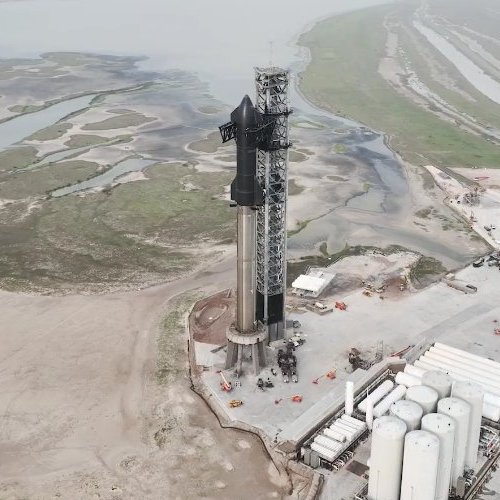
SpaceX this morning successfully launched and landed both Starship and Superheavy in the ocean, with both vehicles splashing down in a vertical position as planned.

Some quick details:

  • One engine on Superheavy failed during launch, but the vehicle completed its job, successfully releasing Starship as planned.
  • Superheavy then completed a controlled splashdown in the Gulf of Mexico, landing softly and vertically. It then tipped over into the water as planned. At this moment it is unclear how successful it was in landing precisely at its planned location. One engine during the landing burn failed.
  • Unlike the previous test, Starship flew under control for its entire flight, even though the camera view showed a flap actually begin breaking up.
  • That flap, despite damage, appeared to function through landing. The screen capture to the right was taken just before landing, as the flap adjusted its position despite the significant damage near its attachment point to the ship.
  • It appeared that Starship successfully completed its flip to vertical just before landing.
  • At landing it was unclear if the landing burn occurred as planned. It did appear the spacecraft splashed down softly, and the controllers announced the burn occurred, but the indicators on the screen showed no engine burn.

Overall, this launch was an incredible success. Based on the results, the fifth test flight should be approved by the FAA relatively quickly. The FAA’s responsibility is supposed to be limited to just issues of safety. As long as SpaceX demonstrates the rocket landed where it was intended, the FAA has no cause to delay future approvals.

If so, the next launch could occur very quickly, as the next prototypes are ready and waiting. We could see another launch within two months, at the most. I predict late July, though it could be a bit later if SpaceX engineers need more time to analyze what happened to Starship during descent and then apply that knowledge to the next prototype.

UPDATE: China also had a successful launch this morning. Pseudo-company Galactic Energy’s Ceres-1 rocket placed three satellites into orbit, lifting off from the Jiuquan spaceport in the northwest of China.

Little information was released by China’s state-run press, which didn’t even bother to mention the pseudo-company’s name in its report. The solid-fueled lower stages landed somewhere inside China, but we have no idea where or how close to habitable areas.

The leaders in the 2024 launch race:

60 SpaceX
27 China
8 Russia
7 Rocket Lab

American private enterprise now leads the world combined in successful launches, 70 to 41, while SpaceX by itself leads the entire world, including other American companies, 60 to 51.

Note that for context the U.S. total at this moment, 70 launches and achieved in less than half a year, matches the nation’s previous annual record set in 1966 and held until 2022.

30 comments

Leaving Earth cover

Leaving Earth: Space Stations, Rival Superpowers, and the Quest for Interplanetary Travel, can be purchased as an ebook everywhere for only $3.99 (before discount) at amazon, Barnes & Noble, all ebook vendors, or direct from my ebook publisher, ebookit.

If you buy it from ebookit you don't support the big oppressive tech companies and I get a bigger cut much sooner.


Winner of the 2003 Eugene M. Emme Award of the American Astronautical Society.

 
"Leaving Earth is one of the best and certainly the most comprehensive summary of our drive into space that I have ever read. It will be invaluable to future scholars because it will tell them how the next chapter of human history opened." -- Arthur C. Clarke

Firefly gets a major 25-launch contract from Lockheed Martin

Firefly today announced that Lockheed Martin has awarded it a launch contract for 25 launches through 2029.

The contract “commits Lockheed Martin to 15 launch reservations and 10 optional launches.”

What is interesting about this agreement is who Lockheed did not give the launches to. Lockheed Martin has been a major investor in Rocket Lab, which is about to complete its 50th operational launch. It also has been a major investor in the rocket startup ABL, which in 2021 Lockheed Martin awarded its own giant launch contract for 58 launches through 2029.

ABL however has not yet had a successful launch. It tried twice in 2022, but has done nothing since. It could very well be that this new contract for Firefly is a signal that Lockheed Martin has lost faith in ABL, that there are more fundamental problems in that company. Those problems could also be related to the new regulatory burdens from the FAA that in the past two years appear to have slowed development by all American rocket startups.

That Lockheed Martin did not give this contract to Rocket Lab, which is flying, could be because Lockheed is trying to encourage the development of multiple small satellite launchers, in order to provide its main satellite-making business a variety of good options.

Either way, this deal strengthens Firefly’s position, even though its Alpha rocket has only had two launches (in 2022 and 2023), both of which put the payloads in orbit but failed to place them in the correct orbit. Moreover, the company has said it would launch four times in 2024, and as yet to launch once.

2 comments

June 5, 2024 Quick space links

Courtesy of BtB’s stringer Jay. This post is also an open thread. I welcome my readers to post any comments or additional links relating to any space issues, even if unrelated to the links below. Sorry this is late. Life got in the way.


4 comments

Paper: Not one government policy during the COVID epidemic accomplished anything to stop the disease’s spread

The modern scientific method
What governments believe, even when there
is no evidence to justify it.

In reviewing the many different government actions taken during the COVID epidemic aimed at slowing the spread of the virus, scientists have found that none of these policies accomplished anything.

No matter how we approached these questions, the primary finding was lack of definitive patterns that could support claims about governmental policy impacts. About half the time, government policies were followed by better Covid-19 outcomes, and half of the time they were not. The findings were sometimes contradictory, with some policies appearing helpful when tested one way, and the same policy appearing harmful when tested another way. No claims about the relationship between government responses and pandemic outcomes held generally. Looking at stay-at-home policies and school closures, about half the time it looked like Covid-19 outcomes improved after their imposition, and half the time they got worse. Every policy, Covid-19 outcome, time period, and modeling approach yielded a similar level of uncertainty: about half the time it looked like things got better, and half the time like things got worse.

…Yet scientists used these data to make definitive conclusions.

Claims that government responses made Covid-19 worse are not broadly true, and the same goes for claims that government responses were useless or ineffective. Claims that government responses help reduce the burden of Covid-19 are also not true. What is true is that there is no strong evidence to support claims about the impacts of the policies, one way or the other.

» Read more

14 comments

ESA schedules first Ariane-6 launch for July 9, 2024

After years of delays and technical problems the European Space Agency (ESA) today announced that it has finally scheduled the first Ariane-6 launch, now to take place on July 9, 2024 from French Guiana.

The press release at the link tries to paint a glowing future for Ariane-6, as illustrated by this quote from Stéphane Israël, CEO of Arianespace.

“With 30 missions in our order book, Ariane 6 has already gained the trust of institutional and commercial customers. We are preparing to make Ariane 6’s second launch by the end of the year, followed by a steady rise to around ten launches a year once we reach cruising speed. It represents a splendid challenge for Arianespace and our partners.”

The simple fact is that Ariane-6 costs too much to launch and is not competitive with the new generation of reuseable rockets. If Amazon’s management had not decided to give it a big launch contract (in order to avoid giving that money to SpaceX), it would have very few payloads to launch. Once those launches are completed expect Ariane-6 to go the way of the dodo and the buggy whip, replaced by a new fleet of competing private European rocket companies capable of doing things faster and cheaper.

0 comments
1 365 366 367 368 369 2,930