Massive Attack – Teardrop
An evening pause: Proves that good music with modern rock instruments does not have to be loud. I just wish this singer wasn’t using the modern slurring singing style that makes it almost impossible to understand the words.
Courtesy of BtB’s stringer Jay.
What I see is a room with not a lot going on.
As Jay notes, not much else on Twitter as everyone is talking about the SpaceX Superheavy/Starship test launch.
On Christmas Eve 1968 three Americans became the first humans to visit another world. What they did to celebrate was unexpected and profound, and will be remembered throughout all human history. Genesis: the Story of Apollo 8, Robert Zimmerman's classic history of humanity's first journey to another world, tells that story, and it is now available as both an ebook and an audiobook, both with a foreword by Valerie Anders and a new introduction by Robert Zimmerman.
The print edition can be purchased at Amazon or any other book seller. If you want an autographed copy the price is $60 for the hardback and $45 for the paperback, plus $8 shipping for each. Go here for purchasing details. The ebook is available everywhere for $5.99 (before discount) at amazon, or direct from my ebook publisher, ebookit. If you buy it from ebookit you don't support the big tech companies and the author gets a bigger cut much sooner.
"Not simply about one mission, [Genesis] is also the history of America's quest for the moon... Zimmerman has done a masterful job of tying disparate events together into a solid account of one of America's greatest human triumphs."--San Antonio Express-News
Cool image time! The picture to the right, cropped and reduced to post here, was taken on March 2, 2023 by the high resolution camera on Mars Reconnaissance Orbiter (MRO), and was taken not as part of any specific research request but by the MRO science team to fill a gap in its schedule while also maintaining the camera’s temperature. Sometimes these somewhat random times show nothing of interest. Sometimes they are fascinating, as in this case.
The photo shows what appear to be a spray of small impacts on an easily melted surface. Imagine spraying hot molten lava on a sheet of ice. Instead of creating a crater with an upraised rim, on impact each droplet would quickly melt a hole.
Did these small impacts all occur at the same time? My guess is yes, based on the overview map below.
» Read more
According to data collected from a number of orbiting space X-ray telescopes, astronomers now believe that the lethal zone for nearby habitable planets when a supernova explodes is much larger than previously thought, as great as almost 200 light years.
The calculations in this latest study are based on X-ray observations of 31 supernovae and their aftermath mostly obtained from Chandra, NASA’s Swift and NuSTAR missions, and ESA’s (European Space Agency’s) XMM-Newton. The analysis of these observations shows that there can be lethal consequences from supernovae interacting with their surroundings, for planets located as much as about 160 light-years away. “If a torrent of X-rays sweeps over a nearby planet, the radiation would severely alter the planet’s atmospheric chemistry,” said Ian Brunton of the University of Illinois at Urbana-Champaign who led the study. “For an Earth-like planet, this process could wipe out a significant portion of ozone, which ultimately protects life from the dangerous ultraviolet radiation of its host star.”
You can read the paper here [pdf], which includes a figure that suggests in certain circumstances the lethal zone can be 200 light years across. As the scientists note:
Perhaps the most interesting results are the distances at which the X-ray emission can impose lethal effects on an Earth-like biosphere. This larger range of influence has consequences for the Galactic habitable zone, such as the harmful implications for recently discovered exoplanets that would be susceptible to nearby [supernovae].
In other words, this data suggests the galaxy is far less hospitable to the development of life. It takes a lot of time for life to evolve, billions of years, and during that time a solar system traveling through the galaxy has now a much higher chance of passing too close to a supernova explosion.
Now available in hardback and paperback as well as ebook!
From the press release: In this ground-breaking new history of early America, historian Robert Zimmerman not only exposes the lie behind The New York Times 1619 Project that falsely claims slavery is central to the history of the United States, he also provides profound lessons about the nature of human societies, lessons important for Americans today as well as for all future settlers on Mars and elsewhere in space.
“Zimmerman’s ground-breaking history provides every future generation the basic framework for establishing new societies on other worlds. We would be wise to heed what he says.” —Robert Zubrin, founder of the Mars Society.
All editions are available at Amazon, Barnes & Noble, and all book vendors, with the ebook priced at $5.99 before discount. All editions can also be purchased direct from the ebook publisher, ebookit, in which case you don't support the big tech companies and the author gets a bigger cut much sooner.
Autographed printed copies are also available at discount directly from the author (hardback $29.95; paperback $14.95; Shipping cost for either: $6.00). Just send an email to zimmerman @ nasw dot org.
Aerojet Rocketdyne announced yesterday that it has been awarded a new $67 million contract from Lockheed Martin to build the Orion propulsion engines for Artemis missions six though eight.
This contract option includes delivery of three additional sets of Orion’s service module auxiliary engines and three additional jettison motors. The eight auxiliary engines each produce 105 pounds of thrust to help maintain Orion’s in-space trajectory and position, and supplement the Orion Main Engine. The jettison motor, located on Orion’s Launch Abort System (LAS), generates 40,000 pounds of thrust to separate the LAS from the crew module during both nominal operations and abort scenarios, allowing the spacecraft to continue on its journey. The jettison motor is the only motor on the LAS that fires during every mission.
These Artemis missions are not expected to occur until very late in this decade, by which time Starship will likely be making regular commercial trips to the Moon. At that time Orion will look increasingly ridiculous next to Starship, and will demonstrate starkly the difference in what government can do versus a free private sector.
An official from Astrobotics confirmed this week that an explosion during testing of the Centaur upper stage of its new Vulcan rocket will delay that rocket’s first launch for at least one to two months, from May to June or July.
On March 29, Tory Bruno, the CEO of Colorado-based spacecraft makers United Launch Alliance LLC, announced on his personal Twitter account that ULA’s Vulcan Centaur V rocket had experienced “an anomaly,” which preceded a tweet he shared on April 13 that showed a video of an explosion that occurred outside of a testing rig that housed the ULA rocket. He alluded to a hydrogen-related leak as being a possible culprit and in response the next day to other replies, Bruno said in a tweet that “June/July” will be the next earliest estimated launch timeline.
That timeline is the same one that John Thornton, CEO of North Side-based Astrobotic, shared during a speech as part of a kickoff event for the Aviation and Robotics Summit in the Strip District on Tuesday.
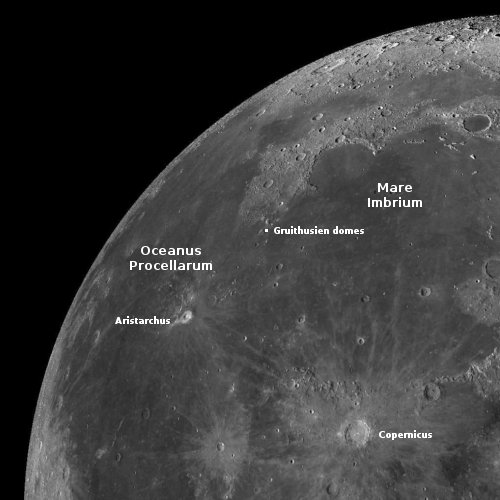
The main payload on that Vulcan inaugural launch is Astrobotic’s Peregrine lunar lander, carrying several NASA science instruments to the Gruithusien Domes region on the Moon, as indicated by the white dot on the picture above.
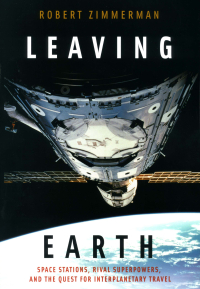
Leaving Earth: Space Stations, Rival Superpowers, and the Quest for Interplanetary Travel, can be purchased as an ebook everywhere for only $3.99 (before discount) at amazon, Barnes & Noble, all ebook vendors, or direct from my ebook publisher, ebookit.
If you buy it from ebookit you don't support the big oppressive tech companies and I get a bigger cut much sooner.
"Leaving Earth is one of the best and certainly the most comprehensive summary of our drive into space that I have ever read. It will be invaluable to future scholars because it will tell them how the next chapter of human history opened." -- Arthur C. Clarke
Rocket Lab engineers, having tested a previously flown Rutherford engine numerous times after recovering it from a launch in May 2022, have now approved that engine for reflight, and are inserting into their Electron rocket assembly line for launch sometime in the third quarter of this year.
The company also revealed that it has now completely abandoned the use of a helicopter in first stage recovery, and will instead pick up all first stages after they have splashed down in the ocean.
Extensive analysis of returned stages shows that Electron withstands an ocean splashdown and engineers expect future complete stages to pass qualification and acceptance testing for re-flight with minimal refurbishment. As a result, Rocket Lab is moving forward with marine operations as the primary method of recovering Electron for re-flight. This is expected to take the number of Electron missions suitable for recovery from around 50% to between 60-70% of missions due to fewer weather constraints faced by marine recovery vs mid-air capture, while also reducing costs associated with helicopter operations.
Rocket Lab will assess the opportunities for flying a complete pre-flown first stage booster following the launch of the pre-flown Rutherford engine in the third quarter this year.
Rocket Lab is presently the only operational American company besides SpaceX that is aggressively pursuing reuse of its rocket. ULA says it wishes to recover and reuse the engines of its still-unflown Vulcan rocket, but development of this concept has been very slow. Many other new companies claim their rockets will be reusable, but none has yet even launched.
According to statements by North Korea’s dictator Kim Jong-un published in its state-run press, that country is only weeks away from launching a spy satellite into orbit.
[S]ome observers said the North may attempt to launch the satellite ahead of President Yoon Suk Yeol’s upcoming state visit to the U.S. later this month. “There is a high possibility that North Korea may attempt a launch around April 23-24, on the basis that weather conditions are favorable, to show off that it has the upper hand on the Korean Peninsula issue by putting it on the table during the South Korea-U.S. summit,” Yang Mu-jin, president of the University of North Korean Studies, said.
Some observers, however, projected that it will take a few more months for the North to put the satellite into orbit given the time needed for technical preparations.
North Korea has completed two previous orbital launches, using its solid-fueled rocket missile technology. It is presently unclear if this new launch will use the same, or fly something new.
The local city council in Brook Park, Ohio, yesterday approved by a vote of 7-0 the purchase of nearly thirteen acres by the British company Blue Abyess to allow it to quickly build its proposed private astronaut training facility.
The Brook Park location will be built around a very large, 150-foot deep, multi-level pool. It’s an area that can replicate what life would be like in outer space and allow for the necessary training, dubbed astronaut boot camp for space exploration. “They’re not swimming pools. They’re aimed at industry, whether that’s marine offshore energy, maritime defense, subsea technology, human performance in extreme environments, or how do humans cope with green space environments,” Vickers said.
Officials say this project could be a huge economic driver, potentially bringing more than 100 jobs to the area.
In addition, it will likely generate major interest from tourists.
The facility will also include a hotel for those private astronauts, whether commercial or tourist. Located next to the Glenn Research Center, the company hopes to provide its services to both the public and NASA.

Starship and Superheavy, having just cleared the tower
In a spectacular first orbital launch attempt, SpaceX’s Superheavy and Starship successfully lifted off, clearing the tower and continuing through max-Q (maximum dynamic pressure). It then reached about 24 miles altitude when the rocket began to slowly spinn just prior to main engine cutoff and stage separation. At that point, because engine cutoff and separation had not occurred as planned, the engineering team used the flight termination system to destroy it so as to eliminate any risk to anyone on the ground.
As the announcers noted repeatedly, if the rocket simply cleared the tower they would consider this a magnificent success, considering that they had never fired Superheavy before in a real countdown. That Superheavy performed exactly as it should for almost its entire flight means SpaceX is that much closer to getting Starship into orbit than one would think at this stage of testing.
» Read more
Embedded below the fold in two parts.
To listen to all of John Batchelor’s podcasts, go here.
» Read more
An evening pause: It is shame there is not more information about this sax player, who is astonishing in her skill.
Hat tip James Street.
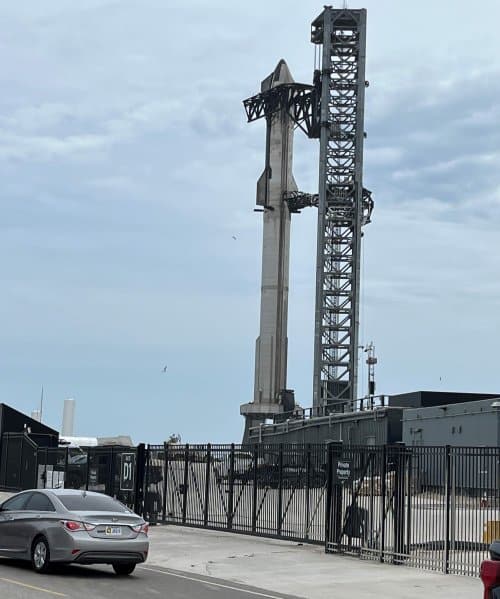
One of my readers, who wishes to go by is nickname Doubting Thomas on Behind the Black, went to Boca Chica earlier this week with the hope of seeing the live first orbital launch of Superheavy with Starship stacked on top. Unfortunately, the launch on April 17, 2023 was scrubbed, and he could not remain in Boca Chica for the now rescheduled launch early tomorrow morning on April 20th.
He sent me some pictures of that experience, however, which I post here with his permission. The best of course is the one to the right, of Starship stacked on Superheavy on the launchpad. This was taken before the roads were closed, and shows how incredibly close the general public can get to that launchpad simply by driving past on a public road.
The next few pictures give us a glimpse at the options people have for viewing future Boca Chica launches.
» Read more
Courtesy of BtB’s stringer Jay.
As far as I can tell, this is just a bunch of pretty pictures. As Jay notes, “OK, who will buy it? How will it get up [in orbit]?”
This is the engine the company has proposed for its Blue Moon manned lunar lander. As the first comment in the thread notes sardonically, “If you could launch something this century…”
They published this at the start of the week, but I didn’t think it merited a post. A quick link however yes.

The American Indian, banned by New York
They’re coming for you next: The education department of New York state has now ruled that all schools outside of Indian reservations must change the names of their schools and teams if they make any reference to American Indian culture or history.
In a November 2022 memo sent by the state, all school districts were ordered to stop using Native American-themed mascots, nicknames and logos by the end of the 2022-2023 school year or risk being in violation of the Dignity Act. Districts risk the removal of school officers and the withholding of state aid if the order is not followed.
That order required schools such as Oneida (Indians), Oriskany (Redskins), Richfield Springs (Indians), Sauquoit Valley (Indians), Waterville (Indians) and West Canada Valley (Indians) with nicknames directly linked to Native Americans to change.
» Read more
Cool image time! The picture to the right, rotated, cropped, reduced, and sharpened to post here, was taken on February 2, 2023 by the high resolution camera on Mars Reconnaissance Orbiter (MRO).
At first glance I thought I was looking at a variety of eroding glacial flows. I was completely wrong. This terrain is located on the floor of 900-mile-long Ares Vallis, thought to have been carved eons ago by some flow, either liquid catastrophic floods or glacial ice, but is now located in the very dry equatorial regions of Mars.
Then what caused these meandering ridges? The overview map below, plus the wider view of MRO’s context camera, provides us more data but little illumination. In fact, both leave us more questions and mysteries.
» Read more
According to testimony by NASA’s administrator Bill Nelson to a Senate committee, its Mars Sample Return (MSR) project now needs a lot of additional funds in order to have any chance of staying on schedule.
Nelson told the Commerce-Justice-Science (CJS) subcommittee of the Senate Appropriations Committee today that he just learned two weeks ago during a visit to the Jet Propulsion Laboratory (JPL), which is building MSR, that they need an additional $250 million this year and an additional $250 million above the request for FY2024 to stay on schedule for launch in 2028.
That FY2024 request warns that the projections for future MSR funding requirements are likely to grow and force NASA to descope the mission or reduce funding for other science projects. NASA just set up a second [independent review board] to take another look at the program.
The project is already beginning to suck money from other science missions, such as solar and astronomy and the Dragonfly mission to Saturn’s moon Titan. In addition, its method for getting the samples back to Earth remains somewhat uncertain due to ESA’s decision to not build a lander/rover for the mission, requiring JPL to propose the use of helicopters instead.
I predict Congress will fund everything, by simply printing more money as it nonchalantly continues to grow the national debt to levels unsustainable. Meanwhile, replacing the present very complex return concept — involving a lander, helicopters, an ascent rocket, and a return capsule (from Europe) — with a much cheaper and simpler option that is now on the horizon, Starship, does not seem to have occurred to any of the these government wonks.
Sierra Space yesterday announced that it has signed a partnership deal with ILC Dover for it to provide spacesuits and other “softgoods” for Sierra Space’s LIFE space station, including helping to build the station’s inflatable modules.
ILC Dover will be an exclusive partner with Sierra Space for softgoods used to support inflatable space habitat systems for low-Earth orbit (LEO), lunar and Mars transport and surface habitation, and use cases even farther into deep space.
The two companies have already been working together on the development and testing of Sierra Space’s first prototype inflatable modules.
The private space station and human spaceflight company Axiom announced this week a set of package space program deals it is marketing to other countries.
In the base tier, Axiom provides countries with advice and insight, and gives those countries priority access on upcoming missions. The second tier enables research and development activities by counties. The third tier offers human spaceflight missions on a regular basis. A fourth tier offers countries the ability to co-develop parts of Axiom’s station.
The first country to join the program is Azerbaijan, which will work with Axiom on satellite solutions and inspiring students to pursue space research and development activities. New Zealand and Uzbekistan are also participating, as well as Rakia Mission, an Israeli space education and research organization involved with the Ax-1 private astronaut mission to the ISS a year ago. Italy is another nation working with Axiom through a partnership that dates back to 2018. An Italian astronaut is slated to fly on Axiom’s Ax-3 mission to the ISS, currently scheduled for late 2023. Two astronauts from Saudi Arabia are flying on the Ax-2 mission in May.
The company also notes that it has found its customers divide into three components, government, private citizens, and corporations. At present this is their order in terms of market share, though the company thinks that corporations will eventually become its biggest customer.
SpaceX this morning successfully used its Falcon 9 rocket from Cape Canaveral to launch 21 second generation Starlink satellites into orbit.
The first stage successfully completed its eighth flight, landing on a drone ship in the Atlantic.
The leaders in the 2023 launch race:
25 SpaceX
16 China
6 Russia
3 Rocket Lab
American private enterprise now leads China 28 to 16 in the national rankings, and the entire world combined 28 to 27. SpaceX now trails the entire world, including American companies, 25 to 30.