NASA announces new possible launch dates for first SLS launch

NASA on May 16th announced the new possible launch dates for first SLS launch, outlining potential launch windows through the first half of 2023, with the first at the end of July 2022.

The calendar of launch windows through June of ’23 can be viewed here [pdf].

The July 26th to August 10th window is the one the agency is clearly targeting for that first launch, but it will not confirm this until after SLS successfully completes the next dress rehearsal countdown attempt in June. That the agency is now showing us potential launch dates in ’23 also suggests it is anticipating the possibility the launch could be delayed that much, especially if it determines it must replace the SLS’s two solid rocket boosters because they have been stacked unused for too long.

SLS was initially planned for a launch in 2015. It is now seven-plus years behind schedule, which is how long it took SpaceX to go from a blank sheet of paper to launching its Falcon Heavy for the first time.

3 comments

SLS launch delayed until August, at the earliest

In describing its plans for doing a second dress rehearsal countdown of its SLS rocket in June, NASA officials yesterday noted that they have delayed the actual launch until an August launch window so they will have time to do a third dress rehearsal before that launch.

But Free warned the issues are complex and it’s possible more than one tanking test will be required to thoroughly test the complex systems in the SLS rocket and their interaction with the ground systems that provide propellants, power and other critical elements. He said the August launch windows would “allow us to do two wet dress rehearsal attempts if we need them.”

“We are optimistic that we only need one more based on everything we’ve been able to do thus far to fine tune our tanking procedures,” he said. “But we also want to be realistic and upfront with you that it may take more than one attempt to get the procedures where we need them.”

According to this SpacePolicyOnline report, NASA has also mapped out additional launch windows for September through December.

In reviewing every news story about yesterday’s press conference, I could not find any that asked the agency about the status of SLS’s two solid rocket strap-on boosters. Both have now been stacked for more than seventeen months, and by August will have been stacked for twenty months, eight months past NASA’s use-by rule of one year. Either the past rules were too conservative, or NASA is simply ignoring the possibility that those boosters might no longer be viable. In either case, it is disappointing no reporter asked about this.

7 comments

NASA to conduct second SLS launch dress rehearsal in June

In announcing a press conference later today about the status of NASA’s SLS rocket, the agency revealed it now plans to conduct a second SLS launch dress rehearsal in June.

NASA’s SLS rocket and Orion spacecraft arrived back at Kennedy’s Vehicle Assembly Building April 26 after a 10-hour journey from launch pad 39B. Since their arrival, teams have worked to replace a faulty upper stage check valve and repair a small leak within the tail service mast umbilical ground plate housing. The teams also have been performing additional checkouts while the spaceport’s supplier of gaseous nitrogen makes upgrades to their pipeline configuration to support Artemis I activities.

We will likely find out NASA’s new launch schedule for the rocket today.

4 comments

SLS rocket rolled back to VAB

NASA’s SLS rocket has now been rolled back to the vehicle assembly building (VAB) so that engineers can assess the various problems that prevented the agency from completing a full dress rehearsal countdown last week.

Over the next several days, the team will extend the work platforms to allow access to SLS and Orion. In the coming weeks, teams will work on replacing a faulty upper stage check valve and a small leak within the tail service mast umbilical ground plate housing, and perform additional checkouts before returning to the launch pad for the next wet dress rehearsal attempt.

More details about these problems can be found here.

The bottom line is that these engineering fixes are certain to take at least two months to fix. Then NASA must decide what next to do. If it decides to redo the dress rehearsal countdown, then an actual launch cannot happen sooner than July, and only if they proceed directly to launch after completing the rehearsal. If the rocket is rolled back to the VAB after the next rehearsal the launch will be delayed further, into August or September.

And all that assumes the next rehearsal goes perfect, something that seems unlikely based on what has happened so far.

The delays are a problem because the first stage’s two strap-on solid rocket boosters are already well past their “use-by” date of January ’22. The possibility that NASA will have to unstack this rocket and replace these boosters is growing. If that happens the launch cannot occur sooner than early ’23, if then.

Worse, these delays cause all other subsequent SLS launches to be delayed as well. Right now the manned mission to the Moon, presently scheduled for ’25, is likely going to be pushed back to ’26.

11 comments

The most valuable real estate on the Moon

The most valuable real estate on the Moon
Click for full image.

Cool image time! The photo to the right, reduced and annotated to post here, is an oblique view of the terrain near Shackelton Crater and the Moon’s south pole, taken by Lunar Reconnaissance Orbiter (LRO) and released today.

Shackleton-de Gerlache ridge, about 9 miles long, is considered one of the prime landing sites for both a manned Artemis mission as well as the unmanned Nova-C lander from the commercial company Intuitive Machines. To facilitate planning, scientists have created a very detailed geomorphic map [pdf] of this region. As explained at the first link above,

Going back to time-proven traditions of the Apollo missions, geomorphic maps at a very large scale are needed to effectively guide and inform landing site selection, traverse planning, and in-situ landscape interpretation by rovers and astronauts. We assembled a geomorphic map covering a candidate landing site on the Shackleton-de Gerlache-ridge and the adjacent rim of Shackleton crater. The map was derived from one meter per pixel NAC image mosaics and five meters per pixel digital elevation models (DEM) from Lunar Orbiter Laser Altimeter (LOLA) ranging measurements.

Such geology maps guide planning and exploration, but actual images tell us what the first explorers will see. Below is a close-up overhead view of small area at the intersection of the ridge and the rim of Shackleton.
» Read more

5 comments

Former NASA insiders form commercial company to launch satellites to lunar orbit

Capitalism in space: Two former NASA managers have teamed up with two commercial businessman to form a startup, dubbed Quantum Space, to launch an unmanned platform to lunar space to provide support for NASA’s Artemis program.

The team includes Steve Jurczyk, who spent thirty years at NASA and finished his career there before retiring serving as acting NASA administrator for the first three months of the Biden administration.

Jurczyk is one of the three co-founders of Quantum Space. Another is Ben Reed, former division chief of exploration and in-space services at NASA’s Goddard Space Flight Center and who worked on satellite servicing projects there. He is the chief technology officer of Quantum Space. The third co-founder is Kam Ghaffarian, who also helped start commercial space station company Axiom Space and lunar lander developer Intuitive Machines after selling Stinger Ghaffarian Technologies. They’re joined by Kerry Wisnosky, the co-founder and former principal owner of Millennium Engineering and Integration, who is the chief operating officer of Quantum Space.

Their plan is to launch their platform and robots to the Earth-Moon L1 point, the spot where the gravitational spheres of influence of the Earth and Moon meet, about 40,000 miles from the Moon.

The outpost … would consist of two components. One is a spacecraft bus that serves as a platform for hosting payloads, using modular “plug-and-play” interfaces. The other is a spacecraft that would deliver payloads to the platform and install them using robotic manipulators.

Those payloads could include communications, navigation, remote sensing, space domain awareness and space weather sensors, Jurczyk said. Those payloads would primarily come from customers, but he said the company is looking at developing its own payloads, particularly for imaging of the Earth and moon.

They hope to launch their first satellite by ’25.

Like the insiders who run Axiom, these guys are taking advantage of their experience at NASA to build a private space company that will serve NASA’s needs. They are also recognizing that in the coming years, everything NASA “does” will be done by private companies. This company is their effort to jump on that bandwagon.

2 comments

Update on SLS: Still aiming for very unlikely March launch

A detailed update on the work being done by NASA and Boeing engineers to prepare SLS for its first unmanned test launch suggests that though a March launch is still the target, it is likely to be delayed.

The update at the link is very thorough, and outlines a large number of tests that need to be done to get this very cumbersome and complicated rocket ready for launch. They are just about done with the prep work for the core stage, and are now shifting to final testing of the upper stage, followed by some countdown sequence testing and a test of the flight termination system. In addition there are a number of other tests they wish to perform, all of which will take time.

Once these are done they will be ready to roll the rocket out to the launchpad for a final dress rehearsal countdown — dubbed the Wet Dress Rehearsal (WDR), now scheduled for mid- to late-February.

NASA will not set a launch date until after the WDR is completed and they can factor in any additional tasks with already-known work. “We’ve continually said that until we get through WDR we won’t set a launch date, so us getting out in mid-February for WDR allows them to look at March and April as opportunities,” Lanham said.

“I really can’t put my finger on it again until we come back from WDR and see if we have any issues there that we’ve got to go correct.” After the WDR test, the vehicle and Mobile Launcher will be rolled back to the VAB for final pre-launch maintenance and servicing.

Some have said the earliest realistic launch date is May, with the mid-summer more likely. We shall have to wait and see.

5 comments

SLS likely facing another launch delay

Engineers for NASA’s SLS rocket have determined that they need to replace the flight controller on one of the engines in the rocket’s core stage, an action that will likely force a delay from the presently scheduled February launch date.

After performing a series of inspections and troubleshooting, engineers determined the best course of action is to replace the engine controller, returning the rocket to full functionality and redundancy while continuing to investigate and identify a root cause. NASA is developing a plan and updated schedule to replace the engine controller while continuing integrated testing and reviewing launch opportunities in March and April.

It appears they hope to make this change-out quickly and only have to delay one or two months, though at the moment it is also unclear this will be possible.

15 comments

NASA IG: Artemis manned lunar landing will likely not happen in ’25

IG's estimate of SLS's per launch cost

According to a new NASA inspector general report released today [pdf], because of numerous technical, budgetary, and management issues, the planned Artemis manned lunar landing now set for 2025 is likely to be delayed several years beyond that date. From the report’s summary:

NASA’s three initial Artemis missions, designed to culminate in a crewed lunar landing, face varying degrees of technical difficulties and delays heightened by the COVID-19 pandemic and weather events that will push launch schedules from months to years past the Agency’s current goals. With Artemis I mission elements now being integrated and tested at Kennedy Space Center, we estimate NASA will be ready to launch by summer 2022 rather than November 2021 as planned. Although Artemis II is scheduled to launch in late 2023, we project that it will be delayed until at least mid-2024 due to the mission’s reuse of Orion components from Artemis I. … Given the time needed to develop and fully test [SpaceX’s Starship lunar lander] and new spacesuits, we project NASA will exceed its current timetable for landing humans on the Moon in late 2024 by several years. [emphasis mine]

Gosh, it sure didn’t long for my prediction from last week — that the new target date of ’25 was garbage — to come true.

Today’s report also states that it does not expect the first test launch of SLS to occur in February ’22, as NASA presently predicts, but later, in the summer of ’22. It then notes that the next SLS launch, meant to be the first manned launch of SLS and Orion and presently scheduled for late ’23, will almost certainly be delayed to mid-’24. And that’s assuming all goes well on the first unmanned test flight.

While the report lauds SpaceX’s fast development pace, it also does not have strong confidence in SpaceX’s ability to get its Starship lunar lander ready on time, and believes that NASA could see its completion occurring from three to four years later than planned.

The report also confirms an August 2021 inspector general report about NASA’s failed program to develop lunar spacesuits, stating that its delays make a ’24 lunar landing impossible.

The report states that Gateway is well behind schedule, and will likely not be operational until ’26, at the earliest. While the present plan for that first manned lunar landing does not require Gateway, Gateway’s delays and cost overruns impact the overall program.

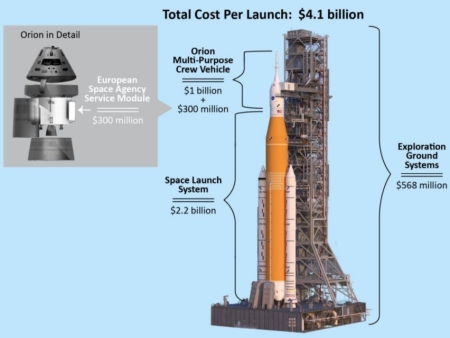
Finally, the report firmly states that the per launch cost of SLS is $4.1 billion, a price that will make any robust lunar exploration program utterly unsustainable.

Before the arrival of Trump, NASA’s original plan for SLS and Gateway called for a manned lunar landing in 2028. The Trump administration attempted to push NASA to get it done by ’24. This inspector general report suggests to me that this push effort was largely wasted, that NASA’s Artemis program will likely continue to have repeated delays, announced piecemeal in small chunks. This has been the public relations strategy of NASA throughout its entire SLS program. They announce a target date and then slowly over time delay it in small amounts to hide the fact that the real delay is many years.

Expect this same pattern with the manned lunar landing mission. They announce a delay of one year from ’24 to ’25. After a year they will then announce another delay to ’26. A year later another delay to ’27. And so forth.


15 comments

NASA admits manned lunar landing can’t happen before ’25

NASA administrator Bill Nelson admitted today that the goal of landing Americans back on the Moon by 2024 was impossible, and that the agency has now delayed that target date one year to 2025.

Nelson attempted to blame the delay on Blue Origin’s lawsuit against NASA for its award of the manned lunar lander contract to SpaceX.

He blamed the shifting timeline on a lawsuit over the agency’s moon lander, to be built by SpaceX, and delays with NASA’s Orion capsule, which is to fly astronauts to lunar orbit. “We’ve lost nearly seven months in litigation, and that likely has pushed the first human landing likely to no earlier than 2025,” Mr. Nelson said, adding that NASA will need to have more detailed discussions with SpaceX to set a more specific timeline.

This however is a bald-faced lie. The Trump 2024 deadline was never realistic. Moreover, delays in SLS and Orion have been continuous and ongoing for years, all of which made a ’24 landing quite difficult and if attempted extremely unsafe. Even as it is, trying this mission by ’25 is risky, especially if it depends on SLS. Moreover, as the article notes, how SLS, Orion, and SpaceX’s Starship will team up to get this mission — designed by a committee — to and from the Moon remains exceedingly unclear.

With great confidence I predict that if the lunar mission depends on SLS in any manner, it will not launch in ’25 either.

9 comments

NASA issues request for commercially-built spacesuits for its Artemis program

Capitalism in space: After more than a decade of delays in building its own in-house next generation spacesuits, NASA this week issued a request for proposals from the commercial space industry for new spacesuits for its Artemis program.

Bidders can use the technology NASA developed for [its unfinished upgraded spacesuits] in its proposals, or they can use their own designs, the document states. The suits must be able to meet a variety of requirements, including up to six spacewalks on the lunar surface during initial Artemis Moon missions. They must also be made of materials such that less than 100 grams of lunar regolith is brought back into the “cabin environment” after each spacewalk on the Moon. NASA plans to award a contract by next April.

The plan is comparable to what NASA has been doing across the board now for the last three years, buy the product from the commercial sector in a fixed price contract. The company that builds the suits will retain ownership of the design, and can make money selling its use to others.

This policy approach continues the agency’s acceptance of almost all the recommendations put forth in my 2017 policy paper, Capitalism in Space, a free pdf download.

It also likely means NASA might finally get the spacesuits it needs for future lunar missions quickly and at a reasonable cost, something the agency itself has been unable to do.

9 comments
1 9 10 11 12 13 16