NASA awards Aerojet Rocketdyne contract to build 20 Orion main engines

NASA announced yesterday that it has awarded Aerojet Rocketdyne the contract to build twenty Orion main engines for capsules on missions running through 2032, with the first to be used on the seventh Artemis launch..

This engine is the one that Orion will use to enter and leave lunar orbit.

Based on the pace that NASA expects to launch SLS, once per year, I expect the last engine in this contract will fly in 2048, not 2032, since it will take about 27 years to put that many Orions into space after SLS’s first launch, expected sometime in the next five months.

In other words, this is a contract to keep the jobs at Aerojet Rocketdyne in existence for the next three decades, even if that company’s engineers build little and accomplish less. Nice welfare work I must say.

1 comment

The problem Starship poses to NASA and Congress

An interesting essay published earlier this week in The Space Review raises the coming dilemma that both NASA and Congress will soon have to face once Starship is operational and launching large cargoes and crews to orbit, both near Earth and to the Moon.

That dilemma: What do about SLS and Lunar Gateway once it becomes ridiculously obvious that they are inferior vessels for future space travel?

I think this quote from the article more than any illustrates the reality that these government officials will soon have to deal with in some manner:

[When] the Lunar Starship ever docks with Gateway, the size comparison with Gateway will appear silly and beg the question as to whether Gateway is actually necessary. Does this even make sense? Couldn’t two Starships simply dock with each other and transfer propellant from one to another. Is there really a need for a middleman?

The author, Doug Plata, also notes other contrasts that will make SLS and Lunar Gateway look absurd, such as when two Starships begin transferring fuel in orbit or when a Starship launches 400 satellites in one go, or when a private Starship mission circles the Moon and returns to Earth for later reuse.

All of these scenarios are actually being planned, with the first something NASA itself is paying for, since the lunar landing Starship will dock with Lunar Gateway to pick up and drop off its passengers for the Moon.

The bottom line for Plata is that the federal government needs to stop wasting money on bad programs like SLS and Lunar Gateway and switch its focus to buying products from commercial sources like SpaceX. They will get far more bang for the buck, while actually getting something accomplished in space.

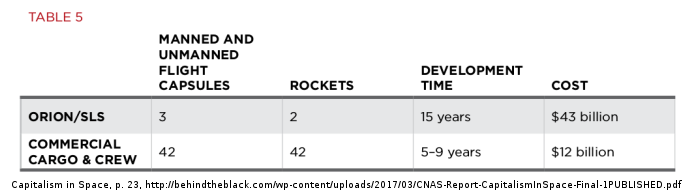
Though he uses different words, and has the advantage of recent events to reference, Plata is essentially repeating my recommendations from my 2017 policy paper, Capitalism in Space [free pdf]. Plata draws as his proof for his argument the recent developments with Starship. I drew as my proof a comparison between SLS and what private commercial space was doing for NASA, as starkly illustrated by this one table:

The cost difference between SLS and private space

The government has got to stop trying to build things, as it does an abysmal job. It instead must buy what it needs from private commercial vendors who know how to do it and have proven they can do it well.

If the government does this, will not only save money, it will fuel an American renaissance in space. As we see already beginning to see happen now in rocketry and the unmanned lunar landing business.

20 comments

Inspector general slams NASA spacesuit program

NASA's failed spacesuit
NASA’s failed spacesuit

A NASA inspector general report released today [pdf] bluntly slammed NASA endless and much delayed project to develop a new spacesuit for its Artemis program.

After noting that the project has been ongoing at NASA for fourteen years, the summary then blasts the program hard:

NASA’s current schedule is to produce the first two flight-ready xEMUs [NASA acronym for spacesuits] by November 2024, but the Agency faces significant challenges in meeting this goal. This schedule includes approximately a 20-month delay in delivery for the planned design, verification, and testing suit, two qualification suits, an ISS Demo suit, and two lunar flight suits. These delays—attributable to funding shortfalls, COVID-19 impacts, and technical challenges—have left no schedule margin for delivery of the two flight-ready xEMUs. Given the integration requirements, the suits would not be ready for flight until April 2025 at the earliest. Moreover, by the time two flight-ready xEMUs are available, NASA will have spent over a billion dollars on the development and assembly of its next-generation spacesuits.

Given these anticipated delays in spacesuit development, a lunar landing in late 2024 as NASA currently plans is not feasible. [emphasis mine]

This bears repeating: NASA will spent more than a billion dollars and fourteen years to build two spacesuits. What a bargain! Imagine if we have to pay a tailor for fitting!

And yet, despite this incredibly inefficient use of money, the report also finds that NASA doesn’t have enough to get the suits made on time!

Besides the endless managerial incompetencies noted in the report, it also notes several technical issues contributing to the problems, including one case where “staff used the wrong specifications” causing a unit’s failure.

Overall, the entire management of this program by NASA and the government appears to have been confused, incoherent, wasteful, and unable to get the job done, a pattern quite typical of almost every government project for the past four decades. Yet, though the report notes that in October 2019 the agency had finally decided to dump this failed program entirely and instead hire private companies to build the suits, the report criticizes this change, noting that the commercial contractors will not be required to use NASA designs, meaning the $420 million NASA has spent will literally be wasted.

So what? That money has been wasted already. I am quite willing to bet that for no more than a quarter of that cost, two private companies could get new spacesuits ready, and do it quickly, as long as our entirely incompetent government gets out of their way.

15 comments

NASA to scientists: Don’t expect to use SLS for science missions for at least a decade

In a briefing held by the planetary science community to propose its future missions for the next decade, a NASA official explained that there will likely be no available launches on NASA’s SLS rocket for planetary missions until the late 2020s, and more likely not until the next decade.

While NASA has a goal of being able to launch three SLS missions in a 24-month period, and two in 12 months, the supply chain is currently limited to one SLS per year. That will change by the early 2030s, [the official] said, growing to two per year and thus creating opportunities for additional SLS missions beyond the Artemis program. That will be enabled by changes to at the Michoud Assembly Facility to increase core stage production and a “block upgrade” to the RS-25 engine used on that core stage that will be cheaper and faster to produce.

The official also claimed that the cost of buying a launch on SLS is at best going to be $800 million, but that price won’t be available until the ’30s when SLS’s are launching more frequently. Until then, it appears NASA will charge one billion per launch.

All of this is pure fantasy on NASA’s part. Once cheaper and more usable private commercial rockets come on line, such as SpaceX’s Starship, SLS will go the way of the horse buggy. And this is likely to happen much sooner than 2030, more likely in the next three years.

Moreover, for both cost and practical reasons I cannot see any planetary scientist planning a mission on SLS, ever. There are now much cheaper options that are actually flying, such as SpaceX’s Falcon Heavy, which costs about $100 million per launch. Moreover, SLS’s slow and cumbersome launch pace should scare any planetary scientist away, as such missions must launch on time, and SLS might easily miss their launch windows. In fact, this has already happened. For years Congress mandated that Europa Clipper launch on SLS. When it became clear that SLS would not be available for that mission’s launch window, Congress finally relented and allowed NASA to buy the launch from a commercial company.

17 comments

Brazil signs Artemis Accords

Brazil on June 15th became the first South American country to sign the Artemis Accords, designed to bypass the limitations placed on property rights created by the Outer Space Treaty.

U.S. policy requires any nation that wishes to participate in its Artemis program to go back to the Moon to agree to the accords. Brazil is now the eleventh country to sign, joining Australia, Canada, Italy, Japan, Luxembourg, New Zealand, South Korea, the United Kingdom, the United Arab Emirates, Ukraine, and the United States.

Russia and China oppose the accords, which causes a problem for Russia as it desperately needs to partner with someone because it can’t on its own afford to build much. It is negotiating possible partnerships with China at its new space station as well as building a base on the Moon, but those agreements are not firm. And continues to send out feelers, including statements by Putin, calling for continuing cooperation with the U.S. in space.

Whether the Biden administration will make an exception for Russia in regards to the Artemis Accords remains unclear. That twelve countries have agreed to the accords however gives the U.S. greater leverage with those countries that have not yet signed.

1 comment

New Zealand signs Artemis Accords

On May 31st New Zealand became the 11th country to sign the Artemis Accords, designed to bypass the Outer Space Treaty’s limitations on property rights in space.

The full list, according to the NASA press release, now includes Australia, Canada, Italy, Japan, Luxembourg, South Korea, the United Kingdom, the United Arab Emirates, Ukraine, and the United States.

China and Russia have both said they oppose the accords. That such European nations as Germany and France have not joined in suggests their governments have not yet decided what direction they wish to go. Since U.S. policy now requires partners in the Artemis program to sign the accords, one would think that Germany and France and the European Space Agency (ESA) would certainly sign.

They have not, however. Instead, ESA has been in negotiations with China on the subject of space cooperation. If it signs a deal with China it could then become very difficult for it to partner with the U.S.

We might therefore be seeing here the first signs of a true and permanent political split in the alliance between mainland Europe and the United States.

Note too that these political winds signal bad news for Orion. The spacecraft relies on the ESA’s service module for its in-space journeys. If Europe does not sign the accords and instead partners with China, the U.S. will then be faced with either abandoning Orion or finding someone else to build its service module. I suspect that with the coming of cheap, affordable, and efficient private spacecraft, Orion will then die.

5 comments

Canada to build a Moon rover for NASA

Canada has signed an agreement with NASA to build an unmanned lunar rover to launch in 2026.

Like NASA,the Canadian government isn’t going to build the rover but will select private companies to design and build for it.

To get the ball rolling on the project, which will explore a lunar polar region, the CSA will soon select two Canadian companies to develop concepts for the rover and its instruments, agency officials added.

Other Canadian gear will reach the moon in the coming years as well, if all goes according to plan. For example, three commercial technologies funded by the CSA’s Lunar Exploration Accelerator Program are scheduled to get a lunar-surface test in 2022 — an artificial intelligence flight computer from Mission Control Space Services; lightweight panoramic cameras built by Canadensys; and a new planetary navigation system developed by NGC Aerospace Ltd.

All three will travel on the first moon mission of the HAKUTO-R lander, which is built by Tokyo-based company ispace, it was announced on Wednesday.

No word on who will launch this new rover, but then it is probably too early for such a decision.

1 comment

South Korea signs the Artemis Accords

On May 24 South Korea officially signed the Artemis Accords, joining nine other countries in the agreement designed as a work around of the Outer Space Treaty’s provisions in order to protect property rights in space.

By my count, that makes eight signatories, including Japan, United Kingdom, Australia, Canada, Luxembourg, the United Arab Emirates and Italy.

Essentially, the space-faring nations of the world are splitting into two groups, those who will follow these accords, and those who won’t, led by China and Russia. In a sense, we are seeing a renewal of the Cold War in space, with the western powers that believe in private enterprise and freedom aligned against those whose cultures are authoritarian and ruled from above.

8 comments

Lockheed Martin and General Motors partner to design manned lunar rover

Capitalism in space: Lockheed Martin and General Motors announced yesterday that they are partnering to design a manned lunar rover, intended for sale to NASA’s Artemis program as well as any other manned lunar missions anyone else should decide to fly.

Lockheed and GM don’t have a NASA contract to build the LTV [Lunar Terrain Vehicle]; the agency hasn’t awarded any such deals yet. But the companies are positioning themselves to be in the driver’s seat when such decisions are made — and when other customers may come along as well.

Obviously the first customer for this moon buggy would be NASA for Artemis. Nor is this the only manned rover being planned. Toyota and Japan’s space agency JAXA are also partnering to build one.

The decision by NASA to use Starship as its lunar lander however has made such a project much more viable. Unlike the lunar landers proposed by Blue Origin and Dynectics, Starship has the payload capacity to carry such things to the Moon, right off the bat. Thus it makes sense now to start designing them and offering them for sale. We should not be surprised if other car manufacturers start proposing their own manned rovers.

Moreover, Starship’s potential also means these rovers could be purchased by others for work on the Moon. If anyone besides NASA decides to hire SpaceX and Starship for their own lunar missions, the Lockheed Martin/GM LTV can also be sold to them. So can the Toyota rover. So could one built by Ford or Mazarati.

Isn’t freedom and capitalism wonderful? Instead of a half century of the nothing that international cooperation and government control brought us in space, private enterprise is suddenly in a burst opening the entire solar system to the world. And don’t expect the pace to slow.

7 comments

Blue Origin protests Starship contract award for lunar lander

Blue Origin today filed a protest with the Government Accountability Office (GAO) of NASA’s decision to award SpaceX’s Starship the sole contract for building a manned lunar lander, claiming the agency “moved the goalposts” during the award process.

Blue Origin says in the GAO protest that its “National Team,” which included Draper, Lockheed Martin and Northrop Grumman, bid $5.99 billion for the HLS [Human Landing System] award, slightly more than double SpaceX’s bid. However, it argues that it was not given the opportunity to revise that bid when NASA concluded that the funding available would not allow it to select two bidders, as originally anticipated. NASA requested $3.3 billion for HLS in its fiscal year 2021 budget proposal but received only $850 million in an omnibus appropriations bill passed in December 2020. [emphasis mine]

The highlighted words kind of say it all. Blue Origin’s National Team put in a very high bid. Why should they have any expectation of winning?

Moreover, their track record, especially Blue Origin’s (the leader of the team), pales in comparison to SpaceX.
» Read more

11 comments

SpaceX wins competition to build Artemis manned lunar lander, using Starship

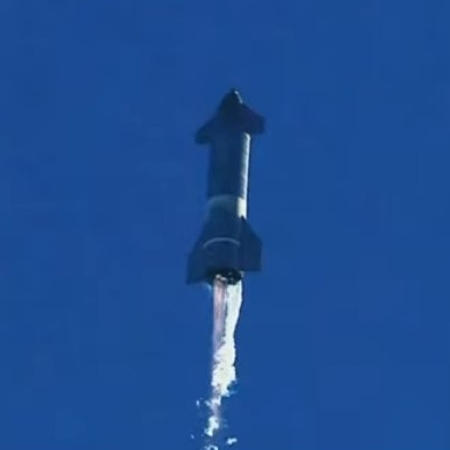
Starship prototype #8 on first flight test
Starship prototype #8 on its first flight test,
December 2020

Capitalism in space: NASA has just announced that it has chosen SpaceX to build the Artemis manned lunar lander, using Starship.

The award, a $2.9 billion fixed price contract, also requires SpaceX to complete an unmanned demo lunar landing with Starship that also returns to Earth, before it lands NASA astronauts on the Moon. The contract also still retains the goal to get this to happen by 2024, though NASA official emphasized that they will only launch when ready.

After these flights the agency says it will open bidding again to the entire industry, which means that others are now being challenged to come up with something that can beat SpaceX in the future.

Nonetheless, the contract award was a surprise, as NASA originally intended to pick two teams to provide redundancy and encourage competition. Instead, the agency completely bypassed lunar landers proposed by Dynetics and a team led by Blue Origin that included Lockheed Martin and Draper.

Even more significantly, though NASA explained in the telecon that they still plan to use SLS and Orion to bring astronauts to Gateway, who will then be picked up by Starship for the landing, this decision is a major rejection of the Space Launch System (SLS), since Starship will not use it to get to the Moon, while the other two landers required it.

In fact, this decision practically makes SLS unnecessary in the Artemis program, as NASA has also awarded SpaceX the contract for supplying cargo to the Lunar Gateway station as well as launching its first two modules, using Dragon capsules and Falcon Heavy. SLS is still slated to launch Orion to Gateway, but Starship can replace Orion as well, since Starship is being designed to carry people from Earth to the Moon. This makes SLS and Orion essentially unneeded, easily abandoned once Starship starts flying.

NASA’s decision also means the Biden administration is willing to use its clout to push for Starship over SLS in Congress, which has favored SLS for years because of the pork it brings to their states and congressional districts. They apparently think that Congress is now ready to risk the end of SLS if it comes with a new program that actually accomplishes something. These developments firmly confirm my sense from February that the political winds are bending away from SLS.

This decision is also a major blow to Blue Origin and the older big space companies that Jeff Bezos’ company partnered with. Their dependence on the very costly and cumbersome SLS rocket meant that their ability to launch on a schedule and cost desired by NASA was severely limited. NASA looked at the numbers, and decided the time was right to go with a more radical system. As was noted by one NASA official during the press teleconference, “NASA is now more open to innovation.”

Based on the details announced during the announcement, NASA was especially drawn to Starship’s payload capability to bring a large payload to the Moon, at the same time it brings humans there as well. It also appears SpaceX’s recent track record of success also added weight to their bid.

53 comments

NASA sets March 18th for next SLS static fire test

NASA has now scheduled the next static fire test of the core stage of its SLS rocket for March 18th.

The background:

NASA attempted the hot fire test on January 16, but computers terminated the test after 67 seconds instead of 485 seconds because of the conservative test parameters that were set. This is not a test vehicle, but the actual core stage that will be used for the first SLS launch. NASA needs to ensure the testing does not damage it.

NASA decided to redo the test and scheduled it for February 25, but a problem with a pre-valve forced another delay.

If this March test is successful, it will take a month to prep the core stage for shipment by barge to Florida, where it will take several months to prep it for launch linked to its two solid rocket boosters now stacked and ready for launch. If that schedule moves fast, NASA is still aiming for a late ’21 launch, though most industry experts expect that date to shift into early ’22.

If the March test has any problems however this schedule goes out the window. Worse, it increases the chance that the two boosters will have reached the end of their 12-month use-by date (approximately December ’21), and will have to be dissembled and inspected. If that happens the launch will certainly be delayed by many months.

There is another possibility. NASA might waive that 12-month use-by date requirement for the boosters. If the agency does this, however, it will be another example of the same management mistakes that caused both the Challenger and Columbia shuttle failures, a desire to put aside proper engineering to meet a schedule.

One more thought: That it takes about four months to assemble the solid rocket boosters for SLS illustrates well the cumbersome and inefficient nature of this rocket. Launches not only cannot happen within days, they really cannot happen for months. Depending on such a rocket with such a low launch cadence will make the exploration of the solar system practically impossible.

3 comments
1 10 11 12 13 14 16