
Do you want to name an asteroid that might hit the Earth? NASA has a contest for students to do just that.
Do you want to name an asteroid that might hit the Earth? NASA has started a contest for students to do just that.
Do you want to name an asteroid that might hit the Earth? NASA has started a contest for students to do just that.
An evening pause: As Dawn begins its journey away from Vesta, the science team has put together this stunning video tour of the giant asteroid.
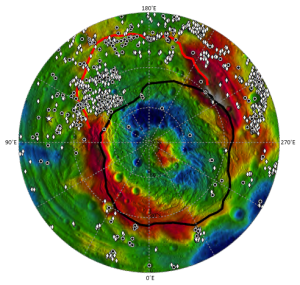
In a preprint paper published today at the Los Alamos astro-ph website, scientists have taken a detailed look at the mysterious dark streaks seen by Dawn on the surface of the asteroid Vesta and have concluded that the material comes from impacts, not from volcanic activity.
The scientists also concluded that
the majority of the spectra of [dark material] are similar to carbonaceous chondrite meteorites mixed with materials indigenous to Vesta.
Carbonaceous chondrite meteorites are considered to be the most primeval material in the solar system. This means that Vesta has the potential to give scientists a convenient laboratory for studying that primeval material and the early formation of the solar system. Ideally, the best way to do this would of course be to go there.
The scientists also theorize that much of this material was brought to Vesta by a single large impact.
» Read more
An update on Dawn’s reaction wheel failure.
Essentially, this will delay the journey to Ceres for about nine days. The spacecraft is left with two working reaction wheels, with which it can complete all its science work. However, if they cannot get the failed wheel working again, Dawn will be left with no backup should another wheel fail.
Uh-oh: One of Dawn’s reaction wheels, used to orient the spacecraft, shut down last week.
During a planned communications pass on Aug. 9, the team learned that the reaction wheel had been powered off. Telemetry data from the spacecraft suggest the wheel developed excessive friction, similar to the experience with another Dawn reaction wheel in June 2010. The Dawn team demonstrated during the cruise to Vesta in 2011 that, if necessary, they could complete the cruise to Ceres without the use of reaction wheels.
That the spacecraft can get to Ceres without reaction wheels is good. However, can it be oriented precisely to do science without these wheels? The JPL press release does not say.
Dawn has begun its slow departure from Vesta in anticipation of its journey to the solar system’s largest asteroid, Ceres.
The departure was actually announced two weeks ago, but since this is a very slow process it isn’t like we have missed anything. Dawn’s ion engines are very efficient, but they work at a very leisurely pace. It will take a month for the engine’s thrusters to push Dawn out of its orbit around Vesta.
New computer models suggest that the Moon was created when a Mars-sized asteroid hit the Earth in a head-on collision at high speed, not a glancing blow at relatively slow speeds, as previously thought.
Watching a big asteroid zip past the earth, live.
The only program surveying the southern sky for dangerous asteroids has lost its NASA funding and will end this month.
Scientists have identified the oldest known impact crater on Earth, three billion years old.
A private organization focused on preventing asteroids from impacting the Earth today announced its plans to build and launch an infrared space telescope by 2017.
Scientists have found a previously unknown mineral embedded in a meteorite that crashed to Earth in 1969.
Dubbed panguite, the new titanium oxide is named after Pan Gu, the giant from ancient Chinese mythology who established the world by separating yin from yang to create the earth and the sky. … “Panguite is an especially exciting discovery since it is not only a new mineral, but also a material previously unknown to science,” says Chi Ma, a senior scientist and director of the Geological and Planetary Sciences division’s Analytical Facility at Caltech and corresponding author on the paper.