
An asteroid that was discovered only four days before it flew by the Earth on June 14 has turned out to be much bigger than first thought.

An asteroid that was discovered only four days before it flew by the Earth on June 14 has turned out to be much bigger than first thought.

This particular asteroid may not have been a danger, but much of the concern was rooted in the late warning of its detection — 2012 LZ1 was spotted only four days before closest approach. One of the reasons for its late discovery is because it was detected in Southern Hemisphere skies, part of the world were we have few asteroid-watching programs. If it had been on a collision course with Earth, a few days notice is no time at all.

So, in the aftermath of the flyby, astronomers at the famous Arecibo Observatory in Puerto Rico used radar to image the interplanetary interloper (pictured top). What they uncovered was a surprise: Asteroid 2012 LZ1 is actually bigger than thought… in fact, it is quite a lot bigger. 2012 LZ1 is one kilometer wide (0.62 miles), double the initial estimate.
1 comment

Scientists have concluded that a 460 foot diameter asteroid only has a 1 percent chance of hitting the Earth in 2040.

O goody: Scientists have concluded that a 460 foot diameter asteroid only has a 1 percent chance of hitting the Earth in 2040.

Observations to date indicate there is a slight chance that AG5 could impact Earth in 2040. Attendees expressed confidence that in the next four years, analysis of space and ground-based observations will show the likelihood of 2011 AG5 missing Earth to be greater than 99 percent.

It appears that they won’t really be able to pin down the impact odds for 2040 until 2023, when the asteroid passes the Earth at a distance of 1.1 million miles.

0 comments

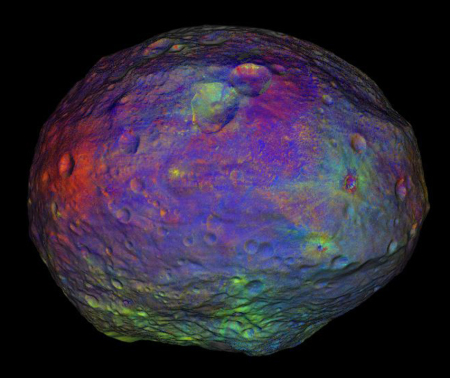
A global view of Vesta

Vesta

The accumulating data from Dawn has now allowed scientists to compile a global picture of the varied surface makeup of the asteroid Vesta.

The colors were chosen to highlight differences in surface composition that are too subtle for the human eye to see. Scientists are still analyzing what some of the colors mean for the composition of the surface. But it is clear that the orange material thrown out from some impact craters is different from the surrounding surface material. Green shows the relative abundance of iron. Parts of the huge impact basin known as Rheasilvia in Vesta’s southern hemisphere, for instance, have areas with less iron than nearby areas.

It also makes for a very nice image of the giant asteroid.

0 comments

Based on further analysis of the data from WISE, the infrared space telescope, astronomers have now made a better estimate of the population of potentially hazardous asteroids

Based on further analysis of the data from WISE, the infrared space telescope, astronomers have now made a better estimate of the population of potentially hazardous asteroids.

Potentially hazardous asteroids, or PHAs, are a subset of the larger group of near-Earth asteroids. The PHAs have the closest orbits to Earth’s, coming within five million miles (about eight million kilometers), and they are big enough to survive passing through Earth’s atmosphere and cause damage on a regional, or greater, scale.

The new results come from the asteroid-hunting portion of the WISE mission, called NEOWISE. The project sampled 107 PHAs to make predictions about the entire population as a whole. Findings indicate there are roughly 4,700 PHAs, plus or minus 1,500, with diameters larger than 330 feet (about 100 meters). So far, an estimated 20 to 30 percent of these objects have been found.

0 comments

To mine the asteroids, first build small cheap space telescopes.

To mine the asteroids, first build small cheap space telescopes.

The space telescope will be based on the same design Planetary Resources will eventually use for its asteroid-prospecting spacecraft: a 30-kilogram to 50-kilogram flier packed with imaging sensors and a laser-optical communication system the company is developing to avoid encumbering its spacecraft with large antennas. The company, which says it has about two dozen employees, will market these spacecraft as cheap but effective telescopes for both astronomical and Earth-observing applications. Sales would provide cash for the company’s core work on asteroid mining, Eric Anderson, co-founder and co-chairman of Planetary Resources, said.

The telescope slated for launch sometime in the next two years β€œwould be something, let’s say, a university buys [for astronomical observations], or a commercial company that wants to monitor shipping traffic or something like that,” Anderson said in a phone interview. The cost for the telescope, which Planetary Resources is calling Arkyd-101, would be β€œmillions of dollars, including launch.”

At the Planetary Resources press conference today, there was a lot of talk about the benefits and profits to be gained from mining the asteroids. However, this ain’t gonna happen for quite a few years. In the meantime, the company plans to make money building space telescopes which scientists and others can use, for a fee, to do research.

In other words, the government and astronomers dropped the ball on replacing the Hubble Space Telescope. Now, private enterprise is going to pick it up and run with it.

4 comments

No announcement yet, but of the many stories available this Wired article and this Yahoo article appear to provide the best overview of the asteroid mining plans of Planetary Resources.

No announcement yet, but of the many stories available this Wired article appears to provide the best overview of the asteroid mining plans of Planetary Resources.

The company’s first phase is most interesting:

Within the next 18 to 24 months, Planetary Resources hopes to launch between two and five space-based telescopes at an estimated cost of a few million dollars each that will identify potentially valuable asteroids. Other than their size and orbit, little detailed information is available about the current catalog of near-Earth asteroids. Planetary Resources’ Arkyd-101 Space Telescopes will figure out whether any are worth the trouble of resource extraction.

The actual press conference is scheduled for 10:30 am (Pacific). Stay tuned.

Update: The Planetary Resources website has now been updated. You can read more about their space telescope proposal here.

2 comments
1 63 64 65 66 67 78