
Tag: asteroids
Pan-Starrs Telescope discovers 19 near-earth asteroids in one night
A new record! On January 19, the Pan-Starrs telescope in Hawaii discovered 19 near-earth asteroids, the most for a single night of asteroid-hunting by anyone.
What Is Asteroid Apophis?
Very Small Asteroid Makes record close Earth Approach on February 4, 2011
On February 4 a very small asteroid, about a yard in diameter, zipped past the Earth at a distance of only 3,400 miles, closer than any previously recorded asteroid.
WISE Completes Scan for Asteroids and Comets
The Wide-Field Infrared Survey Explorer, WISE, has completed its four month extended mission, finishing a scan of the heavens that discovered more than 33,000 asteroids and comets.
The Sky Is Falling … More Than We Thought
Chicken Little was right! The sky is falling!
The future Nemesis from space
From the American Astronomical Society meeting this week:
A team of astronomers, using the data from the Sloan Digital Sky Survey, calculated the galactic orbits of nearly 40,000 low mass stars. These stars are generally M dwarfs, cool, not very bright, and thus generally somewhat close to the Sun since if they are too far away we would not see them. You can read the abstract here, and download their full poster here [pdf].
For the astronomers, the data told them a great deal about the orbital properties of these stars. Though a majority are in circular orbits between 20 to 30 thousand light years from the galactic center, a small minority are in extremely eccentric orbits that travel far out into the galactic halo, as much 260,000 light years. A few others dive inward, getting within 6000 light years of the galactic center.
What made this poster stand out to me, however, was this quote from the abstract:
In addition, we have identified a number of stars that will pass very close to the Sun within the next [billion years]. These stars form the “Nemesis” family of orbits. Potential encounters with these stars could have a significant impact on orbits of Oort Cloud and Kuiper Belt members as well as the planets. We comment on the probability of a catastrophic encounter within the next [billion years].
All told, they found that 18 low-mass cool M dwarf stars that will eventually pass close to the Sun. One star, SDSS J112612.07+152517.6, an M3 star that is about 2,300 light years away, is in an orbit that has it moving right towards us at about 90,000 miles per hour. Its mass is less than half that of the Sun, about 0.4 solar masses. This figure from the poster roughly illustrates the star’s position relative to our solar system over the next billion years:
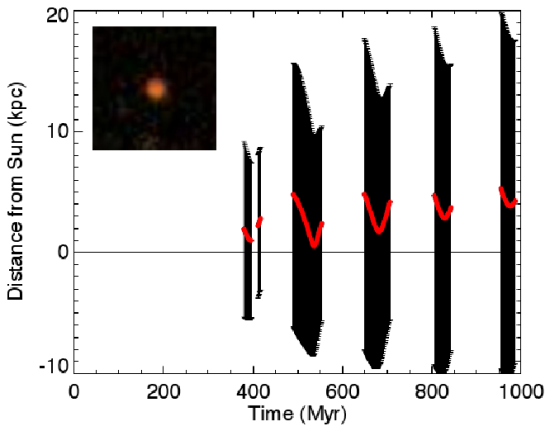
The star itself is shown in the inset. The red curve shows its calculated distance from the Sun over time, with the black area above and below showing the uncertainties of the calculation. As you can see, every hundred million years or so the distance between this star and the Sun shrinks, with the very very very rare possibility that the distance will sometimes shrink to zero!
With 18 stars each doing this every few 100 million years or so, the average time between close approaches is about 5 million years. These results suggest that another star passes close enough to our solar system frequently enough to not only disturb the comets in the Oort cloud, but also possibly affect the orbits of the planets in the outer solar system and Kuiper belt. One wonders, for example, if such an event had some influence on Pluto’s strange orbit.
A private science mission to an asteroid?
A proposal to revive a project to send a private science probe to an asteroid.
The original project, NEAP, was proposed back in 1997 by the late Jim Bensen of SpaceDev (now Sierra Nevada). Benson wanted to not only do research, but he planned to claim the asteroid as his property upon landing. Though his proposal never flew, it was clearly a forerunner to today’s resurgence of the private space industry, and in many ways kickstarted that resurgence.
An asteroid discovered more than 100 years ago is actually an extinct comet coming back to life
An asteroid discovered more than 100 years ago is actually an extinct comet. And it is coming back to life!
Solar Sail Flotilla Could Divert Possibly Dangerous Asteroid
Another scheme to stop a dangerous asteroid: Use a flotilla of solar sails to divert Apophis.
Amino acids found on meteorite that crashed in the Sudan
Dead alien life arrives on Earth! Not really but still exciting anyway: Scientists have found the remains of space-born amino acids — essential to life — in the meteorite that crashed in the Sudan in 2008. Key quote:
“This meteorite formed when two asteroids collided,” said Daniel Glavin of NASA’s Goddard Space Flight Center in Greenbelt, Md. “The shock of the collision heated it to more than 2,000 degrees Fahrenheit [1,093 degrees Celsius], hot enough that all complex organic molecules like amino acids should have been destroyed, but we found them anyway.”
The discovery is further evidence that the basic elements of life can form in even the most hostile of environments.
Air Force agrees to Share data on the Meteorites its surveillance satellites detect
The Air Force has agreed to share the meteorite data its surveillance satellites detect.
Though the article above makes it sound like this data includes a lot of Earth-destroying asteriods, almost all of these detections are of smaller rocks burning up in the atmosphere, information researchers need to produce a more complete census of the solar system.