GMT about to begin construction

Forget the TMT! The consortium building the Giant Magellan Telescope (GMT) have secured the half billion dollars of funding required to begin construction in Chile.

Unlike Hawaii, Chile’s population welcomes astronomers and telescopes, so don’t expect any of those kinds of political problems getting this telescope finished.

0 comments

Pluto’s moons rotate chaotically

Data from the Hubble Space Telescope has determined that two and maybe more of Pluto’s moons have chaotic rotations.

In a surprising new study, it has been found that two of Pluto’s moons, Nix and Hydra, are in a chaotic rotation. This means that an observer on Pluto would not see the same face of the moons from one night to the next. For visitors on the moons themselves, things would get even more confusing, as every day would be a different length to the one that preceded it. The other two moons studied, Kerberos and Styx, will likely be found to be chaotic too, pending further study.

This would also mean that you would not know where on the horizon the sun or Pluto would rise each day.

This information was gathered partly to help New Horizons prepare for its July 14 fly-by.

2 comments

Astronomers accept terms imposed on them by protesters in Hawaii

The University of Hawaii, which manages the astronomy operation on Mauna Kea, has accepted the terms laid down by the state’s governor for allowing construction of the Thirty Meter Telescope.

Essentially the number of telescopes on the peak will have to be reduced above and beyond the original decades-old agreement, and the University will have to find money to pay for these “native” programs:

Improved cultural research, education and training: We will work with Kahu Kū Mauna and other Native Hawaiian advisors to develop new cultural training and educational programs about Maunakea. Training is currently required for people working on the mountain and we will look for opportunities for improvement. We will develop training and education programs for visitors to ensure that all who come to Maunakea understand its cultural significance and how to respect the mountain. To ensure our cultural training and education programs are accurate, effective and continuing, we will establish at UH Hilo a new program to lead and evaluate our expanded cultural stewardship and educational activities related to Maunakea. …

New scholarship programs: The governor asked TMT to increase its support to Native Hawaiian students, particularly those from Hawaiʻi Island, who wish to pursue science and technology careers. UH recognizes its responsibilities in this area and we will launch a campaign for new scholarship programs for Hawaiʻi Island and Native Hawaiian students to increase their participation in the sciences. The university will allocate a portion of its observing time to UH Hilo for use in projects and programs to support greater participation and improved preparation of Hawaiʻi Island students for professional careers.

The first will essentially buy off the leaders of the protesters, hiring them to pound into outsiders the wonderfulness of native culture. The second, though it will provide educational scholarships — a good thing — is still essentially bigoted and discriminatory in that it determines who shall get the scholarships solely by their ethnic origin. Imagine the reaction if a university in the U.S. offered a comparable scholarship only to whites.

7 comments

ALMA detects a solar flare on Mira 420 light years away

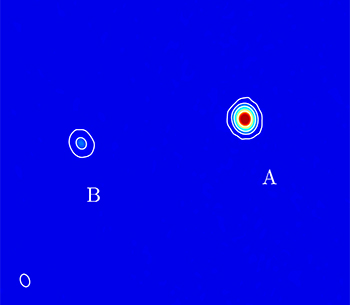
Mira A and Mira B

The just completed ALMA (Atacama Large Millimeter/submillimeter Array), a collection of 66 antennas located in Chile, has snapped a picture of the variable star Mira with its companion star, detecting details on the primary’s surface, including evidence of a solar flare.

Mira is a star with a mass like our Sun’s, but near the end of its life having evolved into a red giant that is shedding its outer layers. Being able to track its behavior with this kind of detail will allow astronomers to better hone their theories about the life and death of stars, including our own.

0 comments

A solar system like our own, but when it was a baby

Astronomers have discovered a very young 15 million year old star only 360 light years away that has a debris disk about the size of our solar system’s Kuiper Belt.

The ring is about the same distance from its parent star as the Kuiper belt is from the Sun, and receives roughly the same amount of light. Its blue-grey colour hints that it could consist of ices and rocky silicates such as those found in the Kuiper belt, says lead author Thayne Currie, an astronomer at the Subaru Telescope in Hawaii, which is run by the National Astronomical Observatory of Japan. “This is absolutely the closest example we have of a young Kuiper belt,” he says.

The best part of this discovery however might be how it was made, by using a new instrument on the ground-based Gemini telescope on Mauna Kea in Hawaii.

The instrument, which is part of the Gemini South telescope in Chile, uses a disk called a coronagraph to blot out the glare of bright stars. That allows it to take multi-wavelength pictures of faint, orbiting planets and debris disks around stars, by recording near-infrared light from the parent star as it scatters off the debris. The researchers discovered the disk around HD 115600 fewer than 6 months after the GPI began operation. A similar instrument, known as SPHERE, began operating in May 2014 on the European Southern Observatory’s Very Large Telescope in Chile and has also begun to make discoveries.

Assuming protesters don’t force Gemini to close, we should be getting a lot more exoplanetary discoveries from it in the coming years.

1 comment

Hubble films of movie of a jet firing from a black hole

Cool image time! Using images taken by the Hubble Space Telescope over the past two decades astronomers have assembled a movie of the motion of blobs, ejected by a jet from a supermassive black hole at the center of a galaxy.

The jet from NGC 3862 has a string-of-pearls structure of glowing knots of material. Taking advantage of Hubble’s sharp resolution and long-term optical stability, Eileen Meyer of the Space Telescope Science Institute (STScI) in Baltimore, Maryland, matched archival Hubble images with a new, deep image taken in 2014 to better understand jet motions. Meyer was surprised to see a fast knot with an apparent speed of seven times the speed of light catch up with the end of a slower moving, but still superluminal, knot along the string. The resulting “shock collision” caused the merging blobs to brighten significantly.

The movie is below the fold.
» Read more

0 comments

Hawaii’s governor imposes new deal for Mauna Kea

In his effort to appease the protesters hostile to building the Thirty Meter Telescope (TMT) on Mauna Kea, Hawaii’s Democratic governor has thrown out the decades-old agreement that had guided telescope construction there and has instead imposed a new deal, which will allow for TMT but will force astronomers to remove one quarter of the other telescopes on the mountain.

Astronomers have always honored the original agreement, allowing the construction of no more than 13 telescopes on the mountain. For example, to build TMT the Caltech Submillimeter Observatory was to be removed this year. Now they will have to remove some additional telescopes that had been built with the understanding that they could remain there, based on the original agreement.

The governor’s plan will also limit access to the mountain by non-natives, and require visitors to receive “cultural training”, likely a session explaining the sacredness of the native religion and how it must be obeyed at all times.

To my mind this new deal is another indication of the slow retreat of western civilization in the U.S. Once again our ability to push the unknown will be limited in favor of fostering the superiority of one ethnic group over another.

1 comment

Prototype variable star has a previously unknown companion

The uncertainty of science: The star that gave its name to the class of variable stars called Cepheid variables — used by astronomers to measure distances to nearby galaxies — has after more than 200 years of study been suddenly found to be a binary system.

Delta Cephei, prototype of the cepheids, which has given its name to all similar variable stars, was discovered 230 years ago by the English astronomer John Goodricke. Since the early 20th century, scientists have been interested in measuring cosmic distances using a relationship between these stars’ periods of pulsation and their luminosities (intrinsic brightness), discovered by the American Henrietta Leavitt. Today, researchers from the Astronomical Observatory of UNIGE, Johns Hopkins University and the ESA show that Delta Cephei is, in fact, a double star, made up of a cepheid-type variable star and a companion that had thus far escaped detection, probably because of its low luminosity. Yet, pairs of stars, called binaries, complicate the calibration of the period-luminosity relationship, and can bias the measurement of distances. This is a surprising discovery, since Delta Cephei is one of the most studied stars, of which scientists thought they knew almost everything. [emphasis mine]

This discovery illustrates the shaky foundation of a great deal of astronomical research. The presence of a companion is an additional variable that could very significantly skew the relationship between the stars’ pulses and its luminosity, thus making the use of this data to determine distance much less reliable. This in turn could have a significant effect on the present estimate of the expansion rate of the universe, which in turn could have a significant effect on the theories of dark energy. Moreover, if the past distance estimates to many objects are wrong than what we know about those objects is far less certain.

1 comment

Mysterious X-rays at the center of the galaxy

The uncertainty of science: The x-ray space telescope NuSTAR has detected high energy x-rays at the center of the Milky Way coming from no obvious source.

In and of themselves, X-rays from the galactic center aren’t unusual. But the X-rays NuSTAR detects don’t seem to be associated with structures already known to exist. For example, a supernova remnant named Sgr A East emits low-energy X-rays but not high-energy X-rays. The high-energy blotch doesn’t correlate with structures seen in radio images either, such as the dust and gas clouds of Sgr A West that are falling toward the supermassive black hole.

Instead, Perez and her colleagues propose that thousands of stellar corpses could be responsible for the high-energy X-rays: massive (and still-growing) white dwarfs, spun-up pulsars, or black holes or neutrons stars feeding on low-mass companion stars.

All of their proposed solutions, however, have serious problems explaining all of the data.

0 comments

An exoplanet that shouldn’t exist

Worlds without end: Astronomers have discovered an exoplanet that is too big for its tiny host star.

Present theory says that a Jupiter-sized planet should not have formed around this M-class dwarf star. But it has. In addition, the planet has the mass of Saturn but has been puffed up to the size of Jupiter. Yet, the star doesn’t provide it enough heat to cause it to puff up in this manner.

1 comment

Hawaii agency withdraws support for TMT

Maybe it is time to get out: The Office of Hawaiian Affairs (OHA), which had approved the Thirty Meter Telescope (TMT) in 2009, has formally withdrawn its support.

I think the testimony to OHA by the opponents of the telescope says it all:

Thursday’s vote followed a day of emotional testimony at OHA’s offices in Honolulu.


“We have compromised and negotiated 13 times already, and enough is enough,” said testifier Mehana Kihoi. She said scientists did not understand the significance of the mountain to Hawaiian people. “These are people with no sacred place, no connection, no culture,” she said. Kihoi had spent more than 28 days occupying the mountain with other protesters and choked back tears as she described the spiritual experience of being there. “When you place your hands and your bare feet into the soil, you feel that warmth, you feel her heart. At 3 a.m., when … you feel her breath come down and sit on your bones, you know that she is alive.” She called on trustees to oppose the project: “Money comes and goes; our aina [land] is forever.”

Longtime Native Hawaiian activist Walter Ritte said stopping the TMT was no longer enough and that Hawaiians needed to take a stronger stand on the mismanagement of the mountain summit. “They’ve misused it to the point that they need to get all of those telescopes off Mauna Kea,” he said. “It’s a matter of principle.” [emphasis mine]

The comments of the first woman reveal an underlying bigotry and hatred of non-Hawaiians. The comments of the second person reveal a hostility to science and the advancement of knowledge that is most striking.

My instinct is to tell them to go to hell and to pull out all the telescopes, and financial support, to the islands. Maybe a tourist boycott should be started, since they obviously find non-Hawaiians and Western culture so offensive. We’d suddenly discover that these self-righteous claims are as shallow as I’ve described, bigoted and small-minded. Suddenly Hawaiians would be begging Westerners to return to the island.

My second and stronger instinct is to also tell them to go to hell, and to push through construction so that we do not bow to this kind of bigotry.

Unfortunately, our society no longer has the courage to do either. We will bow to these demands, and bigotry will win again.

16 comments

Is it dark matter, or a previously unrecognized failure of Newton?

Dark matter?

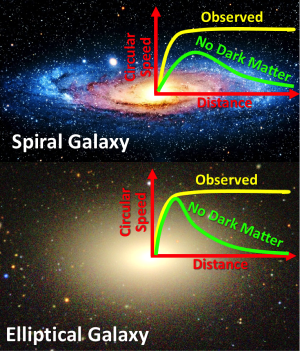
The uncertainty of science: Using new data gathered by the 10-meter Keck telescope in Hawaii, astronomers have found that the outer stars of elliptical galaxies exhibit the same behavior as the outer stars of spirals, suggesting once again the existence of dark matter.

One of the most important scientific discoveries of the 20th century was that the spectacular spiral galaxies, such as our own Milky Way, rotate much faster than expected, powered by [the] extra gravitational force of invisible “dark matter” as it is now called. Since this discovery 40 years ago, we have learned that this mysterious substance, which is probably an exotic elementary particle, makes up about 85 percent of the mass in the Universe, leaving only 15 percent to be the ordinary stuff encountered in our everyday lives. Dark matter is central to our understanding of how galaxies form and evolve – and is ultimately one of the reasons for the existence of life on Earth – yet we know almost nothing about it.

“The surprising finding of our study was that elliptical galaxies maintain a remarkably constant circular speed out to large distances from their centers, in the same way that spiral galaxies are already known to do,” said Cappellari. “This means that in these very different types of galaxies, stars and dark matter conspire to redistribute themselves to produce this effect, with stars dominating in the inner regions of the galaxies, and a gradual shift in the outer regions to dark matter dominance.”

What is most fascinating about this press release, however, is that it also noted that dark matter is only one explanation for the data, and that the failure of Newtonian physics at large distances, instead of dark matter, might also provide an explanation.

However, the [solution] does not come out naturally from models of dark matter, and some disturbing fine-tuning is required to explain the observations. For this reason, the [problem] even led some authors to suggest that, rather than being due to dark matter, it may be due to Newton’s law of gravity becoming progressively less accurate at large distances. Remarkably, decades after it was proposed, this alternative theory (without dark matter) still cannot be conclusively ruled out.

Physicists call this other theory MOND, for modified Newtonian dynamics. It is not a very popular theory, however, and is almost always ignored, even though it appears to work as well as dark matter to explain the motion of stars in galaxies. Instead, most scientists favor dark matter.

For this press release to mention it as suggests the new data favors it over dark matter, which would make this a significant discovery.

9 comments
1 113 114 115 116 117 188