
ALMA captures the rotation of the large asteroid Juno

The large ground-based telescope ALMA has captured a series of images of the large asteroid Juno, allowing scientists to estimate its rotation and overall shape.

Linked together into a brief animation, these high-resolution images show the asteroid rotating through space as it shines in millimeter-wavelength light. “In contrast to optical telescopes, which capture the reflected light from the Sun, the new ALMA images show the actual millimeter-wavelength light emitted by the asteroid,” said Todd Hunter, an astronomer with the National Radio Astronomy Observatory (NRAO) in Charlottesville, Va.

…The complete ALMA observation, which includes 10 separate images, documents about 60 percent of one rotation of the asteroid. It was conducted over the course of four hours on 19 October 2014 when Juno was approximately 295 million kilometers from Earth. In these images, the asteroid’s axis of rotation is tilted away from the Earth, revealing its southern hemisphere most prominently.
0 comments

Dark matter is even more of a mystery that expected

The uncertainty of science: Using the Hubble and Chandra space telescopes astronomers have discovered that dark matter is not only invisible to direct observation, it is invisible to itself!

In this new research, Harvey and his team realized just how invisible this stuff is, even to itself. As two galactic clusters collide, the stars, gas and dark matter interact in different ways. The clouds of gas suffer drag, slow down and often stop, whereas the stars zip past one another, unless they collide โ€” which is rare. On studying what happens to dark matter during these collisions, the researchers realized that, like stars, the colliding clouds of dark matter have little effect on one another.

Thought to be spread evenly throughout each cluster, it seems logical to assume that the clouds of dark matter would have a strong interaction โ€” much like the colliding clouds of gas as the colliding dark matter particles should come into very close proximity. But rather than creating drag, the dark matter clouds slide through one another seamlessly.

I guarantee that this result is not definitive. The data here is on the very edge of reality, built on too many assumptions. We know that something undetected as yet is influencing the motions of galaxies, but what exactly it is remains completely unknown. These results only make the mystery more mysterious.

4 comments

GAO denied access to Webb telescope workers by Northrop Grumman

In a report as well as at House hearings today the GAO reported that Northrop Grumman has denied them one-on-one access to workers building the James Webb Space Telescope.

The interviews, part of a running series of GAO audits of the NASA flagship observatory, which is billions of dollars overbudget and years behind schedule, were intended to identify potential future trouble spots, according to a GAO official. But Northrop Grumman Aerospace, which along with NASA says the $9 billion project is back on track, cited concerns that the employees, 30 in all, would be intimidated by the process.

To give Northrop Grumman the benefit of the doubt, these interviews were a somewhat unusual request. Then again, if all was well why would they resist? Note too that the quote above says the cost of the telescope project is now $9 billion. That’s a billion increase since the last time I heard NASA discuss Webb. If the project was “back on track: as the agency and Northrop Grumman claim, than why has the budget suddenly increased by another billion?

3 comments

Ganymede’s underground salt water ocean

By measuring the interaction of Jupiter and Ganymede’s magnetic fields, scientists have been able to estimate the size of the salt water ocean in Ganymede’s interior.

A team of scientists led by Joachim Saur of the University of Cologne in Germany came up with the idea of using Hubble to learn more about the inside of the moon. “I was always brainstorming how we could use a telescope in other ways,” said Saur. “Is there a way you could use a telescope to look inside a planetary body? Then I thought, the aurorae! Because aurorae are controlled by the magnetic field, if you observe the aurorae in an appropriate way, you learn something about the magnetic field. If you know the magnetic field, then you know something about the moon’s interior.”

If a saltwater ocean were present, Jupiter’s magnetic field would create a secondary magnetic field in the ocean that would counter Jupiter’s field. This “magnetic friction” would suppress the rocking of the aurorae. This ocean fights Jupiter’s magnetic field so strongly that it reduces the rocking of the aurorae to 2 degrees, instead of 6 degrees if the ocean were not present. Scientists estimate the ocean is 60 miles (100 kilometers) thick โ€” 10 times deeper than Earth’s oceans โ€” and is buried under a 95-mile (150-kilometer) crust of mostly ice.

That’s more water than contained in all of Earth’s oceans.

1 comment

Tiny grains from the interior ocean of Enceladus

Using Cassini scientists have detected tiny grains of rock orbiting Saturn that they think were formed on the floor of the interior ocean of Enceladus and then spewed out its vents into space.

They believe that these silicon-rich grains originate on the seafloor of Enceladus, where hydrothermal processes are at work. On the seafloor, hot water at a temperature of at least 90 degrees Celsius dissolves minerals from the moonโ€™s rocky interior. The origin of this energy is not well understood, but likely includes a combination of tidal heating as Enceladus orbits Saturn, radioactive decay in the core and chemical reactions.

As the hot water travels upward, it comes into contact with cooler water, causing the minerals to condense out and form nano-grains of โ€˜silicaโ€™ floating in the water. To avoid growing too large, these silica grains must spend a few months to several years at most rising from the seafloor to the surface of the ocean, before being incorporated into larger ice grains in the vents that connect the ocean to the surface of Enceladus. After being ejected into space via the moonโ€™s geysers, the ice grains erode, liberating the tiny rocky inclusions subsequently detected by Cassini.

Additional data suggest that the interior of Enceladus is very porous, which means that interior ocean might not be one large bubble but a complex liquid-filled cave.

2 comments

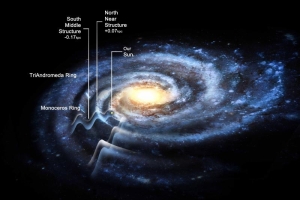
The Milky Way is like ripples in a pond

Milky Way ripples

The uncertainty of science: New survey data of the stars in the Milky Way suggest that the galaxy is not only corrugated with concentric ripples — like you’d see if you dropped a stone in a pond — it is also about 50% larger than previous estimates.

I have watched the size of the Milky Way fluctuate up and down depending on the research for the past forty years. Sometimes it is larger than expected. Sometimes smaller. Without doubt we are getting a better idea of its actual size, but don’t be surprised if the numbers continue to bounce about for decades, even centuries, to come.

The confirmation that the spiral arms are the equivalent of ripples in a pond is also not surprising, as it confirms the intuitive conclusion of anyone who looks at a whirlpool-shaped spiral galaxy: It is a whirlpool spiraling into the gravity well at its center.

1 comment

The race to map the space around the supermassive black hole at the center of our galaxy

The uncertainty of science: Using a new generation of telescopes, in space and on the ground, astronomers hope to better confine Einstein’s General Theory of Relativity by studying the distortion in light and energy produced by the powerful gravitational field surrounding Sagittarius A* (pronounced A-star), the 4 million solar mass black hole at the center of the Milky Way.

This is an excellent article explaining both the limits of our ability to study black holes as well as what we do know about Sagittarius A*.

Correction: Thanks to commenter Mike Nelson for noticing that I had mistakenly written “billion” instead of “million” for the mass of Sagittarius A* above.

3 comments

Islamic cleric insists Sun orbits Earth

Islamic science: At student discussion on Sunday an Islamic cleric insisted that the Sun orbits the Earth.

Sheikh Bandar al-Khaibari told a student that the Earth is “stationary and does not move,” according to Al-Arabiya, justifying the statement with religious texts and statements. But then he tried to debunk the common knowledge about the Earth’s rotation using “logic,” in a visual demonstration that prompted the speech to go viral. โ€œFirst of all, where are we now?” he asked. “We go to Sharjah airport to travel to China by plane, clear?!” Khaibari argued, confusingly, that the Earth cannot rotate because it would render air travel impossible.

Even if Islam was peaceful, which it is not, it remains a problem because it apparently also encourages this kind of ignorance.

12 comments

A stellar fly-by 70,000 years ago

Astronomers have identified a nearby star, now 20 light years away, that 70,000 years ago flew past the solar system at a distance of only 0.8 light years.

The starโ€™s trajectory suggests that 70,000 years ago it passed roughly 52,000 astronomical units away (or about 0.8 light years, which equals 8 trillion kilometers, or 5 trillion miles). This is astronomically close; our closest neighbor star Proxima Centauri is 4.2 light years distant. In fact, the astronomers explain in the paper that they are 98% certain that it went through what is known as the โ€œouter Oort Cloudโ€ โ€“ a region at the edge of the solar system filled with trillions of comets a mile or more across that are thought to give rise to long-period comets orbiting the Sun after their orbits are perturbed.

I feel it necessary to note that the Oort Cloud itself has never been directly observed and only exists theoretically based on the random arrival of comets from the outer solar system.

1 comment
1 115 116 117 118 119 188