
Week long movie of Pluto produced by New Horizons

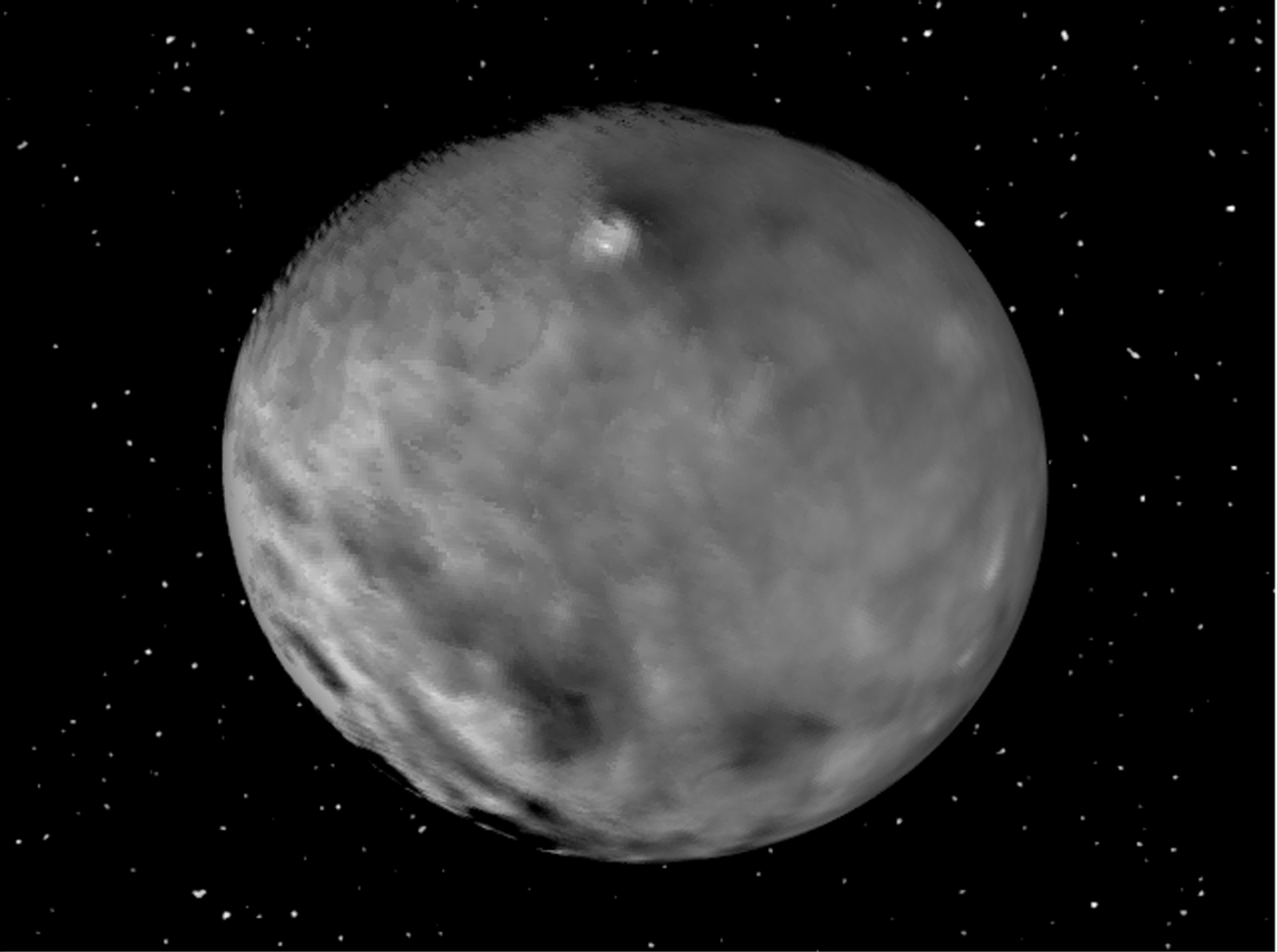
Cool images! Using New Horizons’ long range camera scientists have compiled a movie showing Charon and Pluto orbiting each other during the last week of January 2015.

Pluto and Charon were observed for an entire rotation of each body; a “day” on Pluto and Charon is 6.4 Earth days. The first of the images was taken when New Horizons was about 3 billion miles from Earth, but just 126 million miles (203 million kilometers) from Pluto—about 30% farther than Earth’s distance from the Sun. The last frame came 6½ days later, with New Horizons more than 5 million miles (8 million kilometers) closer.

The wobble easily visible in Pluto’s motion, as Charon orbits, is due to the gravity of Charon, about one-eighth as massive as Pluto and about the size of Texas.

Our view of Pluto, and Charon, is only going to get better as New Horizons zooms towards its July fly-by.
1 comment

Astronomers find an invisible dwarf galaxy

Using dark matter data that suggested the existence of a faint dwarf galaxy 300,000 light years away on the other side of the Milky Way, astronomers have pinpointed its location by finding a tiny cluster of bright Cepheid variable stars, also located at that distance.

“These young stars are likely the signature of this predicted galaxy,” said Chakrabarti, assistant professor in RIT’s School of Physics and Astronomy. “They can’t be part of our galaxy because the disk of the Milky Way terminates at 48,000 light years.” Invisible particles known as dark matter make up 23 percent of the mass of the universe. The mysterious matter represents a fundamental problem in astronomy because it is not understood, Chakrabarti said.

This result is intriguing because it not only found a previously unknown dwarf galaxy orbiting the Milky Way, it also provides further evidence that dark matter, whatever it is, does exist. The dark matter of this unseen dwarf galaxy showed its gravitational effects on Milky Way stars, and when the astronomers looked at the right spot suggested by those effects, they found distant stars that had to belong to the invisible dwarf galaxy, proving it was there. This is comparable to finding Neptune and Pluto by analyzing their gravitational effects and then predicting their location in the sky.

0 comments

The Hubble Space Telescope lives on!

At a press conference at the January meeting of the American Astronomical Society scientists and engineers of the Space Telescope Science Institute that operates the Hubble Space Telescope reported that it is functioning far better than expected and is likely to continue to function until 2020 or beyond.

This is good news, since there is nothing being planned to replace Hubble. The article implies that the James Webb Space Telescope has that job, but Webb is an infrared telescope, not optical, and thus observes the universe in wavelengths not visible to the human eye.

1 comment

Gravitational wave/inflation discovery literally bites the dust

The uncertainty of science: The big discovery earlier this year of gravitational waves confirming the cosmological theory of inflation has now been found to be completely bogus. Instead of being caused by gravitational waves, the detection was caused by dust in the Milky Way.

Even while the mainstream press was going nuts touting the original announcement, I never even posted anything about it. To me, there were too many assumptions underlying the discovery, as well as too many data points with far too large margins of error, to trust the result. It was interesting, but hardly a certain discovery. Now we have found that the only thing certain about it was that it wasn’t the discovery the scientists thought.

Nor is this unusual for the field of cosmology. Because much of this sub-field of astronomy is dependent on large uncertainties and assumptions, its “facts” are often disproven or untrustworthy. And while the Big Bang theory itself unquestionably fits the known facts better than any other theory at this time, there remain too many uncertainties to believe in it without strong skepticism.

6 comments

Solar system of ancient Earths found

Worlds without end: Using archived Kepler data astronomers have identified a solar system of five Earth-sized exoplanets, orbiting a red dwarf star about 117 light years from Earth.

The paper describes Kepler-444, a star that’s 25 percent smaller than our sun and is 117 light years from Earth. The star’s five known planets have sizes that fall between Mercury and Venus. Those planets are so close to their star that they complete their orbits in fewer than 10 days. At that distance, they’re all much hotter than Mercury and aren’t habitable.

The important detail from this discovery is that the star is very ancient, more than 11 billion years old, which means these planets are that old as well. In other words, planets began forming the same time as the first stars. Which also means that there has been plenty of time in the universe for other intelligent life to form, besides our own.

2 comments

Comet 67P/C-G’s coma fluctuates widely

Climate change: Data from Rosetta has shown that the coma surrounding Comet 67P/C-G’s nucleus varies far more than had been expected by Earth-based observations.

“From a telescope, images of a comet’s atmosphere suggest that the coma is uniform and does not vary over short periods of hours or days. That’s what we were expecting as we approached the comet,” said Dr. Stephen Fuselier, a director in the SwRI Space Science and Engineering Division and the lead U.S. co-investigator for the Rosetta Orbiter Spectrometer for Ion and Neutral Analysis Double Focusing Mass Spectrometer (ROSINA DFMS) instrument. “It was certainly a surprise when we saw time variations from 200 km away. More surprising was that the composition of the coma was also varying by very large amounts. We’re taught that comets are made mostly of water ice. For this comet, the coma sometimes contains much more carbon dioxide than water vapor.”

The variations might be seasonal, or even reflect a variation from day to night.

Expect more news stories about Comet 67P/C-G from Rosetta. The journal Science is today publishing a special section on results from Rosetta.

0 comments

A quasar shuts down

Astronomers have identified the first quasar to change its energy output.

Quasars are massive, luminous objects that draw their energy from black holes. Until now, scientists have been unable to study both the bright and dim phases of a quasar in a single source. As described in an upcoming edition of the Astrophysical Journal, Yale-led researchers spotted a quasar that had dimmed by a factor of six or seven, compared with observations from a few years earlier.

It is also believed that quasars are the central supermassive black holes at the center of these very distant and ancient galaxies. Knowing how these black holes change can tell us something about the behavior of Sagittarius A*, the generally quiet central black hole in the Milky Way.

0 comments

More Earthlike exoplanets found

Worlds without end: Using Kepler astronomers have discovered a red dwarf star 150 light years away with three Earth-like exoplanets, one of which is in the habitable zone.

The three planets are 2.1, 1.7 and 1.5 times the size of Earth. The outermost planet, at 1.5 Earth radii, is the smallest of the bunch and orbits far enough from its host star that it receives levels of light from its star similar to those received by Earth from the sun, said UC Berkeley graduate student Erik Petigura, who discovered the planets Jan. 6 while conducting a computer analysis of the Kepler data NASA has made available to astronomers. He calculated that the three planets receive 10.5, 3.2, and 1.4 times the light intensity of Earth. “Most planets we have found to date are scorched. This system is the closest star with lukewarm transiting planets,” Petigura said. “There is a very real possibility that the outermost planet is rocky like Earth, which means this planet could have the right temperature to support liquid water oceans.”

These planets were found by Kepler in its present reconfigured mission, which once again illustrates the incredible effectiveness of an optical telescope in space. If only we were building some.

0 comments

New Hubble images to celebrate its upcoming 25th anniversary

The Space Telescope Science Institute (STScI) that operates the Hubble Space Telescope yesterday released two spectacular new images at the January meeting of the American Astronomical Society.

They also announced new data from Hubble that suggests a major eruption had occurred at the center of the Milky Way about two million years ago.

0 comments
1 116 117 118 119 120 188