
More Earthlike exoplanets confirmed

Worlds without end: Astronomers have confirmed from Kepler data the existence of 8 new exoplanets, all capable of having liquid water on their surface, with two more like Earth than any previous discovery.

These findings nearly double the number of known planets in the habitable zone, but researchers are especially excited about two of the new exoplanets: Their size, location, and star type means they could be rocky planets like Earth — which means they could have evolved life as we recognize it.

One of the planets, Kepler-438b, is only 12 percent bigger than Earth in diameter. That means it’s quite likely a rocky planet. Scientists have given it a 70 percent chance. Kepler-442b is a bit bigger at around 33 percent larger than Earth, but still has a 60 percent chance of being rocky.

But while 438b hits the sweet spot in size, 442b has it beat when it comes to distance from the sun. Both planets orbit a small red dwarf star, cooler than Earth’s Sun, but they also orbit more closely. 438b gets 40 percent more light than Earth, which means it has around a 70 percent chance of being able to hold liquid water. But with 66 percent as much light as our own planet, 442b has a 97 percent chance of being in the habitable zone.
0 comments

Loose fibers significantly cuts Gaia’s output

Europe’s Gaia telescope, designed to precisely measure the motions of a billion stars in the Milky Way, will have its accuracy cut in half because of the presence of loose fibers on the telescope’s sun shield that are allowing too much stray light in.

These fibres were spotted on Gaia before launch, but cutting them off was considered too risky, because that could allow small particles to enter the spacecraft. Another option, taping them down, was also ruled out because the increased stiffness could prevent the sunshield from unfolding.

The stray light shouldn’t affect measurements of the galaxy’s brightest stars, says Gaia science team member Anthony Brown at the Leiden Observatory in the Netherlands, but it will double the expected errors on most of the stars in the Milky Way, which are much fainter.

For astronomers this is a great tragedy. Gaia will still teach us much, just not as much as they had hoped.

2 comments

Kepler reborn

Kepler detects its first exoplanet after its mission was reshaped because of the failure of two of its four gyros.

The newfound planet, HIP 116454b, has a diameter of 20,000 miles, two and a half times the size of Earth. HARPS-N showed that it weighs almost 12 times as much as Earth. This makes HIP 116454b a super-Earth, a class of planets that doesn’t exist in our solar system. The average density suggests that this planet is either a water world (composed of about three-fourths water and one-fourth rock) or a mini-Neptune with an extended, gaseous atmosphere.

This close-in planet circles its star once every 9.1 days at a distance of 8.4 million miles. Its host star is a type K orange dwarf slightly smaller and cooler than our sun. The system is 180 light-years from Earth in the constellation Pisces.

Even more cool, the detection took place during Kepler’s first test run in its new configuration. This bodes well for the space telescope’s ability to make future discoveries.

0 comments

Europe approves construction of giant telescope

Europe has approved the construction of the European Extremely Large Telescope (E-ELT), which when completed will be the largest ground-based telescope.

The E-ELT will have a mirror 39 meters across, almost four times bigger than the world’s largest telescope today.

A word to the wise: This very month Sky & Telescope’s cover article, written by yours truly, describes the many difficulties the world’s present generation of giant telescopes have faced. Four out of five have not produced the science promised. Two of the four were dogged by so many technical problems that they required complete reconstruction. The builders of E-ELT will face even greater engineering challenges. Do not be surprised if this telescope does not get completed by 2025 as promised, and even if it does, do not be surprised if it takes another half decade or more before the engineers work out all the kinks.

0 comments

Looking down a comet’s neck

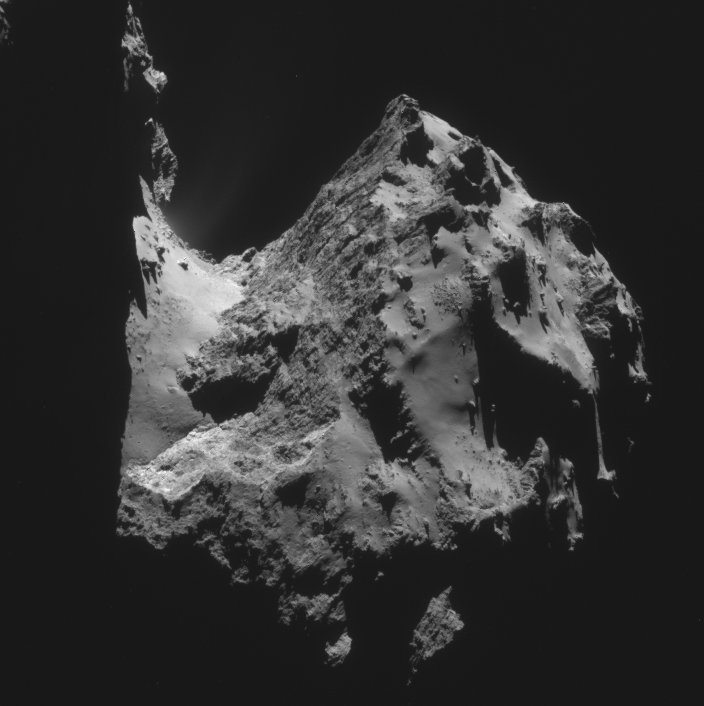
Looking down Comet 67P/C-G's neck

Because all the focus in past two weeks has been on the attempt to land Philae on the surface of Comet 67P/C-G, no one has been paying much attention to the images that Rosetta has continued to produce. On the right however is a humdinger, released on November 17. The image looks into the neck or saddle of the comet, from the side. The giant boulder Cheops can be seen in the saddle, with a jet visible against the black sky above it.

What I like about this image is that I can imagine hiking up the sandy slope to this narrow saddle, where I could stand next to Cheops and look out at that jet. For the explorer in all of us this sure wets the appetite for the future. If only people could go and do that now!

1 comment

The best image yet of the birth of a solar system

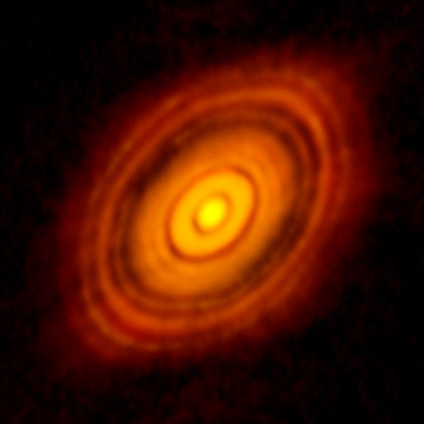
HL Tau

The new ground-based telescope ALMA has taken an amazing image of a baby star and the planet-forming accretion disk that surrounds it.

ALMA uncovered never-before-seen features in this system, including multiple concentric rings separated by clearly defined gaps. These structures suggest that planet formation is already well underway around this remarkably young star. “These features are almost certainly the result of young planet-like bodies that are being formed in the disk. This is surprising since HL Tau is no more than a million years old and such young stars are not expected to have large planetary bodies capable of producing the structures we see in this image,” said ALMA Deputy Director Stuartt Corder.

ALMA has just been completed and is only in its initial shake-out period. It is also not an optical telescope, but observes in longer wavelengths above infrared. Thus, it can peer through dust clouds to see details like this. And these details confirm that the most accepted theory of planetary formation appears to be right.

3 comments

How a big impact gave Vesta its grooves

New data suggests that when a large impact hit Vesta’s Rheasilvia basin sometime in the past, the entire asteroid was shaken up, producing ripples that eventually surfaced as the giant grooves that circle the asteroid’s equator.

โ€œVesta got hammered,โ€ said Peter Schultz, professor of earth, environmental, and planetary sciences at Brown and the paperโ€™s senior author. โ€œThe whole interior was reverberating, and what we see on the surface is the manifestation of what happened in the interior.โ€

The research suggests that the Rheasilvia basin on Vestaโ€™s south pole was created by an impactor that came in at an angle, rather than straight on. But that glancing blow still did an almost unimaginable amount of damage. The study shows that just seconds after the collision, rocks deep inside the asteroid began to crack and crumble under the stress. Within two minutes major faults reached near the surface, forming deep the canyons seen today near Vestaโ€™s equator, far from the impact point.

Essentially, for a very very short period of time, immediately after the impact, the solid material of the asteroid acted more like a liquid, producing ripples that immediately settled down as the solid deep equatorial grooves we see today.

0 comments

G2 survives Milky Way center fly by

The uncertainty of science: The gas cloud, dubbed G2, that was going to be eaten by the supermassive black hole at the center of the Milky Way as it did a close fly-by this summer has instead turned out to be a massive star formed when the star’s of its binary system merged.

G2 survived the fly-by, produced no big fireworks which were what was predicted if it has been a gas cloud. The data now suggests that the object is instead a very big star formed when two stars merged.

Massive stars in our galaxy, [astronomer Andrea Ghez] noted, primarily come in pairs. When the two stars merge into one, the star expands for more than one million years โ€œbefore it settles back down,โ€ Ghez said. โ€œThis may be happening more than we thought; the stars at the center of the galaxy are massive and mostly binaries. Itโ€™s possible that many of the stars weโ€™ve been watching and not understanding may be the end product of a merger that are calm now.โ€

Be warned that this new hypothesis about G2 has its own uncertainties. Better data might eventually find it to be something else again.

0 comments
1 117 118 119 120 121 188