Rosetta snaps more comet pictures

rotating comet nucleus

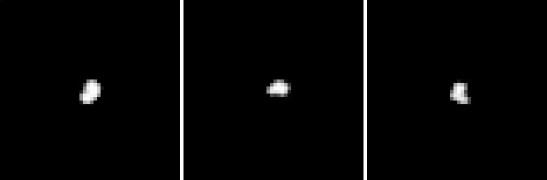
Rosetta’s new images of Comet 67P/Churyumov-Gerasimenko show the very irregular shape and rotation of its nucleus.

These images were taken on July 4 from a distance of only 23,000 miles. The rendezvous is expected in early August, with the touchdown of Rosetta’s landing probe Philae sometime in November after they have done a reconnaissance of the nucleus to pick a landing spot.

0 comments

A source for the most powerful cosmic rays?

Astronomers think they have discovered a region in the sky, within or near the Milky Way, which might be the source of the most energetic cosmic rays

Nobody knows how ultra–high-energy cosmic rays—mainly protons or heavier atomic nuclei—acquire energies millions of times higher than have been achieved with humanmade particle accelerators. (Physicists dubbed one of the first ones observed the “Oh-My-God particle.”) Lower energy cosmic rays are thought to spring from the lingering remnants of stellar explosions called supernovas. But such clouds are far too small to produce the highest energy cosmic rays. Instead, theorists generally expect that the most energetic cosmic rays rev up over millions of years in unidentified accelerators the size of galaxies.

The Telescope Array aims to help solve that mystery. When a high-energy cosmic array strikes the atmosphere, it disappears in an avalanche of lower energy particles. Those particles trigger the detectors in the array, enabling researchers to deduce the direction and energy of the original cosmic ray. From 2008 to 2013, researchers spotted 72 cosmic rays with energies above 57 exaelectron volts—15 million times the highest energy achieved with a particle accelerator. And 19 of them appear to cluster in a hotspot in the sky about 20° in radius, as Hiroyuki Sagawa, a co-representative for the Telescope Array team from the University of Tokyo, reported today in a press conference at the university. [emphasis mine]

The low number of detections, 19 out of 72 total, that seem to come from this wide 20 degree region, suggests that this report falls most certainly under the heading of “the uncertainty of science.” I would not be surprised at all if this conclusion does not stand up after further research.

Nonetheless, the article is worth reading because it outlines nicely this astronomical mystery. Something out there accelerates these particles to these high energies, and astronomers do not yet know what that something is.

0 comments

Problems with the European Gaia space telescope

Shades of Hubble: The first data from Europe’s Gaia space telescope, launched to map a billion Milky Way stars, will be delayed 9 months while engineers grapple with several problems.

Gaia managers started taking test images early this year, but soon noticed three issues. For one, more light than anticipated is bending around the 10-metre sunshield and entering the telescope.

Small amounts of water trapped in the spacecraft before launch are being released now that the telescope is in the vacuum of space, and more ice than calculated is accumulating on the telescope’s mirrors. In addition, the telescope itself is expanding and contracting by a few dozen nanometres more than expected because of thermal variations.

Mission managers say the number of stars detected will remain the same even if these complications remain untreated, but the accuracy in measurements of the fainter stars will suffer.

Unlike Hubble, however, there is no way to send a shuttle and a team of astronauts to Gaia to fix it. And it sounds like these issues will have an impact on the telescope’s abilities to gather its intended data.

This story raises my hackles for another reason. Gaia was a very technically challenging space telescope to build, but it was far easier and less cutting edge than the James Webb Space Telescope. It also cost far less. What will happen when Webb gets launched later this decade? How likely is it to have similar issues? Based on a story I just completed for Sky & Telescope on the difficulties of building ground-based telescopes, I’d say Webb is very likely to have similar problems, with no way to fix them. The American astronomy community could then be faced with the loss of two decades of research because they had put all the eggs into Webb’s basket, and thus had no money to build anything else.

15 comments

Two exoplanets disappear

The uncertainty of science: Two exoplanets orbiting Gliese 581, both thought to be in the habitable zone, have now been proven to not even exist.

“We’ve proven that some of the controversial signals from Gliese 581 don’t come from two proposed Goldilocks planets, but instead are coming from activity within the star itself masquerading as planets,” lead study author Paul Robertson, an astronomer at Pennsylvania State University in University Park, told Space.com.

This result should serve as a strong reminder: Though it is likely that many if not most of the so far discovered exoplanets are real, it is also likely that many will turn out to be false positives. We won’t have solid real knowledge about them until we can actually get a close look at them, which will require far better telescopes in space, and maybe even interstellar missions to them.

0 comments

Telescope teamwork produces spectacular galaxy image

M106

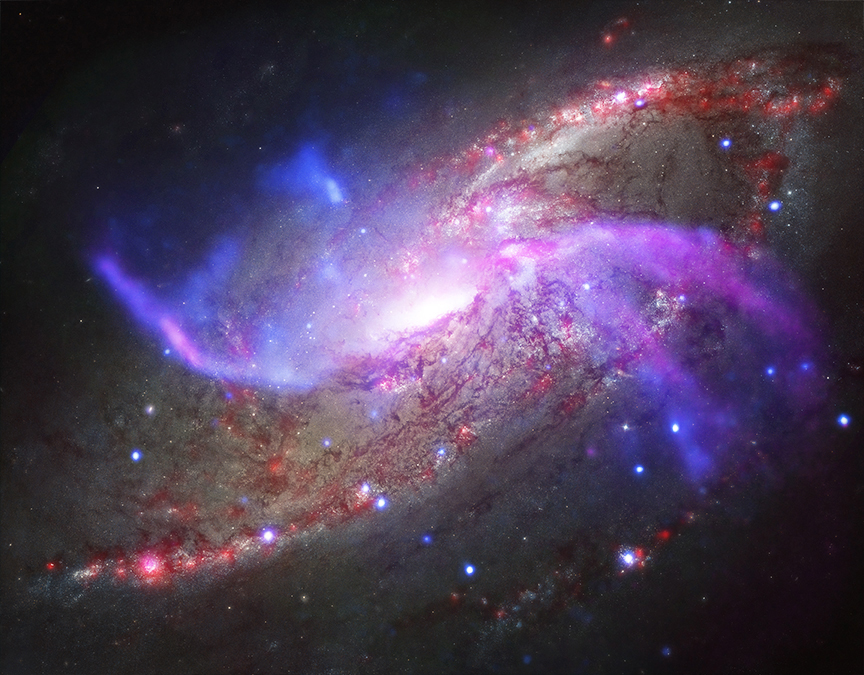
Combining images from a host of space and ground-based telescopes, astronomers have created a spectacular image of the galaxy M106.

This galactic fireworks display is taking place in NGC 4258 (also known as M106), a spiral galaxy like the Milky Way. This galaxy is famous, however, for something that our Galaxy doesn’t have – two extra spiral arms that glow in X-ray, optical, and radio light. These features, or anomalous arms, are not aligned with the plane of the galaxy, but instead intersect with it.

The anomalous arms are seen in this new composite image of NGC 4258, where X-rays from NASA’s Chandra X-ray Observatory are blue, radio data from the NSF’s Karl Jansky Very Large Array are purple, optical data from NASA’s Hubble Space Telescope are yellow and blue, and infrared data from NASA’s Spitzer Space Telescope are red.

A new study of these anomalous arms made with Spitzer shows that shock waves, similar to sonic booms from supersonic planes, are heating large amounts of gas – equivalent to about 10 million Suns. What is generating these shock waves? Radio data shows that the supermassive black hole at the center of NGC 4258 is producing powerful jets of high-energy particles. Researchers thinkthat these jets strike the disk of the galaxy and generate shock waves. These shock waves, in turn, heat some of the gas – composed mainly of hydrogen molecules – to thousands of degrees.

The astronomers also used the Herschel Space Observatory to confirm the data from Spitzer.

0 comments

A trio of supermassive black holes

Astronomers have discovered a trinary of supermassive black holes at the center of a distant collision of multiple galaxies.

Astronomer Roger Deane of the University of Cape Town in South Africa and his colleagues have been watching a particular quasar, known as SDSS J1502+1115, in the constellation Boötes. Other astronomers had found that the object, located 4.3 billion light-years from Earth, possessed two supermassive black holes, each the center of a large galaxy smashing into another. The black holes are at least 24,000 light-years apart.

Deane wanted to confirm their existence, so he used an intercontinental array of radio dishes that yields even sharper views than the Hubble Space Telescope. Lo and behold, one of the black holes turned out to be two. “We were incredibly surprised,” says Deane, whose team reports its findings online today in Nature.

While the discovery of this system is incredibly cool, this article in the journal Science is surprisingly incorrect on some points, while also missing the main story.
» Read more

2 comments

Groundbreaking — the literally blasting off of a mountaintop — took place today in Chile at the eventual site of the European Extremely Large Telescope (E-ELT).

Groundbreaking — the literally blasting off of a mountaintop — took place today in Chile at the eventual site of the European Extremely Large Telescope (E-ELT).

Once completed in 2024 this telescope will have a segmented mirror with a total diameter of 39 meters or 128 feet, the largest ever built.

0 comments

The astronomers who allocate time on the Hubble Space Telescope have decided to devote a large block for finding a Kuiper Belt object that the probe New Horizons might fly past.

The astronomers who allocate time on the Hubble Space Telescope have decided to devote a large block for finding a Kuiper Belt object that the probe New Horizons might fly past.

This allocation is still contingent upon a test observation to see if Hubble will be able to spot enough objects to make the long observations worthwhile.

0 comments

Engineers have returned to full operation the x-ray instrument on the Swift gamma-ray burst space telescope.

Engineers have returned to full operation the x-ray instrument on the Swift gamma-ray burst space telescope.

They are still investigating what went wrong this week, but have figured out how to get the instrument back in full automatic robotic mode so that it can gather x-ray data on gamma ray bursts within seconds of their occurence.

0 comments

A new analysis of Apollo lunar rocks provides strong new evidence for the theory that the Moon was formed when the Earth was hit by a Mars’ sized planet.

A new analysis of Apollo lunar rocks provides strong new evidence for the theory that the Moon was formed when the Earth was hit by a Mars’ sized planet.

The abstract from this just released science paper summarizes the scientific problem.

Earth formed in a series of giant impacts, and the last one made the Moon. This idea, an edifice of post-Apollo science, can explain the Moon’s globally melted silicate composition, its lack of water and iron, and its anomalously large mass and angular momentum. But the theory is seriously called to question by increasingly detailed geochemical analysis of lunar rocks. Lunar samples should be easily distinguishable from Earth, because the Moon derives mostly from the impacting planet, in standard models of the theory. But lunar rocks are the same as Earth in O, Ti, Cr, W, K, and other species, to measurement precision. Some regard this as a repudiation of the theory; others say it wants a reformation. Ideas put forward to salvage or revise it are evaluated, alongside their relationships to past models and their implications for planet formation and Earth.

The new analysis has found that lunar rocks do differ from Earth in certain ways. Not surprisingly, however, the results have uncertainties.

0 comments

The rupture of a drum at a nuclear waste site in New Mexico has shut down a neutrino experiment.

The rupture of a drum at a nuclear waste site in New Mexico has shut down a neutrino experiment.

This article, from Nature, focuses on the harm done to the science experiment, which is considerable and very unfortunate. However, scroll to the end of the article to learn a little about the drum rupture, which has serious implications for the storage of nuclear waste anywhere.

0 comments
1 122 123 124 125 126 188