
67P/C-G in 3D
The Rosetta team, by taking two images seventeen minutes apart, have created a 3D image of Comet 67P/C-G.
You will need the red/blue filter glasses, but if you have them, take a look, it is quite cool.
The Rosetta team, by taking two images seventeen minutes apart, have created a 3D image of Comet 67P/C-G.
You will need the red/blue filter glasses, but if you have them, take a look, it is quite cool.
The Rosetta science team announced today that the spacecraft’s Grain Impact Analyser and Dust Accumulator (GIADA) has captured its first dust grains from Comet 67P/C-G.
Earlier this month, GIADA detected the first four dust grains in its Impact Sensor. The first detection was made on 1 August, when Rosetta was 814 km from 67P/C-G, and about 543 million kilometres from the Sun. Further impacts from three more dust grains were detected on 2, 4, and 5 August, at distances of 603, 286, and 179 km from the comet, respectively.
There is still too little data to come to any firm conclusions about the density and make-up of the coma, but this announcement confirms that the instrument is working as designed. When the comet zips past the Sun at its closest point on August 13, 2015, this instrument will then be able to give us a very good assessment of this particular comet’s behavior as it slowly evaporates.
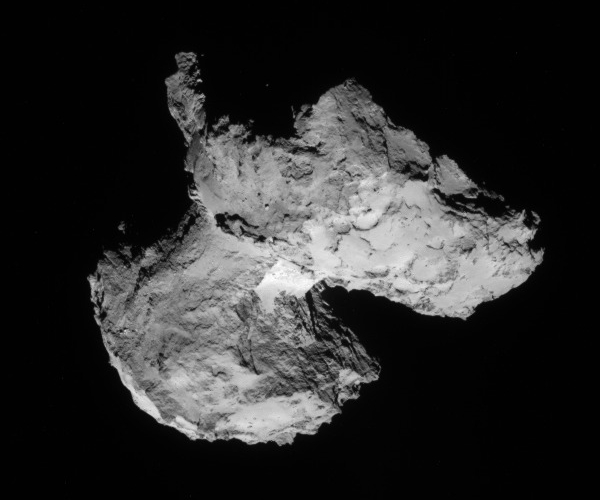
Meanwhile, the images keep coming. The picture at the top of the post was taken on August 12 from about 64 miles.
Astronomers have discovered the two most distant stars of the Milky Way.
Both stars are red giants, aging suns that shine so brightly observers can see them from afar. One star is about 890,000 light-years from Earth in the constellation Pisces—33 times farther from the Milky Way’s center than we are and well beyond the edge of the galactic disk. The only other Milky Way member at a comparable distance is a small galaxy named Leo I, which orbits ours at a distance of 850,000 light-years. If the star in Pisces revolves on a circular path as fast as we do, it takes some eight billion years to complete a single orbit around the galaxy. That’s more than half the age of the universe.
The other newfound star is about 780,000 light-years distant in the constellation Gemini and more than a million light-years from the other star. For comparison, the previous record-breaking individual star was only about half a million light-years from Earth.
Both stars are so far outside the galaxy’s disk that it is quite possible that they are not part of the Milky Way at all.
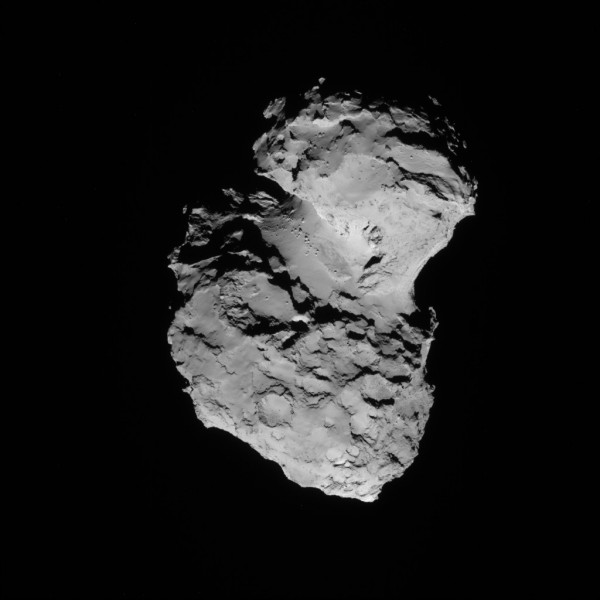
The above image is not the most recent daily image from Rosetta, but it is the most interesting of the last three.
It shows the side of the comet nucleus that has not been featured in most images, as the topographical differences between its two sections is not as distinctly highlighted. What is highlighted is the neck that connects the two sections, lighter colored and thus likely made up of less dusty ice.
Also of interest here is the circular features on the larger bottom section. These certainly resemble craters, and are likely remnants of early impacts that are now been corroded away as the nucleus’s ice particles evaporate off the surface. The scientific question here is this: Why are crater features more evident on this side and section of the comet nucleus than on other areas of its surface?
In anticipation of its fly of Pluto next year, the New Horizon spacecraft has produced a 12 frame movie showing Pluto’s moon Charon circling the planet.
Astronomers using the ground-based Keck Observatory have imaged the sudden growth of what they call a “montrous” storm on Uranus.
Rosetta has successfully achieved orbit around Comet 67P/C-G and has transmitted its first close up images. More information here and here about the rendezvous and what science the mission scientists plan to do as they orbit the comet.
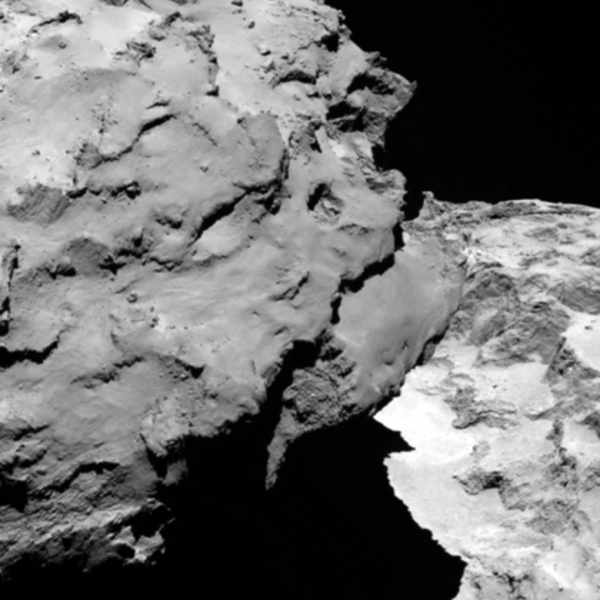
The image below is looking down and past the comet’s smaller component as it casts a shadow on the neck and the larger component beyond. As with the earlier images, the comet’s pitted and corroded surface, lacking any obvious craters, is reminiscent to me of a pile of dirty snow that has been dissolving away. In fact, when I lived in New York I would see this kind of look every winter. When the city would get a big snowfall snowplows would push it into large mounds on the side of the road. As time passed these piles would get dirty from the city’s soot and grime, and also slowly melt away. After several weeks it would look almost exactly like the surface of Comet 67P/C-G.
The images and data that will come down from Rosetta over the next year and half as it orbits the comet in its journey around the Sun will be most fascinating. Stay tuned!
Astronomers are gearing up to observe the next binary fly-by of Eta Carinae’s companion star over the next few weeks.
A binary system, η Carinae has two stars that swing past one another every 5.5 years. The bigger star — some 90 times the mass of the Sun — is incredibly unstable, always seemingly on the verge of blowing up. When the smaller companion star makes its closest approach to the primary star, as is happening now, the interaction between the two triggers violent changes in the high-energy radiation pouring out of the system.
Astronomers are watching the show in the hope of learning what drives this enigmatic system. In the 1840s, η Carinae had a mysterious eruption; in recent decades, it has again brightened unexpectedly. “The star is in an awfully deranged state, and no one knows why,” says Kris Davidson, an astronomer at the University of Minnesota in Minneapolis.
Eta Carinae is also famous because it was one of the first objects imaged by Hubble after its repair in 1993, and was thus the first stellar explosion ever caught on camera in a visually sharp and clear manner. (See my book The Universe in a Mirror for that fascinating story.)
A quick preliminary comparison of the surface features of Comet 67P/C-G, compared to other comets that spacecraft have visited.
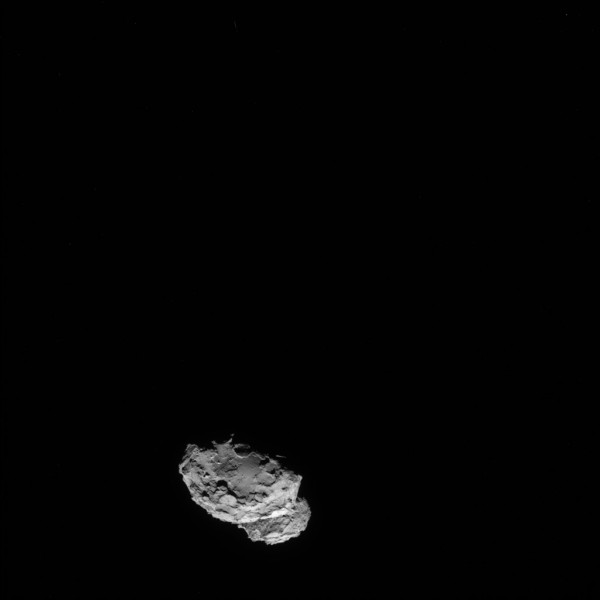
The image above was taken by Rosetta on August 4 from only 126 miles (234 kilometers). Unlike earlier images, this image is raw, uncropped and unprocessed. All I have done is rescale it to fit on my webpage. As they explain at the link,
As you can see, the comet is not centred in the full-frame image. This is a result of the rendezvous burn conducted the previous day, which adjusted Rosetta’s trajectory towards the comet. This effect is corrected for in the commands sent to the spacecraft after the new orbit has been determined.
The science team also notes that beginning tomorrow, the comet will be close enough that they will no longer have to provide a cropped close-up using the navigation camera and that this uncropped raw version will be sufficient.
Astronomers, using WISE data, have discovered a strange exoplanet that is now as cool as a rocky planet, but was once as hot as a red dwarf star.
The current temperature of the object is 100-150 degrees Celsius, intermediate between that of the Earth and Venus. But the object shows evidence of a possible ancient origin, implying that a large change in temperature has taken place. In the past this object would have been as hot as a star for many millions of years.
Called WISE J0304-2705, the object is a member of the recently established “Y dwarf” class – the coolest stellar temperature class yet defined, added to the end of the sequence OBAFGKMLT (for historical reasons this is not in alphabetical order but follows a decline in temperature from O to T). Although its temperature is not far off that of our own world, the object is not like the rocky Earth-like planets and instead is a giant ball of gas like Jupiter.
As cool as this discovery is (no pun intended), I am most enlightened by the information in the second paragraph above. I had not realized that astronomers had added L, T, and Y classes to the low temperature end of their stellar classification system. For those new to astronomy, you remember the sequence of the first seven classes with the phrase “O Be A Fine Girl Kiss Me”. I wonder what how we can amend this phrase to include the L, T, Y, classes?
In 2013 the ground-based Gemini telescope imaged a gigantic volcanic eruption on Jupiter’s moon Io.
More here, including information on two other eruptions that occurred about the same time.