Today’s Comet 67P image

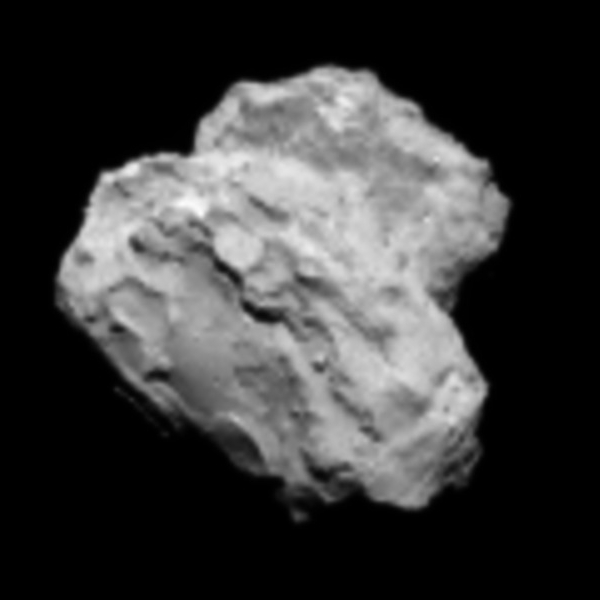
Comet 67P on August 2

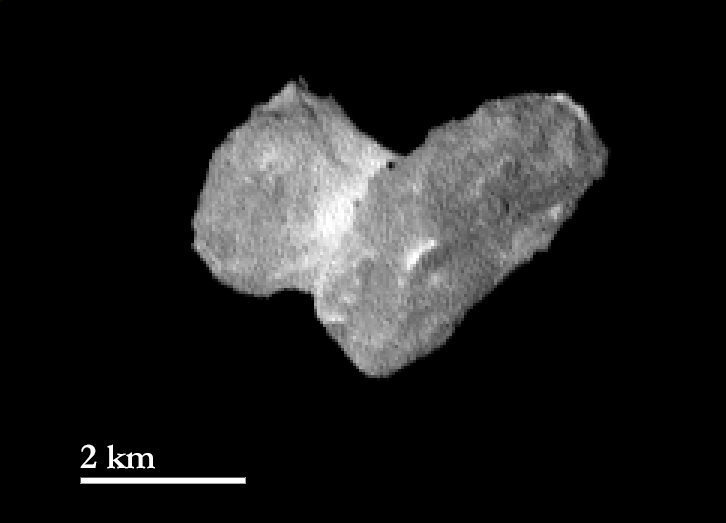
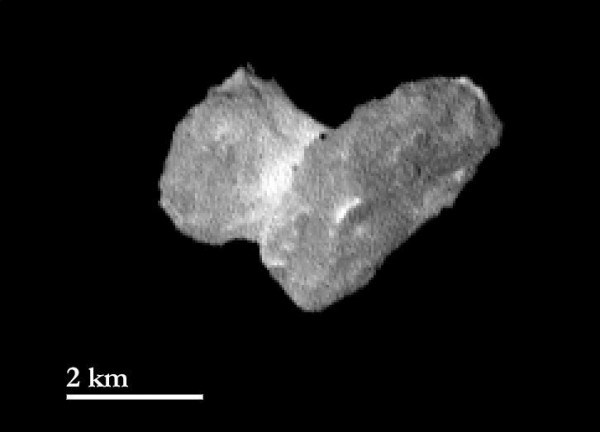
The image above was taken on August 2 using Rosetta’s navigation camera. It has been processed by the science team to bring out the details. I have also rotated it to match the August 1 image taken at a distance of 620 miles that was taken by Rosetta’s OSIRIS narrow angle camera, designed to do the actual science.

You can see that the navigation camera does a pretty good job on its own of capturing the comet’s nucleus. Both images show that the instruments are working perfectly, and thus tell us that the next few months will be quite spectacular after Rosetta goes into orbit in three days, followed in November by the landing of Philae somewhere on the comet’s surface.

If you download both images and then switch back and forth between them you can get a better feel for the geometry of the surface features.
0 comments

Comet 67P from 1000 k

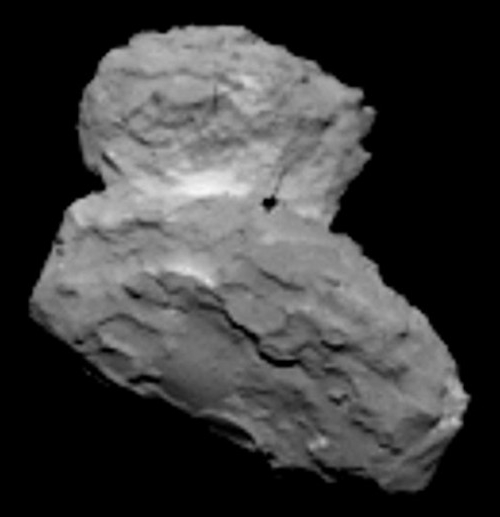
67P from 1000 kilometers

Above is a new image of Comet 67P as seen from about 1000 kilometers, or about 620 miles, released by the Rosetta science team today. The image was taken on August 1 and has been processed somewhat to bring out the details. The black spot near the junction between the nucleus’s two sections is not real but an artifact of the camera’s CCD.

This image is the first real clear and sharp look at the nucleus, and what it shows us is a surface quite different from the many other asteroids that science probes have imaged close-up in the past. From this angle there are far few craters visible then is normally seen on asteroids, and the surface has complex roughness and pitted look that I suspect the planetary geologists are right now scratching their heads about and waving their arms trying to explain. My first guess, which no one should take too seriously, is that as material vents off the comet when it gets close to the Sun it leaves behind these scars.

One more thing: If you go here you can see a number of additional image releases in the last 24 hours, all fascinating. This link explains that the features that looked like craters in earlier images were actually artifacts from the camera’s CCD.

0 comments

A Hubble Space Telescope status report

Five years after the last shuttle repair mission, the Hubble Space Telescope continues to operate almost perfectly.

Jeletic said other than a single gyro failure, the observatory is operating in near-flawless fashion five years after the final shuttle crew departed. “Batteries are fine, solar arrays are fine, all the communications equipment is fine, we don’t see any glitches with the computers, the instruments are all fine,” he said. “In fact, an interesting statistic, the Advanced Camera for Surveys, which was repaired by the astronauts during the last servicing mission, that’s actually now run longer on the repair than it did originally for the Wide Field Camera part of it.”

The ACS, like the repaired Space Telescope Imaging Spectrograph, no longer has any internal redundancy. “It’s amazing. It truly is,” Jeletic said. “Given all the things that can fail, a lot of people were hoping for one or two years of continued work with it. Now we’ve gotten over five.” Likewise, the Space Telescope Imaging Spectrograph, which also is operating in “single-string” mode, is still going strong.

When they completed the 2009 servicing mission, the goal was to give Hubble five more years of operation. They’ve done that, and are now looking to keep the telescope going till at least 2020, marking 30 years in orbit.

The only issue, not surprisingly, is the failure of one of the six gyros on board. These have traditionally been the telescope’s biggest problem, and have been replaced twice over during shuttle missions. Three of today’s six however are using a new design which will hopefully extend their life significantly.

1 comment

Fermi proves that novae produce gamma rays

The Fermi Gamma-Ray Space Telescope has discovered that novae, small scale stellar explosions similar to some supernovae but far less powerful, also produce gamma rays when they explode.

A nova is a sudden, short-lived brightening of an otherwise inconspicuous star caused by a thermonuclear explosion on the surface of a white dwarf, a compact star not much larger than Earth. Each nova explosion releases up to 100,000 times the annual energy output of our sun. Prior to Fermi, no one suspected these outbursts were capable of producing high-energy gamma rays, emission with energy levels millions of times greater than visible light and usually associated with far more powerful cosmic blasts.

What is significant about this is that it demonstrates a solid link between novae and supernovae, since only recently have scientists shown that some supernovae also produce gamma ray bursts. It suggests that the two explosions are produced by somewhat similar processes, but at very different scales. This fact will have important ramifications in the study of stellar evolution and the death of stars. For example, some nova stars often go nova repeatedly. Other data suggest that some more powerful eruptions can be recurrent as well. Extending this recurrent pattern to supernova suggests many new theoretical possibilities.

0 comments

The Milky Way shrinks

The uncertainty of science: New research by astronomers suggests that the Milky Way is about half as massive as previously estimated.

In the sixties I remember astronomers claiming that the Milky Way was twice as big as Andromeda. Then it was considered half as big. Most recently it was considered about the same size. This new research makes it half as big as Andromeda again.

In other words, the data is very uncertain, and the scientists really don’t have a good handle on it. None of these conclusions should be taken very seriously. All we really know at this point is that the Milky Way and Andromeda are approximately comparable.

5 comments

Gaia commissioning complete

After several months of in-orbit analysis, engineers have declared the European space telescope Gaia ready to begin research.

There have been several issues that had raised concerns, but from the article it sounds as if the engineers have either corrected the problems or have found ways to overcome or mitigate them.

Gaia will measure the movement and location of a billion stars, allowing astronomers to map the Milky Way better than ever before.

0 comments

New Rosetta comet images

New images from Rosetta have a resolution of 100 meters per pixel and are finding that the neck connecting the comet’s two sections is apparently much brighter than the rest of the nucleus.

As earlier images had already shown, 67P may consist of two parts: a smaller head connected to a larger body. The connecting region, the neck, is proving to be especially intriguing. β€œThe only thing we know for sure at this point is that this neck region appears brighter compared to the head and body of the nucleus”, says OSIRIS Principal Investigator Holger Sierks from the Max-Planck-Institute for Solar System Research (MPS) in Germany. This collar-like appearance could be caused by differences in material or grain size or could be a topographical effect.

It looks like this comet is going to turn out to be one of the most fascinating objects any space probe has visited in a long time.

0 comments

More images from Rosetta

67P

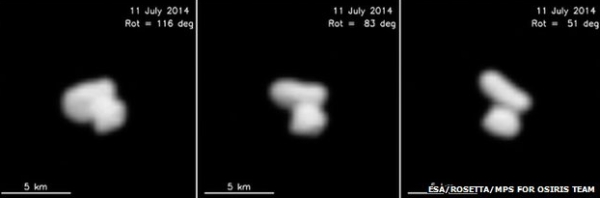
The comet that Rosetta will orbit is getting stranger and stranger, with new images suggesting that it is really two objects stuck together.

The pictures show that 67P/Churyumov-Gerasimenko appears to be not one but two objects joined together. It is what scientists call a “contact binary”. How the comet came to take this form is unknown. It is possible that 67P suffered a major fracture at some point in its past; it is also possible the two parts have totally different origins.

What is clear is that the European Space Agency (Esa) mission team now has additional and unexpected considerations as it plans how to land on the comet later this year – not least, which part of the comet should be chosen for contact?

1 comment

Fast radio pulses exist, come from outside the galaxy, and no one knows what they are

A new astronomical mystery: The Arecibo radio telescope has confirmed the existence of fast radio pulses.

Fast radio bursts (FRBs) are bright flashes of radio waves that last only a few thousandths of a second. Scientists using the Parkes Observatory in Australia have recorded such events for the first time, but the lack of any similar findings by other facilities led to speculation that the Australian instrument might have been picking up signals originating from sources on or near Earth. The discovery at Arecibo is the first detection of a fast radio burst using an instrument other than the Parkes radio telescope. The position of the radio burst is in the direction of the constellation Auriga in the Northern sky. …

“Our result is important because it eliminates any doubt that these radio bursts are truly of cosmic origin,” continues Victoria Kaspi, an astrophysics professor at McGill University in Montreal and Principal Investigator for the pulsar-survey project that detected this fast radio burst. “The radio waves show every sign of having come from far outside our galaxy – a really exciting prospect.”

Exactly what may be causing such radio bursts represents a major new enigma for astrophysicists. Possibilities include a range of exotic astrophysical objects, such as evaporating black holes, mergers of neutron stars, or flares from magnetars β€” a type of neutron star with extremely powerful magnetic fields.

Be warned: All of the above theories could also be wrong. These fast radio flashes could just as easily turn out to be something entirely unpredicted.

0 comments
1 121 122 123 124 125 188