
Volunteers wanted to search for exoplanets
Want to find your very own exoplanet? Volunteers wanted!
Want to find your very own exoplanet? Volunteers wanted!
Kepler has found two more planets orbiting double star systems.
The data also suggests that there will be millions of planets in the galaxy orbiting double stars.
FYI, all this astronomy news is because the American Astronomical Society is having its conference this week in Texas, and today is releasing has what I consider the best news stories.
Billions and billions! Astronomers have concluded that the stars in the Milky Way must average at least one planet per star. More importantly, the data says the galaxy should have billions of habitable planets.
[According to astronomer Uffe Gråe Jørgensen], a statistical analysis … shows that out of the Milky Way’s 100 billion stars, there are about 10 billion stars with planets in the habitable zone. This means that there may be billions of habitable planets in the Milky Way.
New data has found that the crash of two white dwarf stars not only caused the nearest supernova in 25 years, but appear to be the prime cause for these types of supernovae.
The data also says that there are no white dwarf primary systems in the Milky Way that are candidates to go supernova in this way. Thus, we can all sleep easy tonight!
The most distant supernova discovered so far.
SN Primo is the farthest Type Ia supernova whose distance has been confirmed through spectroscopic observations. The supernova was discovered as part of a three-year Hubble program to survey faraway Type Ia supernovae, enabling searches for this special class of stellar explosion at greater distances than previously possible. The remote supernovae will help astronomers determine whether the exploding stars remain dependable distance markers across vast distances of space in an epoch when the cosmos was only one-third its current age of 13.7 billion years.
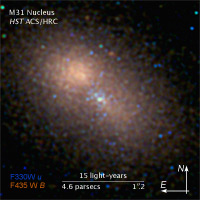
The Hubble Space Telescope has taken a close up of the double nucleus of the Andromedea galaxy, and found an interesting cluster of hot blue stars in between the two clusters.
Click on the image for the full resolution version of the image.
A fitting honor: The National Radio Astronomy Observatory (NRAO) has renamed the recently upgraded thirty-one year old Very Large Array (VLA) after Karl Jansky, the man who invented radio astronomy.
Karl Guthe Jansky joined Bell Telephone Laboratories in New Jersey in 1928, immediately after receiving his undergraduate degree in physics. He was assigned the task of studying radio waves that interfered with the recently-opened transatlantic radiotelephone service. After designing and building advanced, specialized equipment, he made observations over the entire year of 1932 that allowed him to identify thunderstorms as major sources of radio interference, along with a much weaker, unidentified radio source. Careful study of this “strange hiss-type static” led to the conclusion that the radio waves originated from beyond our Solar System, and indeed came from the center of our Milky Way Galaxy.
His discovery was reported on the front page of the New York Times on May 5, 1933, and published in professional journals. Jansky thus opened an entirely new “window” on the Universe. Astronomers previously had been confined to observing those wavelengths of light that our eyes can see. “This discovery was like suddenly being able to see green light for the first time when we could only see blue before,” said Lo.
The uncertainty of science: A Hubble Space Telescope study of massive galaxies two to three billion years after the Big Bang has challenged the widely accepted theory that major galaxy mergers are what make galaxies grow.
After 16 years in space, NASA’s Rossi X-ray Timing Explorer (RXTE) has finally been shut down.
RXTE far exceeded its original science goals and leaves astronomers with a scientific bounty for years to come. Data from the mission have resulted in more than 2,200 papers in refereed journals, 92 doctoral theses, and more than 1,000 rapid notifications alerting astronomers around the globe to new astronomical activity.
“The spacecraft and its instruments had been showing their age, and in the end RXTE had accomplished everything we put it up there to do, and much more,” said Tod Strohmayer, RXTE project scientist at Goddard. The decision to decommission RXTE followed the recommendations of a 2010 review board tasked to evaluate and rank each of NASA’s operating astrophysics missions.