
The National Science Foundation has declined until 2020 to commit to funding a giant American-built ground-based telescope

Bad news for American astronomy: The National Science Foundation has declined until 2020 to commit to any funding for either one of the two giant American-built ground-based telescopes.

For nearly a decade now, two university consortia in the United States have been in a race to build two ground-based telescopes that would be several times bigger than today’s biggest optical telescope. One group—led by the University of California—plans to build the Thirty Meter Telescope (TMT) in Hawaii. The other team—led by Carnegie Observatories, the University of Arizona, and other institutions—is developing a 28-meter behemoth named the Giant Magellan Telescope (GMT), which would be built in Chile. Over the past few years, both teams have raised tens of millions of dollars toward the billion-dollar-plus projects in the hope that the U.S. National Science Foundation (NSF) would come up with the balance.

But now, it turns out, neither project has a chance of receiving any significant funding from NSF for at least another decade. In a solicitation posted by NSF last week, the agency indicated that it does not expect to fund the building of any giant segmented mirror telescopes—that is, TMT or GMT—until the beginning of the 2020s. According to the solicitation, all that NSF can provide right now is $1.25 million over 5 years for the development of a public-private partnership plan that could eventually lead to the building of a large telescope, should NSF be in a position to fund such a telescope sometime in the next decade.

I suspect the NSF’s unwillingness to fund this project at this time is directly related to the budget crisis in Washington. Though the NSF got slightly more money in 2012 than in 2011, that money is all accounted for by other projects. There is no margin for anything new that will be as expensive (in the billions) as these giant telescopes will be.
0 comments

Want to see an asteroid eclipse a star?

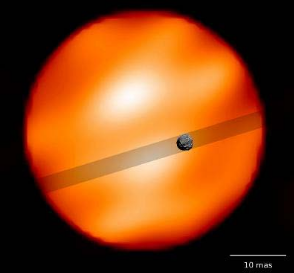
transit of Betelgeuse

On January 2, 2012, an asteroid is going to transit across the face of Betelgeuse. And if you live in Europe, own a very sensitive telescope, look close and don’t blink, you might be able to see it!

This is all according to a preprint paper published today on the Los Alamos astro-ph preprint website, written by scientist Costantino Sigismondi of the Galileo Ferraris Institute and International Center for Relativistic Astrophysics in Rome. You can download the paper here [pdf].

The transit itself will only last 3.6 seconds, and will only be visible along a narrow swath crossing southern India and moving across the Middle East, through parts of Italy, France, and the southwestern most tips of England and Ireland. A map of this path is below the fold.
» Read more

0 comments

A Sun-like Star with Three Sub-Neptune Exoplanets and Two Earth-size Candidates

Want to read the actual paper, “A Sun-like star with three sub-Neptune exoplanets and two Earth-size candidates,” describing the discovery announced yesterday of two Earth-sized planet? You can download it here.

The paper’s closing paragraph sums the discovery up nicely:

A striking feature of the Kepler-20 planetary system is the presence of Earth-size rocky planet candidates interspersed between volatile-rich sub-Neptunes at smaller and larger orbital semi-major axes, as also seen in Kepler candidate multi-planet systems. Assuming that both [Kepler-20e] and [Kepler-20f] are planets, the distribution of the Kepler-20 planets in orbital order is as follows: Kepler-20b (3.7 days, 1.9 Earth radii), [Kepler-20e] (6.1 days, 0.9 Earth radii), Kepler-20c (10.9 days, 3.1 Earth radii), [Kepler-20f] (19.6 days, 1.0 Earth radii), and Kepler-20d (77.6 days, 2.8 Earth radii). Given the radii and irradiation fluxes of the two Earth-size planet candidates, they would not retain gas envelopes. The first, second, and fourth planets have high densities indicative of solid planets, while the other two planets have low densities requiring significant volatile content. The volatile-rich third planet, Kepler-20c dominates the inner part of the Kepler-20 system, by holding much more mass than the other three inner planets put together. In the Solar System, the terrestrial planets, gas-giants, and ice giants are neatly segregated in regions with increasing distance from the sun. Planet formation theories were developed to retrodict these Solar System composition trends. In the Kepler-20 system, the locations of the low-density sub-Neptunes that are rich in water and/or gas, and the Earth-size planet candidates does not exhibit a clean ordering with orbital period, challenging the conventional planet formation paradigm. In situ assembly may form multi-planet systems with close-in hot-Neptunes and super-Earths, provided the initial protoplanetary disk contained massive amounts of solids (∼ 50–100 Earth masses) within 1AU of the star.

0 comments

First Earth-sized planets found

Big news: The first Earth-sized planets have been found by Kepler.

The two planets, dubbed Kepler-20e and 20f, are the smallest planets found to date. They have diameters of 6,900 miles and 8,200 miles – equivalent to 0.87 times Earth (slightly smaller than Venus) and 1.03 times Earth. These worlds are expected to have rocky compositions, so their masses should be less than 1.7 and 3 times Earth’s.

Both worlds circle Kepler-20: a G-type star slightly cooler than the Sun and located 950 light-years from Earth. (It would take the space shuttle 36 million years to travel to Kepler-20.) Kepler-20e orbits every 6.1 days at a distance of 4.7 million miles. Kepler-20f orbits every 19.6 days at a distance of 10.3 million miles. Due to their tight orbits, they are heated to temperatures of 1,400 degrees Fahrenheit and 800 degrees F.

Once again, this is only the beginning. The announcement of an Earth in the habitable zone is only a matter of months away.

2 comments

Former astronaut John Grunsfeld is to take over NASA’s science post from Ed Weiler

Excellent choice: Former astronaut John Grunsfeld has been picked to take over NASA’s chief science post from Ed Weiler.

Not only is Grunsfeld an excellent choice, his experience as an astronaut repairing Hubble will help improve relations between the science and manned space programs. In the past, scientists have often argued against manned space, trying to get that money for their unmanned research probes. Instead, when manned space got cut, so did science, and no one won. Grunsfeld’s leadership I think will forestall these short-sighted complaints.

0 comments

The supernova of a generation

The supernova of a generation.

There will be a slew of stories about this in the next few days. The important takeaways are as follows:

  • After almost a half century, astronomers have finally proven the theory that type Ia supernovae come from the explosion of a white dwarf star, overloaded with material sucked from its binary companion.
  • The prediction that the companion would be a red giant star, however, has turned out to be wrong. At the same time, astronomers still do not know what kind of star it was in this particular case.
  • With this new knowledge astronomers will have a better chance of identifying type Ia supernovae, before they go boom.
  • Finally, type Ia supernovae are used to measure the expansion rate of the universe, and thus were the key to discovering dark energy. By better understanding how these supernovae occur, cosmologists will be better able to constrain what they know about dark energy.
0 comments
1 158 159 160 161 162 188