
Tag: astronomy
Tracing the Canals of Mars
Water from comets
New results using the Herschel Space Telescope suggest that Earth’s water was brought here by comets.
Astronomers have found a dozen supernovae taking place closer to the Big Bang than ever detected.
Astronomers have found a dozen supernovae taking place only a few billion years after the Big Bang.
[The results suggest that these types of supernovae] were exploding about five times more frequently 10 billion years ago than they are today. These supernovas are a major source of iron in the universe, the main component of the Earth’s core and an essential ingredient of the blood in our bodies.
Aden Meinel, astronomer and innovator, has passed away
Aden Meinel, astronomer and innovator, has passed away.
Meinel, first director of the Kitt Peak Observatory, was the also first to conceive and try to build robotic telescopes that could be operated remotely. Many of his ideas were later incorporated both on the ground and in space.
The 2011 Nobel Prize for Physics has been awarded
The 2011 Nobel Prize for Physics has been awarded to the astronomers who discovered dark energy.
Saul Perlmutter from the Lawrence Berkeley National Laboratory and University of California, Berkeley, has been awarded half of this year’s prize for his work on the Supernova Cosmology Project, with the other half awarded to Brian P. Schmidt from the Australian National University and Adam G. Riess from the Johns Hopkins University and Space Telescope Science Institute, Baltimore, for their work on the High-z Supernova Search Team.
For an extraterrestrial skiing experience, Enceladus is the place to go.
Dawn begins close-up orbit observations
Dawn begins close-up orbit observations of Vesta. More new results here.
In this orbit, the average distance from the spacecraft to the Vesta surface is 420 miles (680 kilometers), which is four times closer than the previous survey orbit.
The world’s largest radio telescope has opened its eyes
The world’s largest radio telescope has opened its eyes.
NASA has identified ninety percent of the largest near-Earth asteroids
Data from the infrared telescope WISE has now identified ninety percent of the largest near-Earth asteroids.
NASA researchers also downgraded their estimate of the number of medium-sized asteroids, saying there are 44 percent fewer than previously believed. The downside is that scientists have yet to find many of these mid-sized asteroids, which could destroy a metropolitan city.
The coming blindness of astronomy
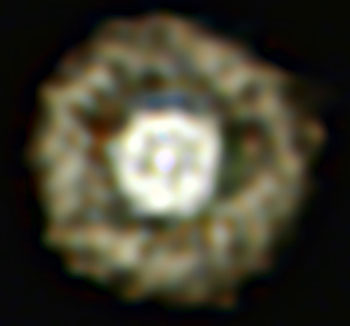
The European Southern Observatory today released this infrared image today of what astronomers have named the Fried Egg Nebula. Taken by the Very Large Telescope in Chile, the picture shows the concentric dust shells surrounding a post-red supergiant star, thought to be transitioning to the next stage of stellar evolution called a yellow hypergiant. As the press release explains,
The monster star, known to astronomers as IRAS 17163-3907, has a diameter about a thousand times bigger than our Sun. At a distance of about 13 000 light-years from Earth, it is the closest yellow hypergiant found to date and new observations show it shines some 500 000 times more brightly than the Sun. . . . If the Fried Egg Nebula were placed in the centre of the Solar System the Earth would lie deep within the star itself and the planet Jupiter would be orbiting just above its surface. The much larger surrounding nebula would engulf all the planets and dwarf planets and even some of the comets that orbit far beyond the orbit of Neptune. The outer shell has a radius of 10 000 times the distance from the Earth to the Sun.
Yellow hypergiants are in an extremely active phase of their evolution, undergoing a series of explosive events — this star has ejected four times the mass of the Sun in just a few hundred years. The material flung out during these bursts has formed the extensive double shell of the nebula, which is made of dust rich in silicates and mixed with gas.
According to the science paper [pdf] describing this research, the stage of yellow hypergiants is a preliminary to the star evolving into a luminous blue variable, of which Eta Carinae is the most famous. In this next stage a star is thought to have a good chance of going supernova.
Though this image is truely spectacular, taken by a ground-based telescope of a star 13,000 light years away, what I find most significant about this image is its fuzziness. It reminds me of the kind of images astronomers and the public routinely accepted as the best possible, before the launch of the Hubble Space Telescope.
» Read more
NASA science administrator Ed Weiler is retiring after 33 years
Science administrator Ed Weiler is retiring after almost 33 years at NASA.
Among Weiler’s many achievements, he was crucial to getting the Hubble Space Telescope launched. Even more important, though others had conceived the idea of using the shuttle to maintain Hubble, he designed the maintenance schedule for the telescope. Seven years before it was launched, he insisted that a regular schedule of repair missions be placed on the shuttle manifest. He also insisted that a duplicate of the telescope’s main camera be built, so that if anything went wrong with the first a repaired unit could be launched quickly. It was his foresight here that made the first repair of Hubble in December 1993 go so smoothly. For this, astronomers will always be grateful.