
A giant storm on a distant star

Astronomers have spotted what they think is a giant storm on a distant star.

As part of a large survey of nearby brown dwarfs โ€“ objects that occupy the mass gap between dwarf stars and giant planets โ€“ the scientists used an infrared camera on the 2.5m telescope at Las Campanas Observatory in Chile to capture repeated images of a brown dwarf dubbed 2MASS J21392676+0220226, or 2MASS 2139 for short, over several hours. In that short time span, they recorded the largest variations in brightness ever seen on a cool brown dwarf.

“We found that our target’s brightness changed by a whopping 30 per cent in just under eight hours,” said PhD candidate Jacqueline Radigan, lead author of a paper to be presented this week at the Extreme Solar Systems II conference in Jackson Hole, Wyoming and submitted to the Astrophysical Journal. “The best explanation is that brighter and darker patches of its atmosphere are coming into our view as the brown dwarf spins on its axis,” said Radigan.
0 comments

Unknown objects in space

Fermi list of object types

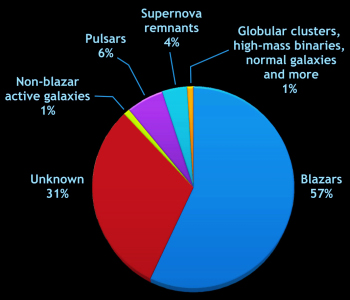
NASA’s Fermi Gamma-Ray Telescope today released an updated catalog of the last two years of its survey of the sky at high energy emissions. All told, there are 1873 objects in the catalog, more than half of which are supermassive black holes at the center of distant galaxies. You can see this all-sky map below the fold.

Many of the objects are quite familiar, such as the Crab Nebula, the remnant of a supernova that exploded a little less than a thousand years ago.

For decades, most astronomers regarded the Crab Nebula as the steadiest beacon at X-ray energies. But data from several orbiting instruments — including Fermi’s Gamma-ray Burst Monitor — now show unexpected variations. Astronomers have shown that since 2008, the nebula has faded by 7 percent at high energies, a reduction likely tied to the environment around its central neutron star.

Since 2007, Fermi and the Italian Space Agency’s AGILE satellite have detected several short-lived gamma-ray flares at energies hundreds of times higher than the nebula’s observed X-ray variations. In April, the satellites detected two of the most powerful yet recorded. To account for these “superflares,” scientists say that electrons near the pulsar must be accelerated to energies a thousand trillion times greater than that of visible light — and far beyond what can be achieved by the Large Hadron Collider near Geneva, Switzerland, now the most powerful particle accelerator on Earth.

What I, and many astronomers, find even most interesting about this catalog, however, is the large number of completely mysterious objects scattered across the sky, objects that emit powerful gamma rays but are not visible in any other wavelengths. All told, these unidentified objects comprise almost one third of the entire catalog.
» Read more

2 comments

Baby Star Found on Earth’s Doorstep

A baby star has been found only 27 light years away.

AP Columbae lies in the constellation Columba the Dove, south of the brilliant constellation Orion. “AP Columbae is still contracting under gravity towards the main sequence,” says astronomer Adric Riedel of Georgia State University in Atlanta, whose team measured the star’s parallaxโ€”an indication of its distanceโ€”and discovered that the star is abnormally luminous. Although the star is dim and red, it’s four times as bright as it should be, because it’s twice the diameter of a main-sequence star of the same color.

0 comments

Kepler team pushes for mission extension

The Kepler team pushes for a mission extension in order to find Earth-sized planets.

The Kepler spacecraft has hit an unexpected obstacle as it patiently watches the heavens for exoplanets: too many rowdy young stars. The orbiting probe detects small dips in the brightness of a star that occur when a planet crosses its face. But an analysis of some 2,500 of the tens of thousands of Sun-like stars detected in Kepler’s field of view has found that the stars themselves flicker more than predicted, with the largest number varying twice as much as the Sun. That makes it harder to detect Earth-sized bodies. As a result, the analysis suggests that Kepler will need more than double its planned mission life of three-and-a-half years to achieve its main goal of determining how common Earth-like planets are in the Milky Way.

While it is important to find those Earth-sized planets, to me the important discovery here is that Kepler is confirming what previous research has suggested: Stars like our Sun are generally far more active and variable than the Sun itself. Which means that either the Sun is unusual, or has been unusually inactive during recorded human history.

0 comments

The Hubble Space Telescope: Movie camera!

Using Hubble Space Telescope images taken over a 14 year period, a team of astronomers led by Patrick Hartigan of Rice University have produced six very short time-lapse movies, showing the changes that have occurred to a variety of interstellar jets and bow shocks over time. The one below is my favorite. They are all worth looking at, as they illustrate forcefully how the changeless heavens are not so changeless.

0 comments

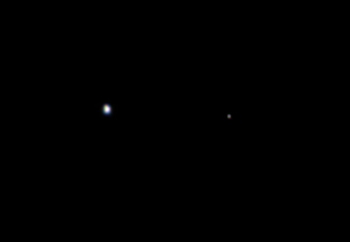
Juno looks back and sees the Earth and the Moon

Earth and Moon

Juno, on its way to Jupiter, took a look back and snapped this picture of the Earth/Moon double planet.

The image was taken by the spacecraft’s camera, JunoCam, on Aug. 26 when the spacecraft was about 6 million miles (9.66 million kilometers) away.

Gives us a glimpse at what our home planet will really look like to future spacefarers, either on they way out or on their way home.

1 comment
1 164 165 166 167 168 188