
The variability of stars according to Kepler

More data from Kepler! In a paper [pdf] published today on the astro-ph website, scientists outline Kepler’s census of the variability of stars. Key quote from the abstract:

We have separated the sample in 129,000 dwarfs and 17,000 giants, and further sub-divided, the luminosity classes into temperature bins corresponding approximately to the spectral classes A, F, G, K, and M. G-dwarfs are found to be the most stable with < 20% being variable. The variability fraction increases to 30% for the K dwarfs, 40% for the M and F dwarfs, and 70% for the A-dwarfs. At the precision of Kepler, > 95% of K and G giants are variable.
0 comments

Amateur detection of Jupiter impact

The detection in June by two different amateur astronomers of an impact on Jupiter bodes well for asteroid/comet research. You can read the actual paper here. [pdf] Key quote from the abstract:

A systematic study of the impact rate and size of these bolides can enable an empirical determination of the flux of meteoroids in Jupiter with implications for the populations of small bodies in the outer Solar System and may allow a better quantification of the threat of impacting bodies to Earth. The serendipitous recording of this optical flash opens a new window in the observation of Jupiter with small telescopes.

0 comments

As imagined by SF authors: the Celestial Spiral

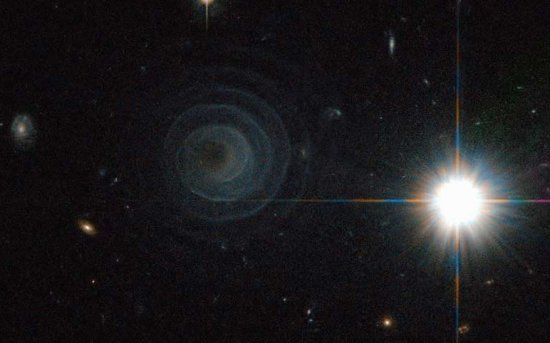
This amazing Hubble image, showing a strange spiral to the left of the bright star, is not of a galaxy. Instead, it is a binary star system where the material from one star is being sucked away from it by the other, thus producing the spiral pattern.

celestial spiral

What is most fascinating about this discovery is that this kind of phenomenon has been predicted for decades, by both astronomers and science fiction writers. Consider for example this quote from Larry Niven from his short story, The Soft Weapon, where he describes what he thinks the binary star Beta Lyrae might look like:

There was smoke across the sky, a trail of red smoke wound in a tight spiral coil. At the center of the coil was the source of the fire: a double star. One member was violet-white, a flame to brand holes in a human retina, its force held in check by the polarized window. The companion was small and yellow. They seemed to burn inches apart, so close that their masses had pulled them both into flattened eggs, so close that a red belt of lesser flame looped around them to link their bulging equators togehter. The belt was hydrogen, still mating in fusion fire, pulled loose from the stellar surfaces by two gravitional wells in conflict.

The gravity did more than that. It sent a loose end of the red belt flailing away, away and out in a burning Maypole spiral that expanded and dimmed as it rose toward interstellar space, until it turned from flame-red to smoke-red, bracketing the sky and painting a spiral path of stars deep red across half the universe.

0 comments

New exoplanets

Exoplanet news! Scientists today announced the discovery of a host of planets, all orbiting a single star similar to the Sun. Though five are Neptune-sized, a sixth (not yet confirmed) might be the size of Earth. What makes this even more exciting is that the astronomers made the discovery using a ground-based telescope.

But wait, there’s more! Thursday NASA will hold a press conference about a new discovery by Kepler!

0 comments

Not a black hole?

European scientists, using the Very Large Telescope at the European Southern Observatory, have determined that a magnetar (a neutron star pulsar with an extremely strong magnetic field) was formed from a star with a mass 40 times that of the Sun. This is a significant discovery, as most theories say that any star this heavy should instead become a black hole when it dies. That this particular star instead became a neutron star challenges present astronomical theory.

0 comments

Astronomers announce their recommendations for the next decade

After two years of discussion among hundreds of astronomers, the committee for the 2010 Decadal Surveyn for Astronomy and Astrophysics announced its recommendations today. The two main recommendations were

The report also called for the federal government to become a partner in one of the two giant ground-based optical telescopes now in the planning stages. In addition, the report recommended that the government increase its participation in the Laser Interferometer Space Antenna (LISA), a space telescope designed to detect gravity waves, as well as commit monies to begin the design work for a new high resolution X-ray space telescope. Other recommendations including asking NASA to increase its support for medium-sized space telescopes.

The report did not recommend any replacement for the Hubble Space Telescope.

This report follows earlier decadal surveys, for the 1970s, 1980s, 1990s, and 2000s, all of which had enormous influence on what federal agencies and astronomers built over the following decade. For example, these decadal surveys recommended the construction of the VLA, the Chandra X-Ray Observatory, the Spitzer Space Telescope, and a host of other telescopes, all of which were built.

0 comments

Webb costs threaten space science

The continuing cost overruns for the James Webb Space Telescope threaten future space science missions, according to NASA, even as astronomers are about to announce their recommendations for what NASA should do in the next decade. Note that I will be attending the 11 am press conference on the new decadal survey, and hope to post from there.

0 comments

Is it a planet or not?

An object, initially announced in 1998 to be the first planet ever photographed, then rejected as a planet when data suggested it was too hot, is now being resurrected as a possible planet. Key quote by Adam Burrows of Princeton University:

[If true] this would punctuate one of the strangest episodes in the history of the emerging field of exoplanet research. If false, it would be one more warning that numerous pitfalls await the intrepid astronomer in search of planetary gold beyond the solar system.

0 comments
1 184 185 186 187 188