Update on Superheavy/Starship: Both ships doing final static fire testing

Link here. The report includes a lot of very interesting information about how SpaceX is evolving its launch platforms and the tank farms that fuel the stages in order to make them operate more efficiently. For example:

In the past, on Pad 1, SpaceX had only four Liquid Oxygen (LOX) Pumps and six subcoolers, and three Liquid Methane (LCH4) Pumps with three subcoolers. This setup allowed SpaceX to start booster load at T-41:15 on Flight 11.

On Pad 2, SpaceX has five pumps and about 10 subcoolers worth of capacity on the LOX side, and four pumps alongside about six subcoolers worth of capacity on the LCH4 side. With these upgrades, along with larger supply lines, SpaceX can now load a full booster within 30 minutes, and each LOX ring takes only about 90 seconds to load. This now means SpaceX can load the Superheavy booster faster than a Falcon 9 and carry over 10 times the propellant. [emphasis mine]

Many of the tests have been more to prove out the fueling systems and launchpad than to test Superheavy.

Other tests however have been to prove out the new Raptor-3 engine. The company have increased the number of engines step by step so that the next test will be the first to test all 33 engines. I suspect that test will also be the full dress rehearsal countdown prior to launch.

Starship meanwhile is undergoing testing on the company’s nearby Massey test stand, the one that I think was rebuilt after an explosion last year.

Stay tuned. It appears the next and 12th orbital test flight will not be long in coming.

6 comments

Three launches, two by SpaceX and one by China

Falcon 9 landing for its seventh time
Falcon 9 landing for its seventh time on today’s
third launch. See below.

Since last night there were three launches globally, two by SpaceX, and one by China.

First, in the wee hours of the morning SpaceX placed 25 more Starlink satellites into orbit, its Falcon 9 rocket lifting off from Vandenberg Space Force Base in California. The first stage (B1063) completed its 32nd flight, landing on a drone ship in the Pacific. With this flight, 43 days after the stage’s previous flight, it moved into a tie for fourth place in the rankings of the most reused launch vehicle:

39 Discovery space shuttle
34 Falcon 9 booster B1067
33 Atlantis space shuttle
32 Falcon 9 booster B1071
32 Falcon 9 booster B1063
30 Falcon 9 booster B1069
28 Columbia space shuttle
27 Falcon 9 booster B1077
27 Falcon 9 booster B1078

Sources here and here.

Next China launched a classified satellite to test “internet technology”, its Smart Dragon-3 (Jielong-3) rocket lifting off from a sea platform in international waters in the South China Sea. Though China has launched numerous times from this sea platform, previous launches were very close to the shore. This was the first time the platform was moved this far into the ocean.

Finally, SpaceX completed its second launch in less than eight hours, sending Northrop Grumman’s Cygnus capsule on its way to ISS with 11,000 pounds of cargo, its Falcon 9 rocket lifting off from Cape Canaveral Space Force Station in Florida. The first stage completed its seventh flight, landing back at Cape Canaveral. Of the two fairings, one was making its first flight, while the other was on its fifth flight.

This was SpaceX’s fourth Cygnus launch for Northrop Grumman. The company originally launched Cygnus on its own Antares rocket, but when that rocket ran out of its Russian first stage engines it was grounded. The company hired Firefly to build a new first stage, but that project remains uncompleted.

Cygnus is scheduled to berth with ISS in two days, on Monday, April 13, at 12:50 pm (Eastern).

The leaders in the 2026 launch race:

44 SpaceX
19 China
5 Rocket Lab
5 Russia

For the third straight year SpaceX continues to lead the entire world combined in total launches, 44 to 34.

28 comments

Amazon to begin commercial availability of Leo internet service in mid-2026

Amazon Leo logo

In an annual letter [pdf] to shareholders, Amazon’s CEO Andy Jassy announced the company plans on inaugurating its Leo internet constellation to customers in “mid-2026,” assuming the company can get a significant more satellites in orbit in the next few months.

Jassy’s wording was interestingly vague, however, suggesting this target date is very uncertain.

Over the last seven years, we’ve built a low Earth orbit satellite network (Amazon Leo) and put more than 200 satellites into space (which is the third-largest low Earth orbit network operating today). With a few thousand more satellites launching in the coming years, the constellation is expanding rapidly.

…While Amazon Leo is officially scheduled to launch in mid-2026, we already have meaningful revenue commitments from enterprises and governments.

To be precise, Amazon presently has launched 241 satellites, out of the 1,616 it needs to launch by July 2026 to meet its FCC license requirement. Because it is not expected to meet that requirement, the company has asked for a time extension, which the FCC is presently considering. The entire first generation constellation is supposed to have 3,232 satellites, so it seems unlikely Amazon will be able to provide internet service by mid-2026, as promised. It won’t have enough coverage with less than a fourth of its constellation in orbit.

0 comments

Now on Starlink!

Starlink logo

My posting this afternoon today was interrupted because I was spending the day going up and down from my roof as I and friend Ken worked to install my new Starlink antenna.

As always with these kinds of jobs, there were moments that reminded me of a motto of mine when I used to assembly Ikea furniture as a part-time job: “It’s ‘Do everything twice day!'” In the end, the problems were minor and quickly solved, such as discovering that the Starlink ethernet cable from the power supply to the router could only be plugged in in one direction. The plugs on either end looked identical, but we struggled for almost twenty minutes trying to get the plug to click into the router, to no avail. Then a light bulb went off, and we decided to flip the cable. Lo and behold, both ends clicked in instantly.

Setting up the account and the Wi-Fi and the computers went very quickly, mostly thanks to my lovely wife Diane. Starlink only allows you to do this stuff on a smart phone, and I won’t touch one of those with a 200-foot pole. She got it all going within a very short time.

I had hesitated doing this for the past two years, mostly because it involved a lot of other non-Starlink-related time-consuming stuff too boring to describe but that we both wanted to avoid. We finally got that stuff taken care of in the past month and could make the switch.

The Zimmerman household is linked to the world, through space. Seems entirely appropriate.

14 comments

European Union to restructure its space bureaucracy

The European Union
This label would be more accurate if it read
“NOT made in the European Union”

The European Commission of the European Union (EU) announced earlier this week that it is renaming its “European Union Agency for the Space Programme” to the “European Union Space Services Agency (EUSPA)”, with the new agency aimed at running the EU’s various satellite projects, including its Galileo GPS-type constellation, its proposed communications constellations, and its various European security satellite projects.

The proposed regulatory document can be read here [pdf]. More details can be found here:

In the text of the draft regulation, the Commission says the agency is expected to play a crucial role in implementing Union space systems and wider space policy from 2028 to 2034 as part of the European Competitiveness Fund. That places the agency firmly inside the next generation of EU planning for satellite navigation, Earth observation, secure connectivity, space situational awareness and related civil and defence applications.

One of the clearest elements in the proposal is the agency’s planned renaming. The draft regulation states that the current European Union Agency for the Space Programme would become the European Union Space Services Agency. The Commission says this is meant to reflect more accurately the body’s current and future role as an operational actor supporting the delivery of Union space systems rather than simply administering a programme framework. That change in title is therefore intended to signal a broader institutional shift rather than a cosmetic rebranding.

The language above as well as the actual regulation itself I think illustrates well why the European Union is increasingly falling behind the rest of the world in space. The wording is obtuse, complex, and jargon-filled, often aimed at making things seem more significant than they really are.

The number of different bureaucracies involved is also a bad sign. On top is the EU. Under that is the European Commission. Below that is this new agency EUSPA. On the side is the European Space Agency, which though it will have a representative at all EUSPA meetings the division of responsibilities between it and EUSPA is very unclear.

All told, everything about this document and the government bureaucracies involved seems designed to do things slowly and in a manner guaranteed to cost more.

No wonder many member nations of the EU and ESA have decided to go their own way, even as they politely maintain membership in these organizations. Germany, France, Spain, and Italy are all now pushing the development of new commercial independent space companies within their borders, all attempting to launch similar space assets, but with the ability to eventually do it faster and cheaper.

I would expect those new private companies will soon eclipse anything proposed by EUSPA in the coming decade.

5 comments

ESA paid Arianespace about $96 million for an Ariane-6 launch

According to a story today on European Spaceflight, the European Space Agency (ESA) paid its commercial division Arianespace €82 million [about $96 million] for its Ariane-6 launch in November 2025 of ESA’s Earth observation Sentinel-1D satellite.

The European Space Agency has disclosed that launching the Sentinel-1D Earth observation satellite aboard an Ariane 62 rocket in November 2025 cost €82,070,773. As part of its involvement in the development of the European Union’s Copernicus Earth observation satellite constellation, ESA is responsible for placing contracts with European industry for the development, launch, and operation of satellites. As part of this responsibility, the agency publishes an annual list of all contracts awarded with a value of more than €15,000. In 2025, this included the disclosure of the cost of launching Sentinel-1D aboard an Ariane 6 rocket in its two-booster variant [dubbed Ariane-62].

This is the first time ESA or Arianespace have revealed any price figures for using Ariane-6, and shows that Arianespace is attempting to price Ariane-6 competitively with SpaceX’s Falcon 9 rocket. The article notes that SpaceX charged ESA about $90 million for an earlier Sentinel launch.

Because Falcon 9 is mostly reusable, SpaceX’s profit margin is far higher than Arianespace’s. Ariane-6 is expendable, and thus costs more. Thus, if necessary SpaceX could significantly lower its price, but hasn’t because it hasn’t yet felt any competitive pressure to do so. When the new reusable rockets from Stoke Space and Rocket Lab begin launching sometime this year, then launch prices will drop considerably, and Ariane-6 will find itself very over-priced, with no way to lower its cost enough to compete.

3 comments

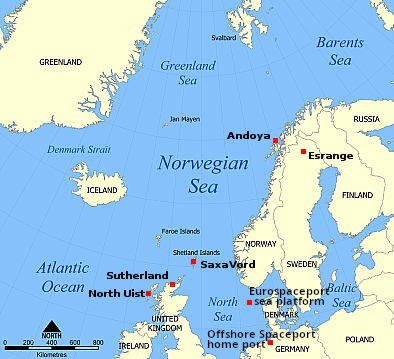
Saxavord spaceport lost about $7 million in both ’23 and ’24; Andoya launch scheduled for today

Proposed or active spaceports in North Europe

According to a report in the Times of London yesterday, the Saxavord spaceport on the Shetland Islands lost about $7 million in both ’23 and ’24.

Annual accounts for Shetland Space Centre, the SaxaVord operating company, show a near 32 per cent rise in revenue to £2.5 million for 2024. The document, recently lodged at Companies House, shows a £5.4 million [$7.25 million] pre-tax loss, compared to £5.1 million [$6.85 million] in 2023.

The spaceport is controlled by billionaire Anders Holch Povlsen, who had been instrumental in using the courts to block launches from the other proposed spaceport in Sutherland, Scotland. Saxavord meanwhile was first proposed about four years ago, but it has also not yet had its first launch. In both cases, the major obstacle has been the United Kingdom’s regulatory bureaucracy run by its Civil Aviation Authority, which has taken years to issue permits and licenses. Those delays have bankrupted two rocket companies, Virgin Orbit and Orbex, because they were unable to launch as scheduled.

Saxavord hopes its first launch will occur later this year, from the German rocket startup Rocket Factory Augsburg. That company had hoped to launch in 2024 — after more than a year delay due to red tape — but an explosion during the final static fire test of the first stage ended those plans.

Meanwhile, the first orbital launch from Norway’s Andoya spaceport is now expected later today by the German rocket startup Isar Aerospace. This will be the second launch of its Spectrum rocket, the first failing just after lift-off in 2025. This second attempt had been scrubbed in January and March, and is now scheduled for 1 pm (Pacific) today. I have embedded its live stream below.
» Read more

1 comment

Update on SpaceX’s Starship/Superheavy launchpad improvements at Boca Chica

Link here. The article provides many details about the design improvements and testing that SpaceX is doing at the Boca Chica launchpad prior to the next Starship/Superheavy orbital test flight, now expected sometime in mid-May.

All the improvements appear designed to allow for quicker reuse of the pad, including protecting it better when both Starship and Superheavy return to be captured by the chopstick towers. For example:

On the tower, work has progressed on the Ship Quick Disconnect (SQD) arm, which connects to the Starship upper stage for propellant loading. This week, technicians added steel reinforcements to the lower side of the arm’s shoulder section. These additions are believed to strengthen the structure while enabling the arm to retract more quickly during launch.

A faster swing-out reduces the risk of damage from the intense exhaust plume of Super Heavy’s 33 Raptor engines at liftoff. This improvement should minimize post-launch refurbishment and contribute to a higher launch cadence. The core work on the SQD arm itself appears largely complete, and scaffolding may soon be removed as final preparations continue.

Other work includes a new tower roof structure to protect it from the rocket’s engine exhaust, and other work on the pad itself to facilitate faster fueling. These additions have been accompanied by testing to make sure they work.

All this work appears intended to make it possible to launch frequently once the next test launch is completed.

10 comments

Orbital repair startup Starfish raises $100 million in private investment capital

Remora rendezvous
Images taken by Starfish’s camera.

The orbital servicing startup Starfish Space has now raised an additional $100 million in private investment capital, in addition to the $29 million raised previously.

Seattle-based Starfish announced April 7 it closed a Series B round led by Point72 Ventures, raising more than $100 million. Activate Capital and Shield Capital co-led the round, with major participation from Industrious Ventures and NightDragon. Several other new and existing investors were also part of the funding round.

…The company, which raised $29 million in November 2024, says the funding will enable it to scale up production of its Otter line of spacecraft designed for in-space servicing of other spacecraft. The company has won several contracts from government and commercial customers for missions to extend the lives of satellites or deorbit defunct satellites.

Starfish has already won contracts to do a variety of demo and satellite repair missions with the military (see here, here, and here) totaling about $144 million.

This financial success has occurred despite the fact that Starfish’s Otter servicing robot has yet to dock and repair any satellite. It has done two rendezvous and proximity demo missions, the second of which was supposed to do a docking but could not when the owner of the target satellite backed out of the project. The Otter-2 robot is still working in orbit, but the company has not been able to find a new target spacecraft to dock to. The company has also demonstrated its camera on another company’s orbital tug, as shown by the images above.

1 comment

Astroscale to fly mission to rendezvous and inspect two different satellites

Screen capture of ISSA-J1 operations around ALOS
Click for full animation.

The Japanese orbital tug company Astroscale this week announced a 2027 mission to fly an inspector satellite to rendezvous and inspect closely two different defunct satellites in different orbits.

The ISSA-J1 mission will inspect two retired Japanese satellites launched in the early 2000s. By approaching them in orbit, ISSA-J1 will observe their current condition more than 20 years after launch, including their attitude, rotation behavior and signs of degradation. The mission will conduct close‑range observations of multiple objects, closer than traditional monitoring methods, demonstrating new possibilities for on‑orbit inspection services.

The screen capture graphic to the right shows ISSA-J1’s proximity flight path around the first defunct satellite, ALOS, which was an Earth resource satellite that operated from 2006 to 2011. After completing its inspection of ALOS, it will then move into a higher orbit to inspect ADEOS‑II, another Earth observation satellite that operated in 2003.

Astroscale has already demonstrated it can do these kinds of inspection missions with its ADRAS-J mission, which flew within fifty feet of an abandoned rocket upper stage. Its eventual goal is to do space junk removal missions, grabbing this kind of space junk and de-orbiting it.

0 comments

Northrop Grumman’s Minotaur-4 rocket launches three payloads for War Department

Northrop Grumman early this morning successfully placed three experimental payloads into orbit for the War Department’s Naval Research Laboratory (NRL), its Minotaur-4 rocket lifting off from Vandenberg Space Force Base in California.

NRL’s payloads included the Lasersheet Anomaly Resolution and Debris Observation (LARADO) instrument; the Global Navigation Satellite System (GNSS) Orbiting Situational Awareness Sensor (GOSAS); and the Gadolinium Aluminum Gallium Garnet (GAGG) Radiation Instrument (GARI-1C).

The first is testing new methods for tracking space junk, the second improved GPS-type location and navigation for military operations, and the third new gamma-ray detection technology for tracking nuclear tests.

This was Northrop Grumman’s first launch in 2026, so the leader board for the 2026 launch race remains unchanged:

42 SpaceX
16 China
5 Rocket Lab
5 Russia

SpaceX continues to lead the entire world combined in total launches, as it did in both ’24 and ’25.

3 comments

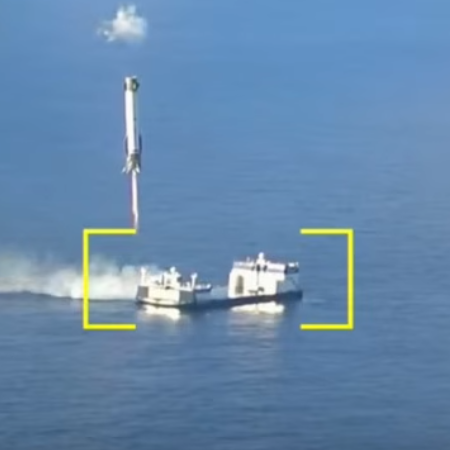
Firefly signs deal with modular sea launch startup Seagate

The startup Seagate, which is building a modular sea launch platform for any rocket company, has now signed a partnership deal with the rocket company Firefly to jointly develop that sea platform.

Seagate Space Corporation announced today a Memorandum of Understanding (MOU) with Firefly Aerospace to collaborate on the development of an offshore launch platform that enables a sea-based launch capability for Firefly’s Alpha rocket. This collaboration marks a significant milestone in expanding responsive, resilient launch solutions for the rapidly growing space economy.

Under the MOU, Seagate Space is working closely with Firefly to mature the design of an integrated offshore launch system capable of supporting the unique requirements of liquid-fueled orbital rockets. Central to this development is the integration of Seagate Space’s Gateway Series, the industry’s first purpose-built offshore spaceport designed specifically for launch operations.

Firefly presently has one operational launchpad, at Vandenberg, though it has a deal to launch its Alpha rocket from Sweden’s Esrange spaceport as well as a lease for a pad at Cape Canaveral. It has also been studying launching from a proposed commercial spaceport in northern Japan. Apparently, the company wants more spaceport options, and a sea platform gives it the most flexibility.

4 comments
1 9 10 11 12 13 677