
Chang’e 2 has reached L2 almost a million miles from Earth
China’s lunar probe, Chang’e 2, has reached the L2 point in space, almost a million miles from Earth.
China’s lunar probe, Chang’e 2, has reached the L2 point in space, almost a million miles from Earth.
China has delayed the launch of its first space station due to the failure of an earlier rocket launch.
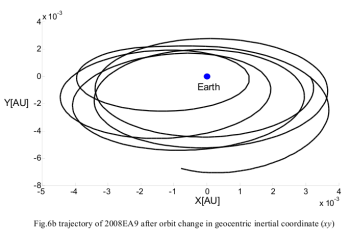
Want to mine an asteroid? Rather than travel to it with all their mining equipment, three Chinese scientists have proposed a better way. In a paper published today on the Los Alamos astro-ph preprint website, they have calculated the energy required to shift the orbits of the six thousand near-Earth asteroids and place them in Earth orbit for later mining. Of these, they found 46 asteroids that had the potential for such an operation, and two likely candidates for a space mission. One 30-foot-wide asteroid, 2008EA9, will actually be in the right place for this technique in 2049. As they write,
It can be seen that the velocity increment of the 2008EA9 is relatively small (-1.00km/s) and it will very close approach [approximately 645,000 miles] to the Earth in [February] 2049. Moreover the size of the NEO 2008EA9 is very small so that the capturing of it is relatively easy.
The real problem, of course, is adding that small “velocity increment” to the asteroid.
» Read more
Another rocket launch failure today, this time by the Chinese.
A discovery in Nebraska of rare earth minerals appears set to challenge China’s monopoly.
To me these were the key quotes from this article:
The U.S. used to produce rare earths through the Mountain Pass Mine in California, but it was shut down in 2002, primarily because of environmental concerns, including the spillage of hundreds of thousands of gallons of water carrying radioactive waste into a nearby lake.
and
Although studies have shown the U.S. has 13 million metric tons of rare-earth minerals, National Mining Association spokeswoman Carol Raulston said it does not mine any of it – partly as a result of the difficulty of obtaining permits. “One of the key problems that investors tell us about is that the permitting regime in this country is so complicated and time-consuming that it has hurt investments here in the United States,” Ms. Raulston said.
Tiangong-1 is not a space station hub.
A look at the Chinese space program.
China’s first space station module, Tiangong-1, has been shipped to the launchpad for final checkout, in preparation for its launch later this year.
On Monday China successfully launched its second data relay satellite, expanding its space communications network in preparation for before its first unmanned rendezvous and docking attempt later this year.
The launch of China’s first space station module is now set for September.