
Why the Endangered Species act doesn’t work

Why the Endangered Species Act doesn’t work.

[R]adical green groups . . . [are] engaged in an industry whose waste products are fish and wildlife. You and I are a major source of revenue for that industry. The Interior Department must respond within 90 days to petitions to list species under the Endangered Species Act. Otherwise, petitioners like the Center for Biological Diversity get to sue and collect attorney fees from the Justice Department.

And this:

Amos Eno runs the hugely successful Yarmouth, Maine-based Resources First Foundation, an outfit that, among other things, assists ranchers who want to restore native ecosystems. Earlier, he worked at Interior’s Endangered Species Office, crafting amendments to strengthen the law, then went on to direct the National Fish and Wildlife Foundation. Eno figures the feds could “recover and delist three dozen species” with the resources they spend responding to the Center for Biological Diversity’s litigation.

“The amount of money [Center for Biological Diversity] makes suing is just obscene,” he told me. “They’re one of the reasons the Endangered Species Act has become so dysfunctional. They deserve the designation of eco-criminals.”
1 comment

Fossil fuels to the rescue

Fossil fuels to the rescue! A liberal discovers the value of natural gas and fracking.

The arguments for converting the U.S. economy to wind, solar and biomass energy have collapsed. The date of depletion of fossil fuels has been pushed back into the future by centuries — or millennia. The abundance and geographic diversity of fossil fuels made possible by technology in time will reduce the dependence of the U.S. on particular foreign energy exporters, eliminating the national security argument for renewable energy. And if the worst-case scenarios for climate change were plausible, then the most effective way to avert catastrophic global warming would be the rapid expansion of nuclear power, not over-complicated schemes worthy of Rube Goldberg or Wile E. Coyote to carpet the world’s deserts and prairies with solar panels and wind farms that would provide only intermittent energy from weak and diffuse sources.

4 comments

IPCC announces reforms for next report

The IPCC announced this week it has established new procedures in an effort to avoid the problems that occurred with the last report.

I remain very skeptical of these reforms, as well as anything this UN organization publishes. Consider this quote for example:

On the issue of citing non-peer-reviewed literature, such as reports from nongovernmental organizations and climate activists, the new procedures say that IPCC report authors can include such documents “as long as they are scientifically and technically valid. [emphasis mine]

How convenient. Decide that something written by Greenpeace is “scientifically and technically valid” and you can use it as evidence.

1 comment

The science remains uncertain

Two papers published this week by the American Geophysical Union once again indicate that the science of climate change remains exceedingly uncertain. More significantly, the models that try to predict the future of the Earth’s climate continue to appear unreliable, with such large margins of error that it is at this time foolish to make any policy based on their predictions.

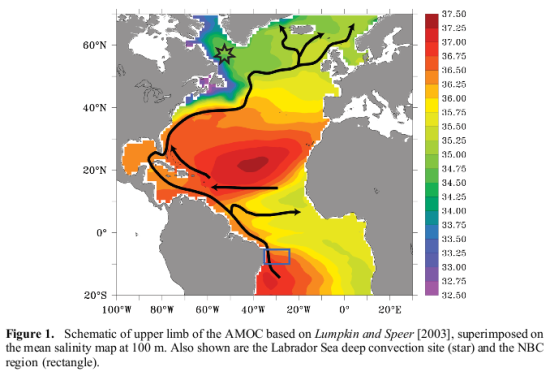
diagram of Atlantic currents

The first paper took a close look at the deep water currents in the Atlantic to see if it could track changes to what the authors’ call the Atlantic meridional overturning circulation (AMOC), more generally referred to as the Atlantic conveyor belt. This conveyor belt begins with the sinking of salty dense water in the northeast Atlantic off of Europe and Africa. The deep water current then travels south and into the Indian and Pacific Oceans where it comes to the surface only to flow back to the Atlantic, traveling north along the coast of North America as the Gulf Stream, bringing with it the warm temperatures that make Europe’s climate much warmer than its latitude would normally suggest.

According to most global warming models, higher temperatures should cause the glaciers in the Arctic and Greenland to melt, thereby pouring an increased amount of fresh water into the North Atlantic. This infusion of fresh water is then expected to lower the salinity and density of the Atlantic water, thus preventing it from sinking and thus acting to slow the conveyor belt, and possibly even causing it to shut down. The consequence would be no more Gulf Stream to warm the climate of Europe.

In other words: Disaster! Death! Destruction! All caused by global warming!

Unfortunately for these global warming models, the paper above found no trend at all. The conveyor belt is not slowing, as predicted. To quote the paper’s abstract:
» Read more

1 comment
1 67 68 69 70 71 84