
Climate change is a serious problem, but the solutions are a joke
This from someone who believes in climate change: “The solutions are a joke.”
This from someone who believes in climate change: “The solutions are a joke.”
The predictions of disaster from the first Earth Day, 1970. I especially like this one:
“Demographers agree almost unanimously on the following grim timetable: by 1975 widespread famines will begin in India; these will spread by 1990 to include all of India, Pakistan, China and the Near East, Africa. By the year 2000, or conceivably sooner, South and Central America will exist under famine conditions. . . . By the year 2000, thirty years from now, the entire world, with the exception of Western Europe, North America, and Australia, will be in famine.” Peter Gunter, professor, North Texas State University [emphasis mine]
A consensus was reached and the science was settled!
Remember this the next time some blowhard global-warming pundit tries to claim “the science is settled” today.
“Our conclusion was there is no benefit to the environment of oxo-degradable plastics.”
Instead, they say burn them!
Confusion in the environmentalism movement: A global warming activist discovers that anti-nuclear activists lie!
This is wrong, if true: The chief of the UK’s Met Office said yesterday that he has received death threats from climate change skeptics.
A Met Office spokesman confirmed Mr Hirst had received death threats made in a number of ”unsavoury emails”, but said they were ”isolated incidents” and the organisation had not felt it necessary to involve the police.
The UN loses 50 million nonexistent climate refugees, predicted by them in 2005 to overwhelm us by 2010.
The pigs win: Funding for the IPCC restored to budget in 2011 budget deal.
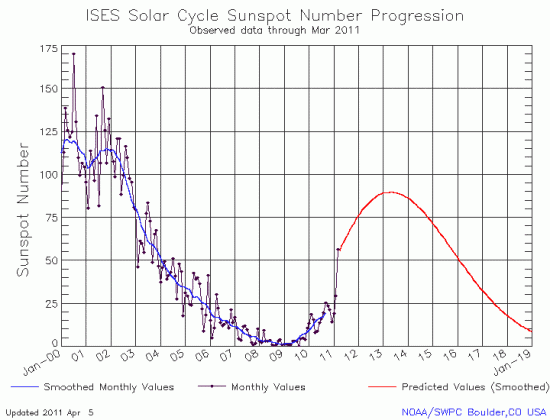
After literally years of inactivity, well below all initial predictions, the Sun truly came to life this past month. Below is the March monthly update of the Sun’s sunspot cycle, published by NOAA’s Space Weather Prediction Center. The red curve is the prediction, while the dotted black line shows the actual activity.
As you can see, the Sun’s sunspot activity shot up precipitously. Though I don’t have the data from past years, the March jump appears to me to probably be one of the fastest monthly rises ever recorded.
Does this mean the newest prediction from the solar scientists at the Marshall Space Flight Center calling for a weak solar maximum in 2013 is wrong? Probably not, though of course in this young field who knows? I would say, however, that the overall trend of the data still suggests the next maximum will be very weak.
Stay tuned! The next few months should finally give us a sense of where the next maximum is heading.
Will the EPA lose control of greenhouse gas rules?
The article above, written for the journal Science, is clearly on the side of the EPA. Nonetheless, it does outline well the political dynamics of this regulatory battle between the EPA and Congress.
I thought the banning of CFCs was going to change this? March sets a record for ozone loss over the Arctic.
Or to put it another way, climate science is far more complicated than too many climate scientists want to admit.
EPA whistleblower slams global warming science and policy in new peer-reviewed study. The paper’s conclusion:
The scientific hypotheses underlying global warming alarmism are overwhelmingly contradicted by real-world data, and for that reason economic studies on the alleged benefits of controlling greenhouse gas emissions are baseless.
Comparing the view of Earth, interpreted differently by Russian and American satellites.