
Mann and company write more science fiction

Junk science: Michael Mann and associates have just released a paper claiming “The rate of sea level rise along the U.S. Atlantic coast is greater now than at any time in the past 2,000 years–and has shown a consistent link between changes in global mean surface temperature and sea level.” You can read the paper itself here.

For many, many, many reasons, I agree here with scientist Richard Mueller, who believes in global warming but also believes in good science, “I now have a list of people whose papers I won’t read anymore.”

Nonetheless, I have looked at this new paper by Mann and crew, and find its evidence so weak it ain’t worth the paper it’s written on. To look at the record of a single fossil and claim it is a sufficient proxy for sea level rise is downright laughable.
1 comment

The failed predictions of global warming activists

The failed predictions of global warming activists.

In 2005 “the United Nations Environment Programme (UNEP) and the United Nations University declared that 50 million people could become environmental refugees by 2010, fleeing the effects of climate change.” Three years later . . . Srgjan Kerim, president of the UN General Assembly, said it had been estimated that there would be between 50 million and 200 million environmental migrants by 2010. A UNEP web page showed a map of regions where people were likely to be displaced by the ravages of global warming. It has recently been taken offline but is still visible in a Google cache.

0 comments

The battle between global warming and the sun

The revelation last week that the sun is very likely about to go into a period of little or no sunspot activity has made a lot of global warming advocates, both scientists and journalists, very nervous. For years these climate activists have declared that the Earth’s climate is getting warmer, and that this warming trend was going to do us great harm. Putting aside whether these claims are based on fact (they are not), the possibility that the Earth might instead become cooler because of a dimming of the sun puts this political agenda under threat, and requires some form of immediate action to defuse that threat. See for example this short podcast (with full transcript) from Scientific American. The key quote:

A cooler sun might mean a drop in global average temperatures of at most 0.3 degree Celsius. But the carbon dioxide already in the atmosphere today will add 0.6 degree Celsius to global average temperatures by the end of the century. And more, since greenhouse gas emissions show no signs of diminishing. So the slightly cooler sun won’t counteract a much hotter Earth.

In order to discredit the threat that solar variation poses to global warming, the journalist here acts to minimize any danger from a dimming sun. Unfortunately, he does so by extrapolating a result (warmer climates) based on a very weak foundation: an unproven theory and our very limited knowledge of the climate.
» Read more

10 comments

Solar scientists predict a major decline in sunspot activity

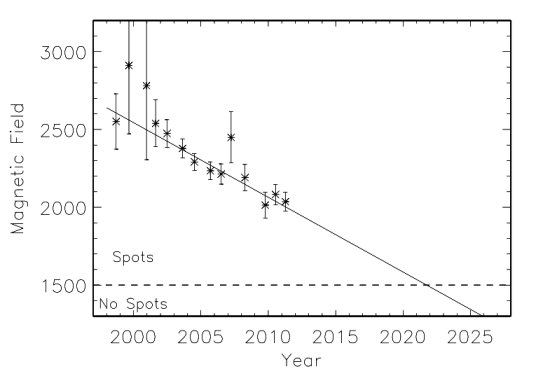
At a press conference today at the 2011 meeting of the Solar Physics Division (SPD) of the American Astronomical Society (AAS) in Las Cruces, New Mexico, solar scientists predicted that not only will the next solar maximum in 2013 be the weakest in centuries, it is very likely that it will be followed by another long Maunder Minimum, a period of decades without sunspots. “The sun may be going into hiatus,” says Dr. Frank Hill, associate director of the NSO’s Solar Synoptic Network. You can read the press releases for this announcement here and here.

decline in magnetic field over the last few cycles

These conclusions are based on three lines of evidence:

  • There has been a long term weakening in the magnetic strength that produces sunspots themselves. The declining trend suggests that by 2022 it will no longer be strong enough to produce sunspots. The graph above shows this decline.
    » Read more
3 comments

Where’s the warming?

Where’s the warming?

Global greenhouse gas emissions have risen even faster during the past decade than predicted by the United Nations Intergovernmental Panel on Climate Change (IPCC) and other international agencies. According to alarmist groups, this proves global warming is much worse than previously feared. The increase in emissions “should shock even the most jaded negotiators” at international climate talks currently taking place in Bonn, Germany, the UK Guardian reports. But there’s only one problem with this storyline; global temperatures have not increased at all during the past decade.

The evidence is powerful, straightforward, and damning. NASA satellite instruments precisely measuring global temperatures show absolutely no warming during the past the past 10 years. This is the case for the Northern Hemisphere mid-latitudes, including the United States. This is the case for the Arctic, where the signs of human-caused global warming are supposed to be first and most powerfully felt. This is the case forglobal sea surface temperatures, which alarmists claim should be sucking up much of the predicted human-induced warming. This is the case for the planet as a whole.

If atmospheric carbon dioxide emissions are the sole or primary driver of global temperatures, then where is all the global warming? We’re talking 10 years of higher-than-expected increases in greenhouse gases, yet 10 years of absolutely no warming. That’s 10 years of nada, nunca, nein, zero, and zilch. [emphasis mine]

3 comments

UK eliminates all but two climate-change projects to balance books.

The United Kingdom’s British Council is eliminating all but of its two climate-change projects in order to balance its books. Unfortunately, some taxpayer-funded propaganda will still continue:

The council says that two flagship global projects will continue: the ‘Climate Generation’ initiative, which engages young climate activists and the ‘Climate4Classrooms’ project, which provides resources for schoolchildren.

0 comments

After a burst the Sun quiets down again

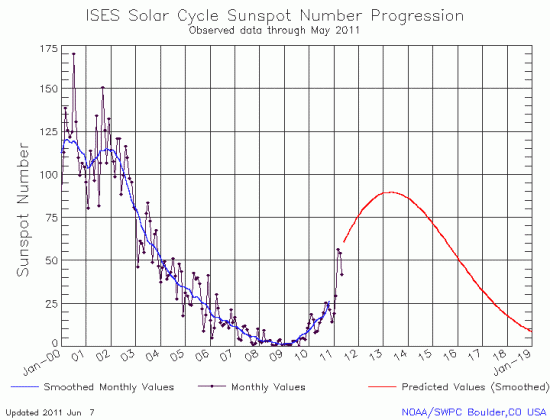
Time again for the monthly updated graph of the Sun’s solar cycle sunspot activity. Posted today by NOAA’s Space Weather Prediction Center, you can see the May results in the graph below.

After a three month steady rise in sunspot activity in January, February, and March, the numbers plummeted during April and May. Though the Sun remains active, with only one blank day since January 16, the pattern of activity as it ramps up to solar maximum continues to suggest that we are looking for the weakest solar maximum in two hundred years, as now predicted by solar scientists at the Marshall Space Flight Center.

Whether this weak maximum foreshadows another Maunder-like minimum, with no sunspots occurring for decades, remains unknown. Only time will tell. However, if such a thing should happen, it will be a marvelous opportunity for scientists to finally pin down precisely the actual influence of the Sun on the Earth’s climate. Up until now they can only guess at how much the Sun varies in brightness. Another Maunder Minimum will tell them.

May Sunspot activity

3 comments

Density of forests increasing

The benefits of CO2 increase: The density of the world’s forests has been increasing as they act as a carbon sink.

The authors say most regions and almost all temperate nations have stopped losing forest and the study’s findings constitute a new signal of what co-author Jesse Ausubel of Rockefeller calls “The Great Reversal” under way in global forests after centuries of loss and decline. “Opportunities to absorb carbon and restore the world’s forests can come through increasing density or area or both.”

0 comments
1 66 67 68 69 70 84