Andy Griffith & Joanna Moore – Down in the Valley
An evening pause: More Americana for this Independence Day week. From 1960s television, The Andy Griffith Show.
Hat tip Edward Thelen.
An evening pause: More Americana for this Independence Day week. From 1960s television, The Andy Griffith Show.
Hat tip Edward Thelen.
An intern who in 1976 purchased more than a thousand surplus 2-inch videotapes from NASA for $218 is now going to auction off three of those reels that show the Apollo 11 moon walk.
Back in 1976, NASA gave 1,150 reels of 2-inch Quadruplex videotape to a government surplus auction. Gary George, a former intern at NASA’s Johnson Space Center, snapped up the lot of them for $218, in the hopes of selling them to news stations to record over for $50 a pop. He never watched them, but because his dad was a space buff, kept three of the tapes marked as “Apollo 11 EVA” (aka Extravehicular Activity, better known as a spacewalk). When he eventually watched the tapes, he realized that he had one of three surviving copies of one of the greatest feats of human ingenuity, the July 20, 1969 Moon landing. Now, those videotapes will be auctioned off to the highest bidder when Sotheby’s will mark the 50th anniversary of the moon landing by putting the tapes up for sale on July 20th, at a starting bid of $700,000.
“I had no idea there was anything of value on them,” George said in an interview with Reuters. He started to get suspicious in 2006, after NASA admitted they had lost the tapes, and believed they could have been in the 2,614 boxes of Apollo mission tapes that were sent to a storage facility in late 1969. George got in touch with video archivist David Crosthwait in California, who had the necessary equipment to view the vintage tapes. In December 2008, George played the reels and quickly realized what he had been storing over the last few decades. He contacted NASA about the reels but “an agreement could not be reached,” according to the auction listing, and off to the auction block they go as part of an auction dedicated to Space Exploration.
The saddest part of this story are the tapes George sold to television stations to use to back-up their daily broadcasts. Some of those tapes probably contained historical recordings of the Apollo missions. While I suspect these tapes were not NASA’s only copies, I cannot be sure, which means some of the source material for the Apollo missions was likely lost.
The Planetary Society’s LightSail-2 technology demonstration satellite was released from its carrier vehicle today and successfully established communications with the ground.
The CubeSat, about the size of a loaf of bread, was scheduled to leave Prox-1 precisely 7 days after both spacecraft successfully flew to orbit aboard a SpaceX Falcon Heavy rocket. Following deployment from its spring-loaded enclosure known as a P-POD, LightSail 2 deployed its radio antenna and began transmitting health and status data, as well as a morse code beacon indicating its call sign. The mission team received LightSail 2’s first signals on 2 July at 01:34 PDT (08:34 UTC), as the spacecraft passed over Cal Poly.
…The team will spend about a week checking out LightSail 2’s systems, exercising the spacecraft’s momentum wheel, and taking camera test images before and after deployment of the CubeSat’s dual-sided solar panels. Following the successful completion of these tests, the team will deploy the 32-square-meter solar sail, about the size of a boxing ring. A time for the solar sail deployment attempt will be announced later.
If they successfully deploy the solar sail and use it to maneuver in space, it will the second time the Planetary Society has done it, having deployed LightSail-1 in 2015. That mission has some communications problems, but eventually succeeded in its main engineering mission by testing the sail deployment system.
LightSail-2 will also be the third time a light sail has been flown in space, with the first, Ikaros, deployed by the Japanese in 2010 and flown in solar orbit through 2012. That mission was successful in using sunlight to accelerate the sail.
An evening pause: It’s Independence Week. Let’s keep that Americana sound going!
Hat tip Tom Biggar.
For the geeks among us, below the fold is a really really good video describing the engineering designs and considerations that have gone into the launch industry’s most important rocket engines, both now and in the future, with the goal of understanding the design choices SpaceX made for its Raptor engine.
The video is almost 50 minutes long, but if you set the speed at 1.25 you can still understand it and save some time.
Hat tip reader Michael Nelson.
» Read more
An evening pause: From the short 1936 film, Every Sunday, made essentially as a screen test for the two young future stars.
Hat tip Edward Thelen.
Capitalism in space: The third flight of Exos Aerospace’s reusable suborbital rocket SARGE was cut short today shortly after launch when the rocket had attitude control problems.
A reusable suborbital rocket developed by Exos Aerospace suffered a loss of attitude control seconds after liftoff on a test flight June 29, but the rocket was still able to glide safely back to Earth.
Exos’ Suborbital Autonomous Rocket with GuidancE, or SARGE, rocket lifted off from Spaceport America in New Mexico at about 2 p.m. Eastern. In the company’s webcast, the rocket started gyrating seconds after liftoff before disappearing from view.
Controllers were able to reestablish some control of the rocket, aborting the flight. The rocket deployed a drogue parachute and parafoil while venting unused propellant. The rocket slowly descended under that parafoil, landing within view of the launch pad 14 minutes after liftoff.
That it appears they were able to safely recover the rocket and its payloads is significant, even though this failure is a setback for the company.
An evening pause: And in this case, the music is most appropriately written by Philip Glass.
Hat tip Danae.
Capitalism in space: SpaceX has begun its third round of private fund-raising this year, this time seeking more than $300 million.
The latest round, filed on Monday, seeks to raise $314.2 million at a price of $214 a share, according to a document seen by CNBC. The new equity would bring SpaceX’s total 2019 fundraising to $1.33 billion once completed.
The block of this new round appears to already be funded from the Ontario Teachers’ Pension Plan.
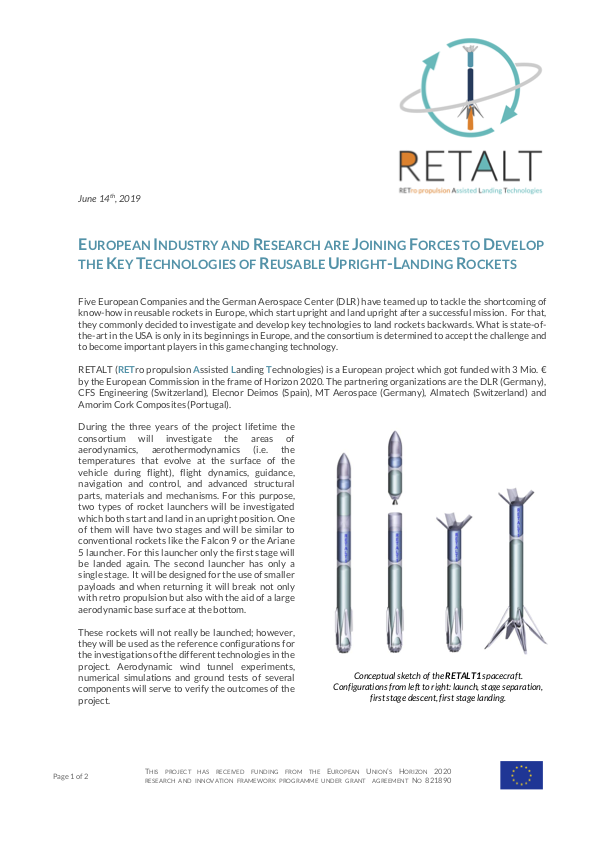
The new colonial movement: Europe has finally admitted that its refusal with Ariane 6 to make it reusable was a mistake, and has begun a major engineering research project to design and fly two different types of reusable rockets.
This month, the European Commission revealed a new three-year project to develop technologies needed for two proposed reusable launch vehicles. The commission provided €3 million to the German space agency, DLR, and five companies to, in the words of a news release about the project, “tackle the shortcoming of know-how in reusable rockets in Europe.”
This new RETALT project’s goals are pretty explicit about copying the retro-propulsive engine firing technique used by SpaceX to land its Falcon 9 rocket first stages back on land and on autonomous drone ships. The Falcon 9 rocket’s ability to land and fly again is “currently dominating the global market,” the European project states. “We are convinced that it is absolutely necessary to investigate Retro Propulsion Assisted Landing Technologies to make re-usability state-of-the-art in Europe.”
What is interesting to me is what appears to be some internal politics within Europe surrounding this effort. France is generally the most dominate member of the European Space Agency. Yet, according to the press release for this announcement, France is not involved in these new reusable rocket projects. Instead, Germany dominates, with companies from Switzerland, Portugal, and Spain participating.
It could be that the failure of Ariane 6 to garner customers, due to its higher costs, has forced these ESA partners to push for their own reusable rocket projects.
Either way, the competition in rocket technology is heating up, more evidence that the 2020s will be the most exciting decade in space since the 1960s.
A evening pause: Hat tip Danae.
The new colonial movement: The Israeli nonprofit company SpaceIL has decided that its second Beresheet spacecraft will not go to the Moon.
The association’s board of directors decided to involve the public in the process of choosing the challenge that Beresheet 2 will lead, as was done in the national mission to the moon. At the same time, the association will continue to focus on establishing the values of the “Beresheet effect” among the younger generation in Israel.
What I think is really going on is that they have realized that they cannot raise the necessary cash to fly another lunar lander, and are therefore setting their sights lower in order to find a mission they can fund.
An evening pause: Dalglish performed, wrote, and recorded some of the best hammered dulcimer music ever. I wish there had been some better camera angles on his fingerwork, but watch how he actually starts to play the dulcimer almost like a guitar.
Hat tip Diane Wilson.
Capitalism in space: During last night’s Falcon Heavy launch SpaceX was for the first time able to catch one of the rocket’s fairings using its ship, GO Ms. Tree (formerly called Mr. Steven).
As noted at the link, SpaceX now has in its hands a fairing untouched by salt water that it can analyze for future reuse, something no other rocket company has been able to do. Moreover, that the ship was able to make the net catch at night bodes well for future fairing recoveries.
Hat tip commenter geoffc.
Capitalism in space: The Falcon Heavy successfully launched tonight, and is presently deploying the 24 satellites on board.
They successfully landed the two first stage side boosters, but the core stage apparently just missed hitting the drone ship in the Atlantic. You could see it come down, but not on the pad. While SpaceX has now successfully recovered all six side boosters on all three Falcon Heavy launches, they have not yet succeeded in recovering the core stage.
The mission’s full success will not be known for several hours, as the satellite deployments unfold. So far the first two satellites have been deployed successfully.
The leaders in the 2019 launch race:
8 China
8 SpaceX
5 Russia
5 Europe (Arianespace)
3 India
The U.S. has now widened its lead over China in the national rankings, 13 to 8.
Capitalism in space: SpaceX’s third Falcon Heavy launch is now a go for launch at 2:30 am (Eastern) tonight.
You can watch it live at SpaceX’s website here or at the embedded video below the fold.
This launch should be especially spectacular, as it will be at night, and the sky is clear. Moreover, they will once again be trying to land all three first stage boosters, with the side boosters flying for the second time only two months after their first flight on the last Falcon Heavy launch.
» Read more
A evening pause: A nice cover of the song by the Alan Parsons Project.
Hat tip Danae.
An evening pause: This seems right for the first day of summer.
Hat tip Edward Thelen, who here demonstrates that good videos can be found on outlets other than youtube.
Hideaway Backstage – Trop Rock Junkies "Living The Life" from Pilot Moon Films on Vimeo.
Capitalism in space: NASA has released a new updated planning schedule for the manned flights of both SpaceX’s Dragon and Boeing’s Starliner manned capsules.
Boeing’s first unmanned demo flight of Starliner is now set for September 17, 2019. This will be followed by SpaceX’s first manned Dragon flight, scheduled for November 15, 2019. Boeing will then follow with its first manned Starliner flight on November 30, 2019.
These are considered target dates. I have great doubts that the Starliner schedule will proceed as described, while SpaceX’s schedule is more likely.
The article also had this interesting tidbit about the upcoming launch schedule of Sierra Nevada’s unmanned reusable cargo ship Dream Chaser:
According to the document, the first flight of Dream Chaser will take place in a planned September 2021 timeframe and will see the vehicle remain berthed to the International Space Station for up to 75 days before returning to Earth to land on a runway for reuse.
There are clearly issues with all these commercial projects. For example, the GAO today released a new report citing the numerous delays in this commercial manned program and calling for NASA to come up with a more complete back-up plan.
Nonetheless, the 2020s have the potential to be the most exciting decade in space exploration since the 1960s. If all goes even close to these plans, the U.S. will have three operating manned spacecraft (Dragon, Starliner, Orion), two reusable cargo spacecraft (Dragon, Dream Chaser), one non-reusable (Cygnus), and a plethora of launch companies putting up payloads of all kinds, from planetary missions to basic commercial satellites numbering in the thousands.
Much could happen to prevent all this. Keep your fingers crossed that nothing will.
Capitalism in space: This week Jeff Bezos revealed that Blue Origin had successfully completed the first static test firing of its BE-7 rocket engine, intended for use in its Blue Moon lunar lander.
Company founder Jeff Bezos tweeted June 19 that the test of the BE-7 engine took place the previous day at NASA’s Marshall Space Flight Center. The 35-second test went as expected, he said. “Data looks great and hardware is in perfect condition,” he wrote in the post, which included a video of the test.
Bezos is clearly lobbying here for the contracts to build NASA’s first manned lunar lander should its Artemis program get funded.
Meanwhile, there is been no update on the status of his company’s BE-4 engine since April 2018. I wonder why..