
Republican space socialism update.
Republican space socialism update.
Simberg summarizes well the foolishness coming from Congress when it comes to budgeting NASA and commercial space.
Republican space socialism update.
Simberg summarizes well the foolishness coming from Congress when it comes to budgeting NASA and commercial space.
The competition heats up: Sierra Nevada outlines its test flight plans for Dream Chaser, its reusable manned mini-shuttle.
A University of Arizona law student has won a trip into space in the Seattle Space Needle’s “Space Race,” beating out 50,000 other contestants.
The competition continues to heat up: ATK today announced that it is building its own manned capsule for its Liberty launch system.
The capsule’s first two flights are scheduled in 2014, both abort tests, followed in 2015 by an orbital flight and, finally, a crewed orbital flight. The spacecraft is designed for ten flights each, and ATK plans to build a minimum of four capsules. All flights will be launched by the Liberty launcher, and ATK is not actively exploring adapting the capsule for other [launch vehicles].
Liberty is based on the upgraded shuttle solid rocket boosters that were developed for the Ares rocket, now cancelled.
Boeing’s CST-100 commercial manned capsule successfully completed its second parachute drop test from 14,000 feet on Wednesday.
Want to relive history? An Australian billionaire is building a full scale replica of the Titanic.
When fully built, the Titanic II will be 270 meters (886 feet) long and capable of holding 1,680 passengers. By modern standards, this is actually fairly small for a cruise ship, especially when compared to newer passenger liners like the behemoth Oasis of the Seas, which measures 360 meters (1,180 feet) long and can hold 5,400 guests.
The Titanic II is set to make the same maiden voyage as the original, traveling from England to New York, by late 2016.
SEC documents have revealed that the total development costs for Orbital Sciences’ Antares rocket have increased to $472 million, $184 million more than what NASA is paying them.
That the company has been willing to commit these extra funds to develop Antares suggests to me that they see a commercial value for the rocket that will exceed these costs. Or to put it more bluntly, they see a market for their rocket that will pay for their investment, and then some.
SpaceX’s static fire test of the Falcon 9 still set for 3 pm today.
I will be discussing this story and the mining of asteroids on The Space Show today, even as this static fire occurs. Don’t forget to tune in.
Update: the static firing appears to have been a success, after an initial abort.
Blue Origin and Sierra Nevada have successfully completed wind tunnel tests of their commercial manned spaceships.
Want to watch the launch of Falcon 9/Dragon? Here’s the low down.
The competition continues to heat up: Engineers in Great Britain have begun testing a new hybrid engine for lifting a spaceplane into orbit.
The financial foolishness in Congress, by Republicans this time, continues. In making its budget recommendations for NASA, the report [pdf] of the House Appropriations Commerce, Justice, Science, and Related Agencies subcommittee also demands that NASA immediately choose one commercial company for its commercial space program. (Hat tip to Clark Lindsey for spotting this.)
The number of ways this action is counter-productive almost can’t be counted.
» Read more
The competition continues to heat up: India yesterday successfully launched its own all-weather imaging satellite.
To mine the asteroids, first build small cheap space telescopes.
The space telescope will be based on the same design Planetary Resources will eventually use for its asteroid-prospecting spacecraft: a 30-kilogram to 50-kilogram flier packed with imaging sensors and a laser-optical communication system the company is developing to avoid encumbering its spacecraft with large antennas. The company, which says it has about two dozen employees, will market these spacecraft as cheap but effective telescopes for both astronomical and Earth-observing applications. Sales would provide cash for the company’s core work on asteroid mining, Eric Anderson, co-founder and co-chairman of Planetary Resources, said.
The telescope slated for launch sometime in the next two years “would be something, let’s say, a university buys [for astronomical observations], or a commercial company that wants to monitor shipping traffic or something like that,” Anderson said in a phone interview. The cost for the telescope, which Planetary Resources is calling Arkyd-101, would be “millions of dollars, including launch.”
At the Planetary Resources press conference today, there was a lot of talk about the benefits and profits to be gained from mining the asteroids. However, this ain’t gonna happen for quite a few years. In the meantime, the company plans to make money building space telescopes which scientists and others can use, for a fee, to do research.
In other words, the government and astronomers dropped the ball on replacing the Hubble Space Telescope. Now, private enterprise is going to pick it up and run with it.
SpaceX and NASA have now set May 7 as the planned launch date for the Dragon test flight to ISS.
No announcement yet, but of the many stories available this Wired article appears to provide the best overview of the asteroid mining plans of Planetary Resources.
The company’s first phase is most interesting:
Within the next 18 to 24 months, Planetary Resources hopes to launch between two and five space-based telescopes at an estimated cost of a few million dollars each that will identify potentially valuable asteroids. Other than their size and orbit, little detailed information is available about the current catalog of near-Earth asteroids. Planetary Resources’ Arkyd-101 Space Telescopes will figure out whether any are worth the trouble of resource extraction.
The actual press conference is scheduled for 10:30 am (Pacific). Stay tuned.
Update: The Planetary Resources website has now been updated. You can read more about their space telescope proposal here.
SpaceX has delayed the launch of its Dragon test mission to ISS, with the launch now scheduled sometime between May 3 and May 7.
“After reviewing our recent progress, it was clear that we needed more time to finish hardware-in-the-loop testing and properly review and follow up on all data,” SpaceX spokeswoman Kirstin Brost Grantham wrote in an email. “While it is still possible that we could launch on May 3rd, it would be wise to add a few more days of margin in case things take longer than expected. As a result, our launch is likely to be pushed back by one week, pending coordination with NASA.”
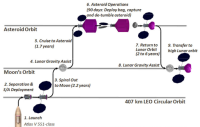
Want to get a jumpstart on Tuesday’s asteroid-mining announcement by Planetary Resources? Read this NASA report [pdf], released April 2.
Orbital Sciences has released an updated launch schedule for its Antares rocket and Cygnus capsule.
The significance?
» Read more
The death of the double click.
The story includes some nice history behind the invention of the GUI.
Interestingly, I could probably count on one hand the times I have double-clicked on a computer, since I rarely use the mouse at all. Instead, I have found it is far faster to use the keyboard to access commands, files, programs, etc.