First Falcon Heavy demo launch to include two used boosters

The competition heats up: SpaceX plans to use two already flown first stage boosters when it does its first demo flight of Falcon Heavy later this year.

Musk said the rocket cores for Falcon Heavy’s first flight are two to three months away from completion. He emphasized that the first launch will carry a lot of risk, and as such, SpaceX doesn’t plan to carry a valuable payload or payloads with it. “We will probably fly something really silly on Falcon Heavy because it is quite a high risk mission,” he said.

SpaceX will seek to recover all the boosters from the first Falcon Heavy flight, assuming all goes according to plan. Musk said the two side boosters would land back at Cape Canaveral Air Force Station, followed by the center core returning to a drone ship in the Atlantic.

They will also try to recover the upper stage, but are not hopeful this will succeed. The article also notes that they hope to fly an additional four used boosters in 2017. SES is eager to use them on its three scheduled flights this year.

The company has also said that the booster that was successfully reused this week will not fly again, but will instead be put on display in Florida.

Posted from the south rim of the Grand Canyon.

3 comments

Bad solder joints cause of Russian Proton engine defects

The problem that has forced the Russians to recall all Proton second and third stage engines has been identified as the use of the wrong materials in solder joints.

According to specifications, the structural walls and the nozzle chamber of the gas generator had to be fused together with the help of the solder designated G70NKh, which employs nickel, chromium and manganese alloy (Ni-Cr-Mn). However the investigation revealed that due to mismanagement of the raw material usage at the Voronezh Mechanical Plant, the required alloy had been replaced with the PZhK-1000 solder comprised of palladium, nickel, chromium and silicon (Pd-Ni-Cr-Si). Because the replaced solder did not meet specifications, it could lead to structural disintegration of the nozzle head during the firing of the gas generator.

The discovery of the problem with the solder triggered inspection of other engines and revealed that all RD-0210 and RD-0212 engines from the second and third stages that had been manufactured during 2015 and 2016 had been equipped with defective gas generators. In order to re-certify these engines for flight, each of them would have to be disassembled, the gas generator would have to be removed and replaced, followed by the re-assembly and re-testing of each engine!

The article also notes that the next Angara rocket is also “unfit for flight” due to unspecified defects. It also notes widespread corruption and mismanagement throughout the Russian aerospace industry.

Sadly, the decision by the Putin administration to consolidate their industry into one huge corporation run by the government, and thus eliminate any competition, is only going to make solving this problem more difficult. What Russia needs is competition, with many different companies free to challenge each other for business. It also needs to allow companies to fail and go out of business.

Instead, everything is controlled from above, and thus no competition can happen. Rather than finding a new company to build these engines, the government is going to provide the company “economic aid” in order to modernize it. This is like putting a band-aid on a broken bone.

4 comments

SpaceX recovers fairing of upper stage of Falcon 9

The competition heats up: Even as SpaceX made history yesterday in its successful use and recovery of a used first stage, it also recovered for the first time the fairing that protected the satellite.

For the first time, SpaceX also recovered the payload fairing, the conical shaped structure on top of the rocket that surrounds and protects the spacecraft during launch. The fairing separates from the spacecraft in two sections during the launch sequence — in this case, 3 minutes and 49 seconds after launch — and usually falls into the ocean and breaks into pieces. SpaceX outfitted these two fairing sections with parachutes so they could be recovered, which apparently will become standard practice.

Musk also indicated that they are now going to begin an effort to recover the second stage. “What’s the worst that could happen? It blows up? It would anyway.”

2 comments

Practically every Russian Proton rocket engine defective

The investigation of the Russian supply of rocket engines for its Proton rocket has discovered that practically every engine, numbering over seventy, had defects that needed repair.

71 engines, mostly used to power the second and third stages of the Proton rocket, require complete overhauls to remove defects. Arbuzov did not specify what was wrong with the engines. In January, Interfax reported on an investigation into high-quality metals swapped by a plant manager for cheaper alternatives. “Most of the work will be done in 2017, but we understand that some portion will inevitably slip into 2018,” Arbuzov said. “Our main goal is to avoid disrupting the government space program’s launch schedule, or the schedules of the Defense Ministry and commercial customers.”

There is also the possibility that these defects will be found in Soyuz rocket engines as well. Stay tuned.

1 comment

A tour of Vector Space Systems

Jim Cantrell and cars

[UPDATE: I have been informed by Vector’s PR department that they have recently changed the company’s name, dropping “Space Systems” from the title. I can’t really change the title here, but I thought I note this fact for my readers.]

Today I got a quick tour of Vector Space System’s very blue collar but active rocket factory in Tucson, Arizona. My tour guide was Jim Cantrell, the CEO of the company.

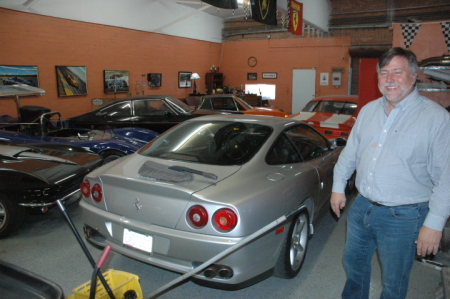
Cantrell, shown on the right in front of one of his side businesses fixing and refurbishing race cars and rare luxury sports cars (also located in this factory), started out with a love of race cars, which he still builds and races. As he said to me, “Long endurance car racing is still my thing.”

However, he has also spent his life in the space business. He has worked for government agencies and numerous private businesses, including SpaceX at its very beginning. Vector Space Systems is an effort put together by him and several other people to capture the smallsat market, a market he truly believes is going to explode with activity in the coming years. If things go as he wishes, they hope to launch at least one hundred times a year, from multiple launch sites. Their goal is simplicity and quick turnaround at an inexpensive cost.

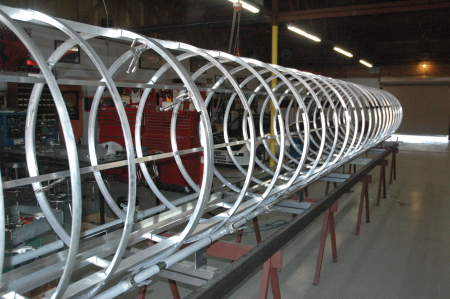
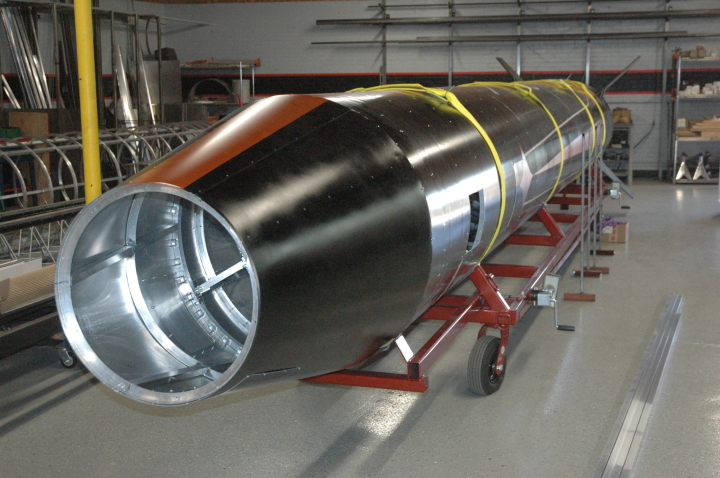
The company is presently in the testing phase leading up to their first orbital launches, which they hope to start in 2018. Right now they are building a series of full scale versions of their Vector-R rocket with a dummy second stage. The idea is to do a string of suborbital test flights, the first of which will fly in about a week from Mohave in California, with the second flying from the Georgia spaceport in Camden County. The image below is the first stage of that first test rocket.
Vector test first stage

Vector first stage engine

second test rocket

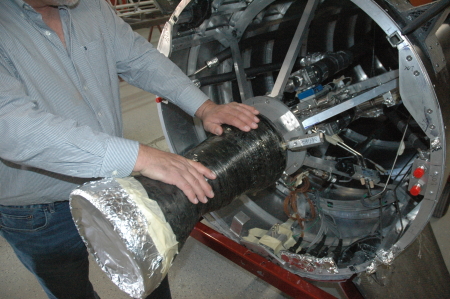
For this flight their main goal is to test the engine, which Cantrell is showing me in the picture to the right. I was astonished at how small and simple the engine was. In fact, the rocket itself was amazingly small. It looked like it could almost fit inside a typical moving truck.

Below and to the right is the first stage for their second test flight, presently being assembled. They hope it will be ready for flight in only a few weeks after the first flight. They plan five suborbital test flights, with the last capable of getting about 90% to orbit. Along the way they will test their avionics, the rocket’s balancing systems, and its computer and tanks. Once these tests are complete they will then move to testing the orbital version in 2018.

Obviously, all this depends on every test flight being successful. But then, even if something goes wrong they will learn something and move on. For example, they recently transported an engineering version of the rocket to the visitor center at Kennedy. As Cantrell explained, “We learned things new just making that move.”

bumper sticker

In the end, I think the bumper sticker to the right, attached to the window of Vector Space System’s office, sums everything up. The people at Vector want to make money in space, but they — like everyone in the space business — also love making rockets and engines and going fast. What better combination from life could you ask for?

6 comments

Atlas 5/Cygnus launch delayed until mid-April

ULA has delayed its next Atlas 5 launch to send a Cygnus cargo capsule to ISS until mid-April.

Gatens said NASA was now expecting the Cygnus to launch to the station no earlier than the middle of April. “The Orbital launch, the next launch, has slipped due to an investigation of a hydraulic leak in the booster engine compartment that’s in work,” she said. “There are some components being replaced. The investigation is going on and we’re currently targeting no earlier than, probably, a mid-April launch.”

ULA spokeswoman Jessica Rye said March 28 that a new launch date has not been set yet for the mission. “Additional information will be provided once testing to resolve the booster hydraulic issue is complete,” she said.

The launch was initially planned for mid-March. This delay has forced NASA to delay a spacewalk because it involves installing equipment that the Cygnus capsule is bringing to ISS.

2 comments

Washington Bubble fights back against Capitalism in Space

The response to my policy paper, Capitalism in Space, has been not surprisingly mixed. Eric Berger at Ars Technica wrote a reasonable analysis that focused on the absurdly high overhead costs of SLS/Orion. There have also been a number of critical reviews, one in Forbes and a second today in the print edition of Space News.

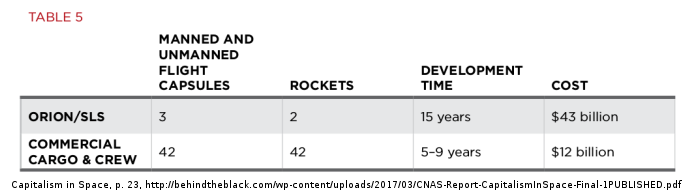
Both have tried to discredit the facts I have put forth about the ungodly cost of SLS/Orion, when compared to commercial space, without actually citing any incorrect facts in my paper. The truth is that everything I have written is true. This graph from my paper remains fundamental:

Table 5 from Capitalism in Space

SLS/Orion is costing four times as much, is taking more than twice as long to build, and is producing one tenth the operational flights. It is essentially a pork-laden jobs program that has no ability to get the United States anywhere in space. It might be an engineering marvel, but the cost is so high and its operational abilities so slow (one flight per year, at best) that it will never be a reliable and effective tool for exploring the solar system.

Meanwhile, private enterprise is getting innovative new rockets off the ground, for far less money, and repeatedly. If we want to settle the solar system, they are providing us the only viable way to do it.

People must recognize that these attacks are essentially the bubble of Washington working to protect its financial and intellectual interests. A lot of people in DC depend on keeping the faucet of government spending flowing to SLS/Orion, even if those projects accomplish nothing. In the case of the attacks from academics, they don’t like the fact that I am an outsider and not beholden to them. Moreover, they are instinctively appalled by the idea of allowing capitalism and freedom to operate freely, without their guiding hands controlling things. Such thoughts must be attacked and squelched (if possible), in order to protect their interests.

That they don’t seem to care that much about the interests of the American people and the country is quite revealing however. As some have said repeatedly, this is how you got Trump.

26 comments

Vector signs deal with Georgia spaceport

Vector Space Systems has signed a deal with a Georgia spaceport to conduct one suborbital test flight there of its Vector-R rocket.

The agreement covers only one flight, but considering that Vector is also planning to launch from Kennedy, I think they are doing this to test their rocket’s ability to easily launch from multiple launch sites. It is a small mobile rocket, and they are probably designing its launch systems to be very mobile as well.

2 comments

A look at Blue Origin’s upcoming plans

Two stories today give us a peek at Blue Origin’s future plans.

The first outlines how the company plans to launch its orbital rocket, New Glenn, from Florida. The second provides a photo tour of the company’s suborbital New Shepard capsule, as designed for tourist flights.

I must mention that I have been disappointed at the lack of test flights for New Shepard in recent months. Their last flight was in October, almost six months ago, when their test of the capsule’s launch abort system was supposedly a success. No tests since, even though they have said they planned the first manned test flights this year. I am beginning to wonder if they have decided to shift resources to the orbital system and thus slow the suborbital program down.

4 comments
1 565 566 567 568 569 785