Tea Party in Space argues for more money for commercial space

Andrew Gasser at the Tea Party in Space website today argues strongly for Congress to fully fund the new commercial space program at the $850 million amount requested by the Obama administration.

As much as I am for these new commercial companies, I do not think it a good idea to fund them at these high levels.

For one thing, the government is still broke. It can’t afford to spend that much money. It is therefore unseemly for a website that uses the “tea party” label to advocate more spending at this time.

For another, the more money the government commits to these companies, the more control the government is going to demand from them. Far better to keep the government participation as small as possible. Make it just enough to allow the companies to succeed but not enough so as to make the whole effort a government program.

3 comments

Orbital announces revised schedule for its initial Taurus 2 and Cygnus flights

Orbital Sciences has announced its revised schedule for the initial Taurus 2 and Cygnus flights.

Orbital will conduct a test of the Taurus 2’s first stage on the launch pad in late January [2012], and the inaugural Taurus 2 flight in late February or early March. This will be followed, in early May, by a Taurus 2 flight carrying the Cygnus station cargo vehicle, a flight during which Cygnus is expected to demonstrate its ability to berth with the station. The first operational space station cargo-delivery mission for Taurus 2 and Cygnus will occur in late August or early September under this revised schedule, Orbital officials said.

Based on conversations I’ve had with people at Orbital, this delay was expected, and is a good thing. The company was under incredible time pressure to get ready for a December launch. Given that this will be the first test flight of Taurus 2, and it must work for the Cygnus cargo flights to follow, better they give themselves some working room to get it right.

0 comments

The new commercial space companies question NASA contracting policies

The new commercial space companies are challenging NASA’s new contracting policy.

The article covers the conflict that I described in this post, whereby NASA is abandoning the more flexible contracting approach used for the commercial cargo contracts of SpaceX and Orbital Sciences and going instead with the contracting system it used for all past NASA subcontracts.

The article is errs badly when it calls the new contracting approach that NASA wants to use “non-traditional.” It is instead the way NASA has been doing things for decades, whereby the agency takes full control of everything and requires contractors to fill out so much paperwork that the costs double and triple.

0 comments

Orbital Science rocket engine sustains damage in test

One of the rocket engines for Orbital Science’s Taurus rocket, to be used to supply cargo to ISS, was badly damaged in a fuel fire June 9.

The results of the investigation and prognosis for the engine and the Taurus II should come together by the end of this week or early next week, Beneski says. Two other AJ26 engines have completed hot-fire acceptance testing without mishap, according to the Aerojet website. Beneski said the engine mishap potentially affects the testing planned to get the Taurus II ready for operational missions to resupply the ISS.

0 comments

The costs of space cargo

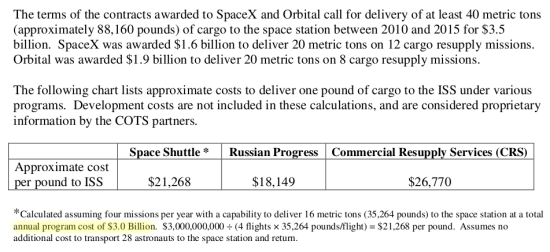
This week there was a bit of a political kerfuffle during House hearings over a House report [pdf] that stated that the cost per pound for launching cargo to ISS was much cheaper using the shuttle versus the new commercial companies under the COTS program. This is shown in this table from page 5 of the report:

House charter graph

The problem is that these numbers are a complete lie, as they are based on a yearly cost of $3 billion to operate the shuttle (highlighted in yellow). I have been following NASA budget battles now for decades, and the shuttle operational budget has never, ever been that low. Routinely, NASA figures the cost to operate the shuttle per year, regardless of number of flights, to be about $4 billion per year.
» Read more

7 comments
1 2