
The weather in Gale Crater on Mars: warmer than expected.
The weather in Gale Crater on Mars: warmer than expected.
The weather in Gale Crater on Mars: warmer than expected.
It appears that Curiosity is traveling across an ancient streambed on Mars.
“From the size of gravels it carried, we can interpret the water was moving about 3 feet per second, with a depth somewhere between ankle and hip deep,” said Curiosity science co-investigator William Dietrich of the University of California, Berkeley. “Plenty of papers have been written about channels on Mars with many different hypotheses about the flows in them. This is the first time we’re actually seeing water-transported gravel on Mars. This is a transition from speculation about the size of streambed material to direct observation of it.”
This discovery also confirms the wisdom of Gale Crater as a target. Satellite data and images had suggested the crater had once been water filled. Now this suggestion appears confirmed.
The Martian weather, as recorded by the Curiosity weather station.
Curiosity has zapped its first rock and moved on.
Curiosity snaps a Martian lunar eclipse.
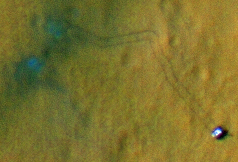
The Mars Reconnaissance Orbiter team today released a set of images showing Curiosity’s first steps on Mars, as well as some fascinating closeups of the spacecraft’s heat shield, parachute, and descent stage. The image on the left shows the tracks of the rover during its first few days of travel.
The journey begins: Curiosity heads east 52 feet on the first leg of its exploration of Gale Crater.
Images from Curiosity have spotted some unexpected geology in Gale Crater.
A mosaic of high-definition images of Mount Sharp, the central peak dominating the landing site at Gale Crater, reveals tilted strata never before seen on Mars. The strata dip downwards at an angle close to that of the slope of the foothills of the 18,000-ft. tall mountain within which they are formed.
“The cool thing is the cameras have discovered something we were unaware of,” says mission chief scientist John Grotzinger. “This thing jumped out at us as being very different to what we expected,” he adds. Lying in the low-lying foothills beyond the dune field between the rover and the base of Mount Sharp, the inclined layers are a “spectacular feature” that could not be seen from orbit.
I think there are two reasons these tilted layers are puzzling scientists.
» Read more
Curiosity has made its first test drive, moving about fifteen feet.
A rose by any other name: NASA scientists are in a battle with astronomers over who gets to name things on Vesta and Mars.
This is not a new problem. The International Astronomical Union (IAU) has maintained its power over naming everything in space since the 1960s, even though the IAU has sometimes ignored the wishes of the actual discoverers and explorers and given names to things that no one likes. For example, even though the Apollo 8 astronauts wanted to give certain unnamed features on the Moon specific names, the IAU refused to accept their choices, even though those astronauts were the first human beings to reach another world and see these features up close.
Eventually, the spacefarers of the future are going to tell the IAU where to go. And that will begin to happen when those spacefarers simply refuse to use the names the IAU assigns.
One of Curiosity’s two wind sensors was apparently damaged in landing and is inoperable.
The Rems team first noticed there was something wrong when readings from the side-facing boom were being returned saturated at high and low values. Further investigation suggested small wires exposed on the sensor circuits were open, probably severed. It is permanent damage. No-one can say for sure how this happened, but engineers are working on the theory that grit thrown on to the rover by the descent crane’s exhaust plume cut the small wires. The wind sensor on the forward-facing mini-boom is unaffected. With just the one sensor, it makes it difficult to fully understand wind behaviour.
The invader prepares its attack: For the first time today Curiosity flexed its robot arm.
War of the Worlds! The Earth invading spacecraft on Mars has fired its laser for the first time!
Forgive me the hyperbole. I have this childhood vision from that moment when I first read H.G. Wells’ War of the Worlds, when the Martian tripod first rose up and fired its death ray at a crowd of curious humans. And here we are, a century after Wells penned that classic science fiction novel, and humans have put a spacecraft on Mars, Curiosity, capable of firing lasers! The laser isn’t a death ray but a scientific tool, but nonetheless the ironies remain delicious.
Curiosity’s travel plans tentatively outlined.
The promised land: where Curiosity is headed.
This image (cut out from a mosaic) shows the view from the landing site of NASA’s Curiosity rover toward the lower reaches of Mount Sharp, where Curiosity is likely to begin its ascent through hundreds of feet (meters) of layered deposits. The lower several hundred feet (meters) show evidence of bearing hydrated minerals, based on orbiter observations. The terrain Curiosity will explore is marked by hills, buttes, mesas and canyons on the scale of one-to-three story buildings, very much like the Four Corners region of the western United States.
Click through to the image itself. Like all mountains, what appears to be a featureless mountainside from a distance instead becomes a complex and rough terrain in close-up.
How Curiosity’s nuclear power plant works.
Interesting factoid: The tread of Curiosity’s tires will leave behind an imprint that reads “JPL,” only it is written in Morse code, not plain English.
Curiosity views its surroundings. More images here.
In another story, there is speculation that Curiosity’s first image actually captured the dust cloud produced when the spacecraft’s Sky Crane/rockets crashed after placing the rover on the ground and then flying away.
Compare this image, taken right after landing, with this image, taken later. The splotch on the horizon has disappeared.
The first color image from Curiosity.
And from Mars Reconnaissance Orbiter, images (scroll down to Update II) showing all of Curiosity’s hardware scattered across the Martian surface. More here.
And here is a good overview of the possible directions Curiosity might roam in the coming days.
The first science images from Curiosity, including nearby Mt. Sharp. More here.