
The oldest known common-place items.
The link is here.
The link is here.
Of the seven science instruments proposed for the next U.S. Mars rover, scheduled for a 2020 launch date, MOXIE test the engineering to produce and store oxygen, pulled from the Martian atmosphere.
Developed in partnership with NASA’s Jet Propulsion Laboratory, it’s based on the fact that the Martian atmosphere, though extremely thin, is composed of 96 percent carbon dioxide, which means its a vast potential source of oxygen for future explorers and settlers. Essentially, MOXIE is a fuel cell in reverse. Instead of generating electricity by using oxygen to burn a fuel, it uses a process called solid oxide electrolysis , where electricity is employed to split carbon dioxide into oxygen and carbon monoxide.
This process would see Martian air pumped into the unit through a dust filter and pressurized before being passed into a fuel cell. At high temperatures, some ceramic oxides act as oxygen ion conductors. In the fuel cell, a thin, non-porous disc of this ceramic separates two porous electrodes. One electrode acts as the cathode and the other as the anode. Carbon dioxide passes through the cathode and when it comes into contact with the ceramic, the interaction of electricity and the ceramic causes the carbon dioxide to split into oxygen and carbon monoxide. The oxygen and the carbon monoxide are then separated and the oxygen stored.
What makes this unusual is that NASA has actually dedicated one science instrument to engineering research, not pure science. The agency does not do this much anymore, but such research is essential if the U.S. is going to someday send humans to other planets.
The competition heats up: Just three weeks after its previous commercial launch SpaceX is scheduled to put AsiaSat 8 into orbit at 1:25 am tomorrow.
If Tuesday morning’s launch goes well, SpaceX will follow it with another commercial launch just three weeks later, also for Asiasat.
The article above notes how this will be the first launch for Asiasat from the U.S. in more than a decade. They had switched to Russian launchers because of cost and the difficulties of working under U.S. security requirements. The security problems still remain, but might be solved if SpaceX builds its own private spaceport.
William Wade, AsiaSat president and CEO, is excited for the upcoming launches, but confirmed the company’s experience here has not been as easy as at other launch sites. Access to Cape Canaveral Air Force Station for roughly 60 employees, shareholders and customers now in town — most not U.S. citizens and many who are Chinese nationals – has been difficult. “That is proving to be somewhat cumbersome,” Wade said. “We have to go through all the security clearances, which is expected, but we are finding as a foreign company that it is a bit more difficult conducting our launches there.”
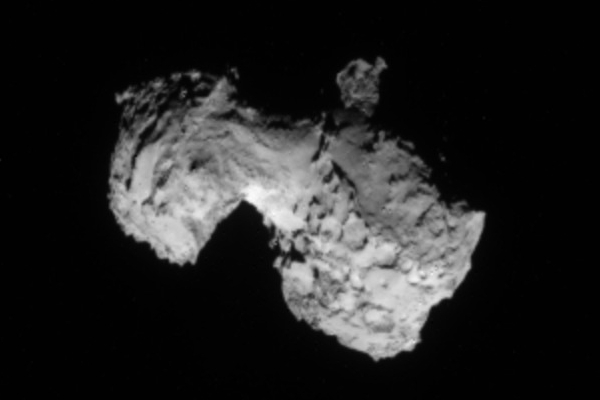
Today’s Rosetta image of Comet 67P, shown above, gives us a different angle of the comet. The spacecraft was only 186 miles (300 kilometers) away when it snapped the picture, and this side view emphasizes the nucleus’s jagged shape.
I am reminded of what happens to a block of ice when you spray warm water on it. It begins to melt away, but very randomly and unevenly, producing very weird shapes and the surface evaporates off. In the case of Comet 67P, the nucleus is a dirty ball of ice, and the Sun’s rays have been causing its surface to evaporate off every time it approaches the Sun. Thus, we get a very weird shape.
At a science conference in Moscow on Saturday the director of Russia’s Space Research Institute described in detail the future exploration plans for the Russian space program.
According to the story, Russia plans to return to the Moon and Mars with unmanned probes. He also described how the first missions will be in partnership with Europe, followed by Russian missions designed to test and prove the technologies. If these flights go well, in 2024 Russia will consider trying again with a repeat of the Phobos-Grunt mission that failed in 2012
This last detail is a change from previous reports that said Russia would launch Phobos-Grunt 2 in 2018. It is also consistent with much of the Russian program for the last two decades (as well as most of NASA’s own ambitious manned exploration program), where the agency makes bold announcements of future plans but somehow with each new announcement the dates for the actual launch have always been pushed back. The actual flight never seems to happen.
Vitaly Lopota, the president of Russia’s largest space company Energia, was suspended Friday by the company’s board of directors.
The move appears to be part of an effort by Russia’s government to obtain majority control over Energia, of which it owns a 38-percent share. The directors elected Igor Komarov as its new chairman of the board. Komarov is chief of the Russian United Rocket and Space Corporation (URSC), the government-owned company tasked with consolidating Russia’s sprawling space sector.
The government is also conducting a criminal investigation of Lopota, which might be justified but to me nonetheless appears to be a power play designed to both eliminate him from the game as well as make sure everyone else toes the line so that URSC can take complete control.
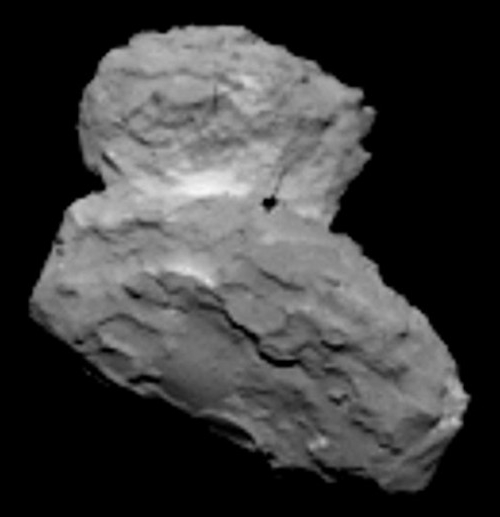
Above is a new image of Comet 67P as seen from about 1000 kilometers, or about 620 miles, released by the Rosetta science team today. The image was taken on August 1 and has been processed somewhat to bring out the details. The black spot near the junction between the nucleus’s two sections is not real but an artifact of the camera’s CCD.
This image is the first real clear and sharp look at the nucleus, and what it shows us is a surface quite different from the many other asteroids that science probes have imaged close-up in the past. From this angle there are far few craters visible then is normally seen on asteroids, and the surface has complex roughness and pitted look that I suspect the planetary geologists are right now scratching their heads about and waving their arms trying to explain. My first guess, which no one should take too seriously, is that as material vents off the comet when it gets close to the Sun it leaves behind these scars.
One more thing: If you go here you can see a number of additional image releases in the last 24 hours, all fascinating. This link explains that the features that looked like craters in earlier images were actually artifacts from the camera’s CCD.
The uncertainty of science and engineering: A physicist takes a close and skeptical look at the “impossible” space drive that NASA engineers discovered seemed to work. Key quote:
“All in all,” Lee concluded, “it will take a lot more information before we can judge whether the thrust is really a thrust or not.”
Read the whole article. They point out the areas of doubt and weakness, as well as the possibilities.
Life imitates science fiction: NASA engineers have confirmed the functionality of an “impossible” space thruster drive.
British scientist Roger Shawyer has been trying to interest people in his EmDrive for some years through his company SPR Ltd. Shawyer claims the EmDrive converts electric power into thrust, without the need for any propellant by bouncing microwaves around in a closed container. He has built a number of demonstration systems, but critics reject his relativity-based theory and insist that, according to the law of conservation of momentum, it cannot work.
According to good scientific practice, an independent third party needed to replicate Shawyer’s results. As Wired.co.uk reported, this happened last year when a Chinese team built its own EmDrive and confirmed that it produced 720 mN (about 72 grams) of thrust, enough for a practical satellite thruster. Such a thruster could be powered by solar electricity, eliminating the need for the supply of propellant that occupies up to half the launch mass of many satellites. The Chinese work attracted little attention; it seems that nobody in the West believed in it.
However, a US scientist, Guido Fetta, has built his own propellant-less microwave thruster, and managed to persuade Nasa to test it out. The test results were presented on July 30 at the 50th Joint Propulsion Conference in Cleveland, Ohio. Astonishingly enough, they are positive.
Since no one understands the physics that are producing the thrust, it is wise at this point to be very skeptical of these results. A lot more testing and experimentation will be necessary before this can be made practical.
However, if it is what they think it is, it will make it possible to turn sunlight into thrust, meaning that spacecraft will no longer need fuel, and will be able to go places much faster using the constant thrust this drive will provide.
The competition heats up: Sierra Nevada and Lockheed Martin today unveiled the composite airframe that will be used for the Dream Chaser spacecraft.
Essentially this is the first major structural component of the actual spacecraft. Lockheed was chosen by Sierra Nevada as the subcontractor to build it because of that company’s extensive experience with composites. It also gets them bonus points in Congress by using this powerful well placed company with many employees in important Congressional districts.
The best part of this story is this quote by the programmer who created the three-finger salute:
“I have to share the credit,” Bradley joked. “I may have invented it, but I think Bill made it famous.”
The Eastern division of the Russian Air Force, Pacific fleet, and space agency Roscosmos will hold joint exercises the first week in August to practice for the first time ever the water rescue of Russian cosmonauts and a Soyuz capsule.
It is obvious these exercises are in conjunction with the construction of the Vostochny spaceport in Eastern Russia. Any aborted manned launch from this site will end up landing in the Pacific, not on land as has happened twice from Baikonur. And since the Russians have never had a manned capsule splashdown in the ocean, they better practice this stuff now.