Orion first test flight scheduled

NASA has set December 4 for the first test flight of Orion.

In related news, the Navy has successfully completed a splashdown recovery test of Orion.

I haven’t labeled these stories “The competition heats up” because I have serous doubts Orion or SLS will survive the next Presidential election, even if this test flight on a Delta 4 Heavy rocket is a complete success. And if you want to know why, just read the first article above. It lists the long troubled ten-year long history of this capsule, with the following punchline describing the schedule for further launches with the actual SLS rocket:

While the first SLS/Orion mission, known as EM-1, is still officially manifested for December 15, 2017 – internally that date has all-but been ruled out. Internal schedules shows EM-1 launch date as September 30, 2018, followed by the Ascent Abort (AA-2) test – required for crew launches – on December 15, 2019, followed by EM-2 on December 31, 2020.

I find also find it interesting that in describing the many problems Orion has had in development, the article fails to mention the cracks that appeared in the capsule that required a major structural fix. Nor does the article mention the ungodly cost of this program, which easily exceeds $10 billion and is at least four times what NASA is spending for its entire program to get three different privately built spaceships built in the commercial program.
27 comments

Dragon launch abort tests scheduled

The competition heats up: SpaceX has scheduled its Dragon launch abort tests for November and January.

The Hawthorne, California-based company plans to conduct a pad abort test at Cape Canaveral Air Force Station, Florida, in November, followed by an in-flight abort test from Vandenberg Air Force Base in California in January, Garrett Reisman, SpaceX Dragon Rider program manager, said here Aug. 6 at the American Institute of Aeronautics and Astronautics Space 2014 conference.

In the pad-abort test, Dragon will be mounted to a mocked-up SpaceX Falcon 9 rocket and use its hydrazine-fueled SuperDraco thrusters to boost itself up and away from the pad, as it might need to do in the event of a major problem just before or during liftoff. The in-flight test will attempt to repeat the feat at altitude.

In related news, two former SpaceX employees who were terminated in July when the company laid off about 400 people in an annual restructuring of its workforce have sued the company for not giving them ample notice as required by California law.

The California law is pretty clear, which means these employees will likely win, which also sounds to me like a good reason to shift SpaceX’s entire operation to Texas and its new spaceport in Brownsville.

3 comments

67P from 52 miles

67P from 52 miles, August 7, 2014

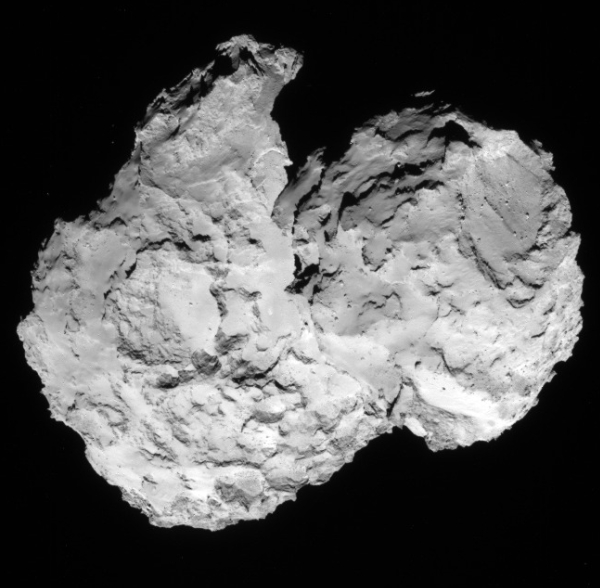
The image above was taken on August 7 from only 52 miles. For the first time I had to scale it down slightly so that it would fit on the webpage.

My impression with this image is that there actually might be hints of some very ancient craters at several of the vaguely circular pitted features. For example, look at the large feature on the end of the nucleus’s smaller component on the right. This might be a crater that now is significantly eroded as the comet’s surface evaporated away each time it approached the Sun every 6.5 years.

0 comments

Congress applies pressure to ULA and the Air Force

Two congressional committees are holding up approval of a budget revision for the Air Force’s launch program because of concerns about cost overruns and the program’s dependency on a Russian rocket engine.

Such requests must be approved by each of the four congressional defense committees, and so far, the EELV proposal has won the support of only two. The Senate Appropriations Defense subcommittee and the House Appropriations Defense subcommittee have green-lighted the plan, while the House and Senate Armed Services committees have deferred approval, according to budget documents dated July 25 and July 31, obtained by Defense News.

[The Senate Armed Services Committee] (SASC) asked the Air Force to draw up a plan, by Sept. 30, β€œthat leads to the production of a liquid rocket engine by 2019,” according to one of the documents, sent to Pentagon Comptroller Michael McCord by SASC Chairman Carl Levin, D-Mich.

Meanwhile, others legislators are questioning the program’s cost overruns. Though only hinted at in the article, this hold up is also related to SpaceX’s demand that the bidding for Air Force launches be opened up to competition.

0 comments

Comet 67P on the day of rendezvous

67P/C-G on August 6

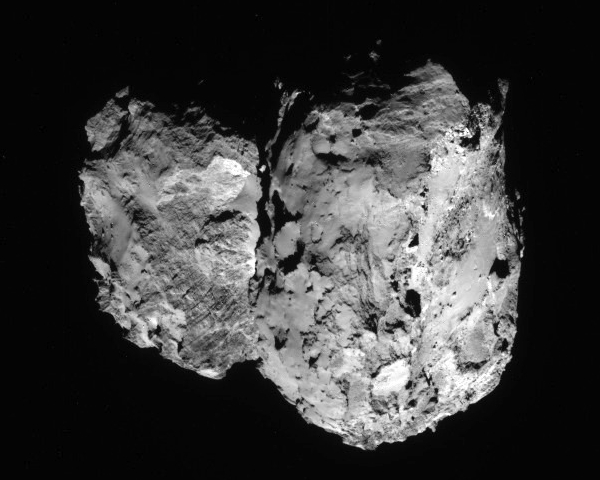
The image above was taken at a distance of 60 miles by Rosetta’s navigation camera on August 6, the day the spacecraft rendezvoused and began flying in tandem with it. It looks at the “backside” of the comet, the side where the distinction between its two components is less pronounced. Once again, no obvious craters, and the surface is pockmarked and corroded.

1 comment

China to build a new canal in Central America

The competition heats up: With approval from Nicaragua, China has inched closer to beginning construction of a new canal that would connect the Pacific and Atlantic oceans.

A month ago, a Nicaraguan committee approved Chinese billionaire Wang Jing’s project to create The Nicaraguan Canal. With a planned capacity to accommodate ships with loaded displacement of 400,000 tons (notably bigger than The Panama Canal), the proposed 278-kilometer-long canal that will run across the Nicaragua isthmus would probably change the landscape of the world’s maritime trade.

“The project is the largest infrastructure project ever in the history of man in terms of engineering difficulty, investment scale, workload and its global impact,” Wang told reporters, adding that with regard the project’s financing, which is around $50 billion, Wang seems quite confident, “If you can deliver, you will find all the world’s money at your disposal.”

16 comments

Rosetta arrives

Rosetta has successfully achieved orbit around Comet 67P/C-G and has transmitted its first close up images. More information here and here about the rendezvous and what science the mission scientists plan to do as they orbit the comet.

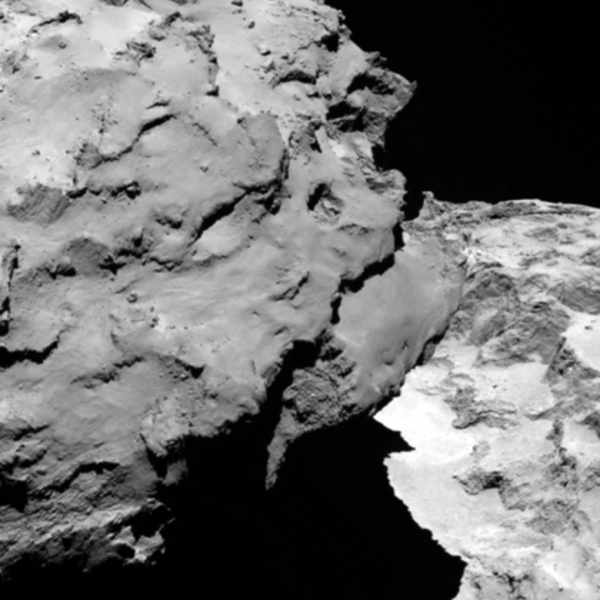
The image below is looking down and past the comet’s smaller component as it casts a shadow on the neck and the larger component beyond. As with the earlier images, the comet’s pitted and corroded surface, lacking any obvious craters, is reminiscent to me of a pile of dirty snow that has been dissolving away. In fact, when I lived in New York I would see this kind of look every winter. When the city would get a big snowfall snowplows would push it into large mounds on the side of the road. As time passed these piles would get dirty from the city’s soot and grime, and also slowly melt away. After several weeks it would look almost exactly like the surface of Comet 67P/C-G.

The images and data that will come down from Rosetta over the next year and half as it orbits the comet in its journey around the Sun will be most fascinating. Stay tuned!

67P/C-G up close

12 comments

Video of the Falcon 9 first stage doing a soft splashdown

Video taken from a chase plane during the July 14 Falcon 9 launch shows the first stage appearing from out of the low clouds, engines firing, vertical and ready for landing. The video, below the fold, also shows the stage slowing just before it hits the water, much like the test vehicles Grasshopper and Falcon 9R do.

Though SpaceX has already claimed their first stage had done this during the July 14 launch, this video proves it. All they need to do now to recover their first stage is to direct it to a land-based landing site.

Hat tip to Doug Messier and Parabolic Arc for this story.
» Read more

3 comments

Comet 67P/C-G at 126 miles

Comet 67P/C-G at 126 miles

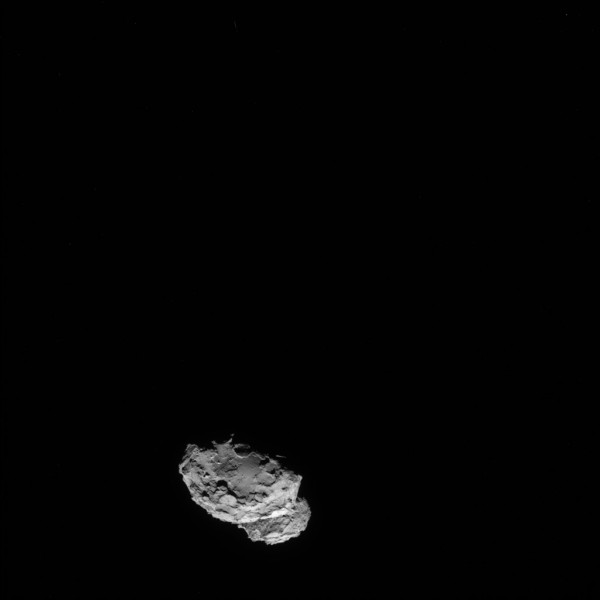
The image above was taken by Rosetta on August 4 from only 126 miles (234 kilometers). Unlike earlier images, this image is raw, uncropped and unprocessed. All I have done is rescale it to fit on my webpage. As they explain at the link,

As you can see, the comet is not centred in the full-frame image. This is a result of the rendezvous burn conducted the previous day, which adjusted Rosetta’s trajectory towards the comet. This effect is corrected for in the commands sent to the spacecraft after the new orbit has been determined.

The science team also notes that beginning tomorrow, the comet will be close enough that they will no longer have to provide a cropped close-up using the navigation camera and that this uncropped raw version will be sufficient.

Rendezvous and orbital insertion on Wednesday!

0 comments

U.S./Russian owned launch company ILS cuts workforce by 25%

The competition heats up: Business loses because of its recent Proton launch failures, combined with strong market competition from SpaceX, today forced International Launch Services (ILS) to cut its work force by 25%.

The company is anticipating a launch rate drop from an average of 7 to 8 missions a year down to 3 to 4. The article also noted one more additional detail that will affect the future market value of Proton:

So far in 2014, the commercial satellites ordered have been mainly at the lighter end of the market for geostationary-orbiting telecommunications spacecraft. This follows a couple of years in which heavier satellites dominated.

Commercial Proton rockets are typically used to launch heavier satellites one at a time. The market’s move to lighter spacecraft has benefited Space Exploration Technologies Corp. of Hawthorne, California, whose Falcon 9 rocket has accumulated commercial orders; and also benefited Arianespace, whose Ariane 5 heavy-lift vehicle’s lower position is reserved for smaller satellites.

The weight of commercial satellites is almost certainly going to continue to drop in the coming years as technology improves and satellite companies work to reduce the cost to launch. In that climate, the Proton’s ability to put big commercial payloads into orbit will become a liability, not an asset. Ariane 5 has the same problem, in that it still needs a big payload for its upper position in order to make a launch cost effective.

Both Falcon 9, with its very low launch costs, and Russia’s new Angara rocket, with its modular design to handle all kinds of payload sizes, are better suited to this new competitive market.

1 comment
1 1,097 1,098 1,099 1,100 1,101 1,354