
Flying a glider to the edge of space
A new project, backed by Airbus, will attempt to fly a manned glider to 90,000 feet, almost doubling the previous altitude record.
A new project, backed by Airbus, will attempt to fly a manned glider to 90,000 feet, almost doubling the previous altitude record.
The competition heats up: Generation Orbit this week completed a test flight of its air launch rocket system for putting small payloads into space.
The flight was to test the handling and flight characteristics of the aircraft to be used to release the launchers.
The company is planning two different air-launched systems, one to put small payloads into suborbital space, another to put 100 pound payloads into orbit. In both cases they are targeting the science and educational community that builds cubesats and has been in desperate need of its own launch services for decades.
The competition heats up: The massive concrete launchpad structure for Russia’s Soyuz rockets at its new spaceport in Vostochny is now almost finished.
Nor is that the only thing getting built.
Also, official Russian TV showed the installation of giant cisterns for kerosene fuel, liquid oxygen and nitrogen gas at a nearly completed storage facility of the launch complex. The active construction of 12 residential buildings, of a kindergarden, of a boiler facility and of a water treatment plant was also continuing at the future space center. A new concrete-production plant, a power conversion station and a car park were reported approaching completion. During the summer, regular workforce was reinforced with 400 members of 22 student teams assembled at the site from 15 regions of the Russia, the local government said.
The head of Russia’s space agency also visited the site this week, demonstrating the government’s continuing strong commitment to get this new spaceport finished on time.
Update: In related news, sources in Russia’s Finance Ministry say that by 2016 the budget for Baikonur will be zeroed out, the money shifted entirely to running Vostochny. This is the first solid indication that Russia plans to abandon its historic Kazakhstan spaceport when the new spaceport is finished. Previously officials insisted that Russia was going to continue its partnership with Kazakhstan.
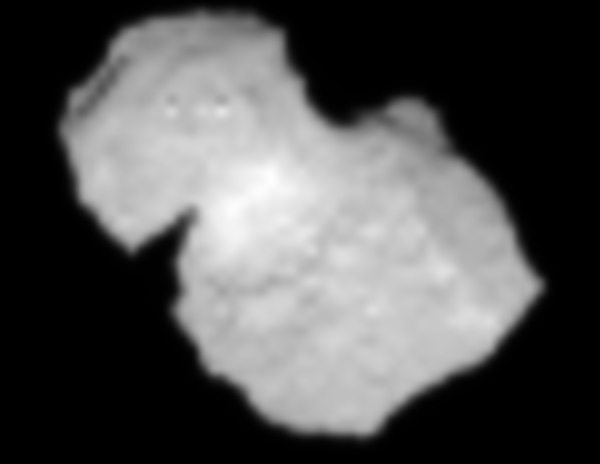
This image of Comet 67P from Rosetta was taken yesterday. Though it has not been processed like the image I posted yesterday, more details continue to come out as the spacecraft each day gets closer to the comet. This image was taken from a distance of 825 miles, 375 miles closer than the previous day.
Very soon these close-up images will become too large to show the entire nucleus in one image. Rosetta will instead begin to snap images of specific features.
Meanwhile, the Rosetta science team released its first temperature readings of the comet.
» Read more
Five years after the last shuttle repair mission, the Hubble Space Telescope continues to operate almost perfectly.
Jeletic said other than a single gyro failure, the observatory is operating in near-flawless fashion five years after the final shuttle crew departed. “Batteries are fine, solar arrays are fine, all the communications equipment is fine, we don’t see any glitches with the computers, the instruments are all fine,” he said. “In fact, an interesting statistic, the Advanced Camera for Surveys, which was repaired by the astronauts during the last servicing mission, that’s actually now run longer on the repair than it did originally for the Wide Field Camera part of it.”
The ACS, like the repaired Space Telescope Imaging Spectrograph, no longer has any internal redundancy. “It’s amazing. It truly is,” Jeletic said. “Given all the things that can fail, a lot of people were hoping for one or two years of continued work with it. Now we’ve gotten over five.” Likewise, the Space Telescope Imaging Spectrograph, which also is operating in “single-string” mode, is still going strong.
When they completed the 2009 servicing mission, the goal was to give Hubble five more years of operation. They’ve done that, and are now looking to keep the telescope going till at least 2020, marking 30 years in orbit.
The only issue, not surprisingly, is the failure of one of the six gyros on board. These have traditionally been the telescope’s biggest problem, and have been replaced twice over during shuttle missions. Three of today’s six however are using a new design which will hopefully extend their life significantly.
Fifty years ago tomorrow Ranger 7 took the first close-up images of the Moon, just before the spacecraft crashed onto the surface.
“It was like looking at a soft quilt or something, no jagged edges on anything,” muses Jim Burke, as if he’s describing something every school kid hasn’t seen a hundred times. “It looked like fresh snow in a way, except it was grey instead of white.”
At the time—50 years ago tomorrow—Burke was one of the first people on Earth to see what the surface of the Moon looks like up close. Early on the morning of July 31, 1964, he joined his colleagues in poring over a series of printed photographs, the pockmarked Moon getting closer and closer until one final blurred image marked the moment when Ranger 7 impacted the surface, making its own brand-new crater. A stripe of static along one side of that last photo indicated the interruption of the final transmission.
The article details the frustrating history of the Ranger program, with the first six attempts all failing. Ranger 7 succeeded, however, working so well that the last image actually got truncated at impact. The full set of images revealed the surprising cratered history of the Moon, with the impact rate of large to small craters far more complex than expected.
The competition heats up: SpaceX is moving forward with its plans for a spaceport in Brownsville, Texas, purchasing more land and applying for building permits.
The U.S. State department is claiming that China completed a “non-destructive” anti-satellite test last week.
The State department also demanded that China refrain from further such actions.
China in turn said that the test was for a a ballistic missile defense system. According to these Chinese reports, the test was of a land-based missile designed to intercept an incoming rocket, much like Israel’s Iron Dome and the U.S. SDI systems. Such a system, however, is in many ways indistinguishable from an anti-sat system. In fact, the U.S. military proved that by firing a missile that successfully destroyed an orbiting satellite several years ago.
In the case of last week’s Chinese test, the interceptor did not apparently impact anything but instead demonstrated its ability to hit a prearranged simulated point in space.
Because of technical and financial issues the European/Russian ExoMars rover mission is expected to miss its 2018 launch window.
The main reason for the delay would be the ExoMars’ brand-new landing system, which is designed to safely take the rover through a fiery descent in the Martian atmosphere and then softly land it on the surface of the Red Planet.
In addition to its late development start, the landing system has a complicated share of responsibilities between Russia and Europe, which greatly slows down the work. For example, the overall landing system is being developed by NPO Lavochkin in Moscow, while its parachute system will be provided by Europe. Many other aspects of the mission are similarly intertwined.
To further complicate matters, NPO Lavochkin, which traditionally builds all Russian planetary probes, but also some of the highly classified military satellites, is notorious for its Soviet-style secrecy. As a result, it is harder for the two sides to coordinate the work, Europeans sources said. Finally, the translation of documents between Russian and English further delays the work on the project.
The program is also significantly over budget.

Today’s Rosetta image of Comet 67P shows that the spacecraft has gotten close enough, 1,200 miles, for several distinct features to become visible, including two large craters, one on each of the nucleus’s two sections.
The competition heats up: A New Zealand company says it is building a rocket capable of launching cubesats into orbit for only $5 million.
Rocket Lab says it is building a carbon-composited launch vehicle –named Electron—which will send small satellites into earth’s orbit for five million U.S. dollars. The U.S. company, which is building the vehicle in New Zealand, expects the first to be ready next year and already has committed to its first 30 launch slots.
Though their low cost will once again increase the space launch customer base, they are not really in competition with any of the big players, who don’t really make their money launching cubesats. Instead, by focusing on the cubesat market, Rocket Lab is aimed at providing launch services to a niche that has, up until now, had no real launch services. If a university or small company wanted to launch a cubesat., they had to piggyback on a large launch.
Arianespace today successfully launched the last European cargo ship to ISS.
After doing some flight tests in orbit and in conjunction with ISS, the docking will occur on August 12.
After this flight the Russian Progress freighter will be the only spacecraft with engines capable of changing the station’s orbit. It will also be the only spacecraft capable of refueling the engines on ISS’s Russian modules.