Martian dunes with strange splotches

Martian dunes with splotches

Cool image time! The picture to the right, cropped to post here, was taken on December 20, 2023 by the high resolution camera on Mars Reconnaissance Orbiter (MRO). It shows what the science team labels as “Dunes with Blotches.”

The blotches, or as I call them splotches, are the round dark patches on dunes themselves. Though their darkness is reminiscent of the dark patches that appear as spider features in the south polar regions of Mars, there are problems linking the two. The spiders form when the winter mantle of dry ice that falls as snow begins to weaken when the Sun reappears in the spring. Sunlight travels through the clear dry ice to warm the base of the mantle, causing it to sublimate into carbon dioxide gas. That gas however is trapped at the base, and only escapes when the thin mantle cracks at weak points. As the gas puffs out it carries with it dust, which leaves dark patches on the surface that disappear when the mantle disappears entirely by summer.

In the southern hemisphere at the poles the ground is somewhat stable, so the trapped gas appears to travel along the same paths each year to the same weak spots. This in turn causes it to carve spidery patterns in the ground, like river tributaries, except here the tributaries of gas flow uphill to their escape point. At the north pole the ground is not as stable. Instead we have many dunes, so that the dry ice mantle sublimates away at different places each year. There is no chance to form such spider patterns over time.

Making these splotches more puzzling is the season. This picture was taken in the winter, at a time one would think no dry ice is sublimating away.
» Read more

0 comments

The volcanic world of Io, as seen by Juno in all its fly-bys

Map of Io
Click for full resolution image.

The mosaic of images above, reduced and sharpened to post here, was compiled by citizen scientists Gerald Eichstädt, Jason Perry, and John Rogers from images taken of the Jupiter moon Io during the three close fly-bys by the orbiter Juno that occurred during its 55th, 57th, and 58th orbits. From the caption:

Global map of Io by JunoCam, combining maps from PJ55, PJ57 and PJ58. Both the sunlit side and the Jupiter-lit-dark side are included. PJ55 map by Gerald Eichstädt; PJ57 map by Jason Perry; PJ58 map by Gerald Eichstädt and John Rogers. Some scaling and shifting was performed in order to align the maps with each other and with the USGS Voyager/Galileo map. Colours were adjusted for better compatability. –John Rogers.

A labeled version, showing the names of many volcanoes but only of the areas photographed during the most recent 58th orbit fly-by on February 3, 2024, can be seen here.

As Juno’s later fly-bys will be progressively farther away, we will no longer get better views of Io until another spacecraft arrives in a Jupiter orbit capable to returning to Io, possibly decades from now. Though Europa Clipper will arrive in Jupiter orbit April 2030, that orbit is designed to repeatedly fly close past Europa, and will likely never get close to Io.

Thus, this map provides a baseline for determing any changes that occur on Io in the coming years.

0 comments

Ukraine: Russia using Starlink; Musk: No we don’t allow it

Over the weekend Ukrainain officials reiterated the claim from last week that Russia soldiers are using Starlink terminals illegally in occupied territories.

Earlier on Sunday, Ukrainian military intelligence said Russia is using Musk’s satellites to facilitate communications on the battlefield. The intelligence agency posted audio of an exchange between two Russian soldiers from the 83rd Assault Brigade in the Donetsk region, claiming that the Russians were speaking over Starlink.

Ukraine intelligence did not specify how many terminals it believed Russia had or how they might have been obtained. Still, Ukrainian Military Intelligence Spokesperson Andriy Yusov said that the use of Starlink by Russians was becoming “systemic.”

Musk soon responded on X, stating that SpaceX does not sell any of its terminals in Russia, and it immediately blocks use of stolen terminals in Russia once detected.

Musk however was very careful to say nothing about what happens in the occupied territories of the Ukraine where Russia troops operate. In the recent slow gains of territory that the Russians have achieved it could have captured terminals and begun using them, in their correct location. SpaceX would have no way to knowing who the user is.

I expect SpaceX will now take actions to deal with this issue, using information provided by the Ukrainians.

5 comments

SpaceX launches 22 Starlink satellites

After about four scrubs due to weather, SpaceX today finally launched another 22 Starlink satellites into orbit, its Falcon 9 rocket lifting off from Vandenberg in California.

The first stage successfully completed its fourteenth flight, landing on a drone ship in the Pacific.

The leaders in the 2024 launch race:

12 SpaceX
8 China
2 Iran

At present American private enterprise leads the entire world combined 14 to 13 in successful launches.

1 comment

Status of ULA sale offer, as seen by bankers

Link here. The article outlines the perspective of the banking community to the sale, relative to the three potential known purchasers, Blue Origin, Cerberus, and Textron.

[M]ost contended that a deal should have been finalized years ago, as SpaceX now dominates the global rocket launch market and has grabbed share from ULA’s best customer, the U.S. military. The sticky part of a sale, those bankers said, is the need for new ownership that can both streamline ULA and invest in further innovation.

The price is another sticking point: Bankers suggested ULA’s owners initially sought more than $4 billion for the company, but the consensus of a reasonable winning bid was in the range of $2 billion to $2.5 billion. As one banker emphasized to me, there’s more competition among heavy launch vehicles like Vulcan today than there was a decade ago, and the rocket’s only just getting going now.

First, it appears that Textron has already dropped out. Second, the reason the sale was delayed was solely the fault of Blue Origin, as delays in delivering its BE-4 rocket engine to ULA caused the first launch of the Vulcan rocket to be delayed years. The sale couldn’t happen until that rocket was proven flightworthy.

The analysis between Blue Origin and Cerberus makes it hard picking either as the likely winner. It suggests that while Blue Origin, as a rocket company, might be able to more quickly take advanage of the ULA’s assets, Cerberus would be a better managerial fit, more able to trim the fat and make ULA more competitive. For sure, Blue Origin shows no ability to trim fat or work fast.

The bankers also indicated a dark horse could still appear.

Hat tip to BtB’s stringer Jay.

4 comments

Axiom commercial manned mission to ISS splashes down safely

The four astronauts on Axiom’s third commercial manned mission to ISS successfully splashed down safely today in the Atlantic off the coast of Florida, with SpaceX recovery crews quickly picking them and the capsule Freedom up from the water.

The crew, made up of three European passengers and one Axiom employee, spent 21 days in space, about 17 on ISS. Axiom sold the tickets, and then purchased the ride from SpaceX and the time on ISS from NASA.

2 comments

SpaceX denies Russian claim that Starlink terminals sold illegally will work in the Ukraine

Russian media sources have recently claimed that Starlink terminals are being sold illegally to Russians for use in the Ukraine and in Russia near the Ukraine border, where they will supposedly work. SpaceX has now denied that claim.

[A]ccording to a report from Russian media outlet ComNews, vendors have been selling the equipment because it allegedly works near the country’s borders and in Ukraine, including the Russian-occupied regions of Donetsk and Luhansk, along with Crimea.

That’s contrary to the official Starlink map, which shows the internet access restricted in Russian-occupied areas. Still, as evidence, ComNews cites the online pages of several vendors, including one that notes the Starlink dish can be used in the “CBO,” a reference to Russian military operation in Ukraine. Although the Russian military has a ban on using Starlink equipment, some volunteer military troops have been buying it up.

The terminals are supposedly obtained secretly through Dubai. The SpaceX denial on X noted that they would deactivate any unauthorized terminal and that…

Starlink also does not operate in Dubai. Starlink cannot be purchased in Dubai nor does SpaceX ship there. Additionally, Starlink has not authorized any third-party intermediaries, resellers or distributors of any kind to sell Starlink in Dubai.

This story however does raise the long-standing question of how SpaceX can control the use and ownership of its terminals. Once shipped to a legal customer, what is to stop that customer from selling that terminal to anyone who can then ship it and sell it to some third party in a blocked region? SpaceX can probably identify the location of its terminals, and if one is found not to be where it should be, deactivate it. But could smugglers eventually block SpaceX from getting this location data?

16 comments

Russia completes its first launch of 2024

Russia early today successfully completed its first launch of 2024 by launching a classified military satellite, its Soyuz-2 rocket lifting off from its military Plesetsk spaceport in the northeast of Russia.

The launch placed the satellite in a polar orbit. Though this likely means the rocket’s lower stages crashed in very remote areas of the Arctic, either in Russia or over the Arctic Ocean, no word on if they hit the ground near habitable areas.

The 2024 launch race:

11 SpaceX
8 China
2 Iran
1 India
1 ULA
1 Japan
1 Rocket Lab
1 Russia

0 comments

More hiking possibilities on Mars!

More hiking possibilities on Mars
Click for original image.

Cool image time! The picture to the right, rotated, cropped, reduced, and sharpened to post here, was taken on September 27, 2023 by the high resolution camera on Mars Reconniassance Orbiter (MRO). Dubbed a “terrain sample” by the science team, this picture was likely chosen not as part of any specific research project but to fill a gap in the camera schedule so as to maintain that camera’s proper temperature.

When the team needs to do this they try to pick interesting targets. In this case the location is the region of many many parallel north-south fissures that extend for more than 800 miles south of the giant but relative flat shield volcano Alba Mons. These fissures are grabens, cracks formed when underground pressure pushed the ground up and caused it to spread and crack.

What attracted me to this picture is the ridgeline. It struck me as a wonderful place to hike. I have even indicated in red the likely route any trail-maker would pick to go from the valley below up onto the ridge, and then along its knifelike edge to the south. The height of the cliff down to the east valley averages about six hundred feet, guaranteeing beautiful scenery the entire length.
» Read more

0 comments

Pieces of a defunct ESA Earth-observation satellite will hit the Earth

The orbit of a defunct European Space Agency (ESA) Earth-observation satellite, ERS-2, is expected to decay later this month, with most of the satellite burning up in the atmosphere but some pieces surviving to hit the ground.

The satellite will break apart when it hits an altitude of about 50 miles (80 km), according to the FAQ [from ESA]. Most of the resulting fragments will then burn up in the atmosphere. Don’t worry too much about the ones the make it down to the surface, for they’ll contain no toxic or radioactive substances, according to ESA.

The article and the FAQ both go out of their way to minimize the risks. Both are correct. However, the risk of this debris hitting anyone, though very very very VERY small, still exists.

0 comments

India’s proposed space station now has a name: Bharatiya Antariksh Station

Though no money has yet been allocated to build it, and India’s space agency ISRO has only begun design work, it has now apparently decided to name the space station the Bharatiya Antariksh Station.

They tentatively hope to launch a test module in 2028 to do unmanned rendezvous and docking tests, with assembly beginning in 2028 and completed by 2035.

None of this schedule is certain of course. ISRO has been proposing this space station since 2017. Nothing has ever come of those plans.

Only now does this seem more likely, with India’s effort to shift its space effort from a government-owned and run program to a competitive commercial industry.

3 comments

India to do 19 launches through March 2025

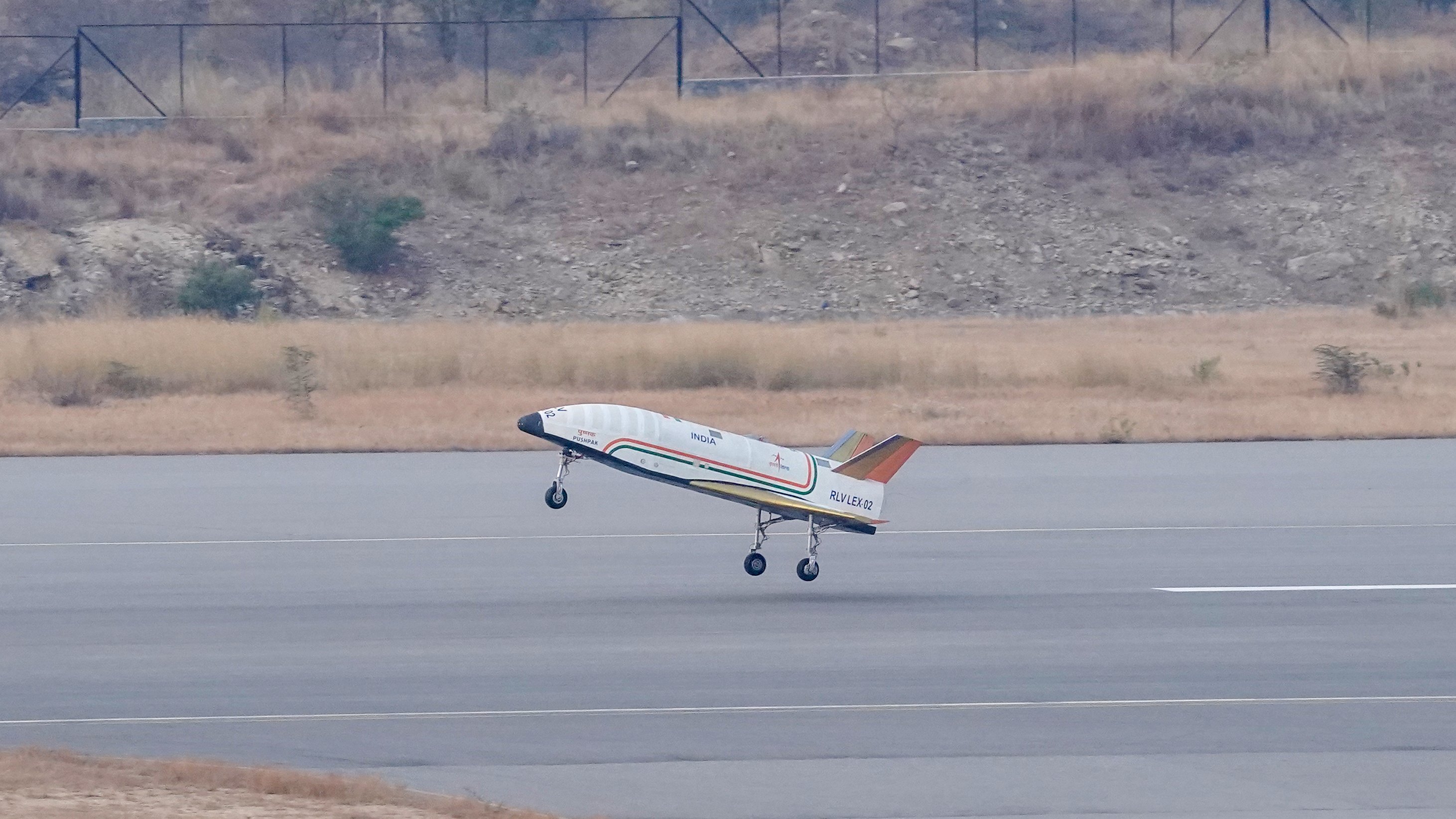
India's planned launches through March 2025

According to India’s space bureaucracy IN-SPACe, that nation has planned as many as 19 launches through March 2025.

The image to the right shows the manifest that IN-SPACe released. That agency is tasked with encouraging India’s private and independnt space industry, and it claims that 30 missions in total are planned, with half by commercial companies. This number however includes payloads and suborbital test missions, not just orbital launches. Based on the manifest to the right it appears that 19 of these missions are launches, with six being entirely private launches. One of those private launches, the first of Agnikul’s commercial Agnibaan rocket, will be suborbital.

It thus appears that in 2024 India hopes to complete 14 orbital launches. If so, this would double that nation’s previous record of seven launches in a single year. This schedule is very aspirational, with those six entirely commercial launches likely not all happening as planned.

0 comments

Vibration testing of Sierra Space’s Tenacity mini-shuttle completed

NASA engineers have now completed vibration testing of Sierra Space’s Tenacity mini-shuttle, set to launch on a Vulcan rocket later this year.

Reading between the blather in the NASA press release at the link, it appears that testing was successful, proving that the Dream Chaser spacecraft can survive the vibrations of launch. This conclusion by me however remains unconfirmed. Engineers are now preparing the mini-shuttle for environmental testing.

Next up, Dream Chaser will move to a huge, in-ground vacuum chamber that will continue to simulate the space environment Dream Chaser will encounter on its mission. The spaceplane will be put through its paces, experiencing low ambient pressures, low-background temperatures, and dynamic solar heating.

Previously the launch date had been targeting April 2024, according to ULA officials. It now appears, from the vagueness of recent reports, as well as the actual testing now in progress, that the launch date has slipped. They appear to be targeting the first half of 2024, but are as yet unwilling to commit to a date.

0 comments

A small Martian volcano?

A small Martian volcano?
Click for original image.

Cool image time! The picture to the right, cropped, reduced, and sharpened to post here, was taken on December 21, 2023 by the high resolution camera on Mars Reconnaissance Orbiter (MRO). The science team labeled it a “fresh crater”, but that description I think is misleading, as it implies a recent impact.

The crater does not look like a fresh impact crater to me. Such things on Mars usually appear very dark, as the impact dredges up dark material. This crater is not dark. More significant is the crater itself. The small 300-foot-wide inner crater, surrounded by a circular plateau and all sitting inside the larger 1,200-foot-wide crater is completely unique compared to any impact crater I have ever seen. Impacts in soft material, such as ice-impregnated ground, can cause concentric ripple rings, but they don’t look like this.

Instead, this crater more resembles the caldera of a volcano, where subsequent eruptions can produce overlapping depressions at the volcano peak. (See for example this picture of Olympus Mons.)

Moreover, the crater sits on top of a peak approximately 300 feet high. While impacts in ice-impregnated ground on Mars can produce splash aprons as seen here, the crater usually sits at about the same elevation as the surrounding terrain, not at the top of a peak. This peak suggests the apron was forned not by a splash but repeated flows coming down from the top.
» Read more

0 comments

Freedom capsule undocks from ISS with AX-3 commercial crew

SpaceX’s Freedom capsule today undocked from ISS at 9:20 am (Eastern), carrying three European passengers and one commander, with a planned splashdown in the Atlantic off the coast of Florida at 8:30 am (Eastern) on February 9, 2024.

Ax-3 astronauts Michael López-Alegría, Walter Villadei, Marcus Wandt, and Alper Gezeravci will complete 18 days aboard the orbiting laboratory at the conclusion of their mission. The SpaceX Dragon will return to Earth with more than 550 pounds of science and supplies, including NASA experiments and hardware.

Live stream for that splashdown can be found here. The mission is a private one. Axiom sold the tickets, and purchased from SpaceX the Falcon 9 launch and use of its Freedom capsule. It also rented time on ISS from NASA for its crew and passengers.

6 comments

Computer problem on Voyager-1 remains unsolved

Engineers remain baffled over a computer issue that has prevented the receipt of any data since November 2023 from Voyager-1, floating some 15 billion miles away just outside the solar system in interstellar space.

In November, the data packages transmitted by Voyager 1 manifested a repeating pattern of ones and zeros as if it were stuck, according to NASA. Dodd said engineers at JPL have spent the better part of three months trying to diagnose the cause of the problem. She said the engineering team is “99.9 percent sure” the problem originated in the FDS [Flight Data Subsystem], which appears to be having trouble “frame syncing” data.

So far, the ground team believes the most likely explanation for the problem is a bit of corrupted memory in the FDS. However, because of the computer hangup, engineers lack detailed data from Voyager 1 that might lead them to the root of the issue. “It’s likely somewhere in the FDS memory,” Dodd said. “A bit got flipped or corrupted. But without the telemetry, we can’t see where that FDS memory corruption is.”

Since November the only signal received from Voyager-1 is a carrier signal that simply tells engineers the spacecraft is alive. Though the effort continues to try to fix the spacecraft, the odds of bringing it back to life are becoming slim, especially because its power supply will run out in 2026 at the very latest. Even if they manage to fix the issue now, the spacecraft has only a short time left regardless.

Considering the computers on this spacecraft, as well as its twin Voyager-2, have been operating continuously for almost a half century since their launch in 1977, their failure now is nothing to be ashamed of. The engineers that built both did well, to put it mildly.

As for Voyager-1’s future, even dead it will fly on into interstellar space, eventually getting within 1.5 light years of a star in the constellation Camelopardalis.

2 comments

Curiosity’s damaged wheels continue to appear stable despite the rough Martian terrain

A new look at Curiosity's worst wheel
To see the original images, go here and here.

The rover Curiosity on Mars has for more than two years been traveling across a very rocky and rough terrain as it climbs higher and higher on Mount Sharp inside Gale Crater. Since the rover’s wheels experienced far more damage than expected early in its mission, when it was on the floor of the crater where the terrain was not as severe, engineers have adopted a whole range of techniques to try to reduce any further damage.

First, they increased the safety margins on the software that guides Curiosity. It picks its way very carefully through the rocks, and stops immediately if it finds itself crossing terrain that is too rough.

Second, the science team does a photo survey of the wheels after every kilometer of travel. The two pictures to the right compare the damage on the rover’s most damaged wheel, with an image from the previous survey on top and the most recent image, taken yesterday, on the bottom. I have numbered the same treads, called grousers, in the two images to make it easier to compare them.

As you can see, it does not appear as if the damage has increased in the 210 sols or seven months of travel since the last survey. This wheel looks bad, but it is the worst wheel on the rover, and the strategies that the engineering team adopted years ago to reduce further damage continue to work, even as Curiosity traverses some very rough ground.

The software requires the rover to travel shorter distances in each drive when the ground is this rough, but the consequence is that it will last much longer, and thus have a better chance of reaching higher elevations on Mount Sharp.

0 comments

SpaceX’s revenue estimate for 2024 is $13.3 billion

According to an independent analysis of SpaceX’s announced launch plans for 2024, the company’s revenue in 2024 is predicted to be somewhere around $13.3 billion, including earnings from Starlink subscribers.

This independent estimate is less than SpaceX’s own projection of $15 billion, but what is important is that the revenue in 2024 equals approximately the total amount of investment capital that SpaceX has raised for Starship/Superheavy and Starlink. Add to this the estimated revenues from 2023, $8 billion, and it appears SpaceX is in a very healthy position to complete the construction of Starship and begin flying it regularly for profit.

6 comments

Perseverance snaps its first picture of grounded Ingenuity

Overview map
Click for interactive map.

Ingenuity on dune, as seen by Perseverance on February 4, 2024
Click for original image.

Perseverance on February 4, 2024 finally moved into a position where it was close enough to take its first picture of the now grounded Ingenuity helicopter. That picture, cropped, reduced, and enhanced to post here, is to the right, taken by the rover’s left high resolution camera. You can see Ingenuity sitting on the slope of a dune near the upper right.

The overview map above provides the context. The green dot marks Ingenuity’s final resting spot. The blue dot marks Perseverance’s present location, with the yellow lines indicating approximately the area covered by the photo.

Whether the rover is now close enough to get good imagery for a final engineering test of Ingenuity — where its rotors will be rotated and shifted slowly to determine the extent of the propeller damage — is not clear. Perseverance could move much closer, but its science team might not want to cross these dunes out of fear the rover would get stuck. They might move forward a few more feet, to the top of the south bank of Neretva Vallis, before doing that test.

7 comments
1 147 148 149 150 151 814