A distant globular cluster

A distant globular cluster
Click for original image.

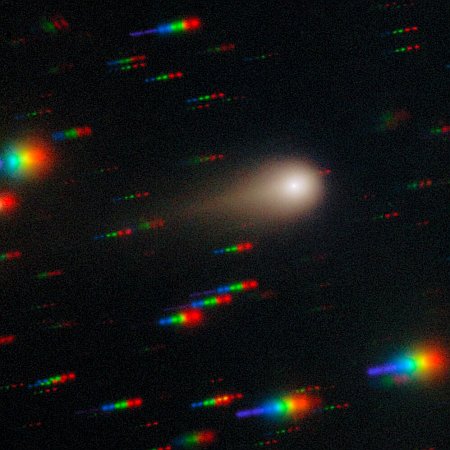
Cool image time! The picture to the right, cropped, reduced, and sharpened to post here, was taken by the Hubble Space Telescope as part of a research project to study globular clusters in galaxies other than the Milky Way.

The data for this image comes from an observing programme comparing old globular clusters in nearby dwarf galaxies — the LMC [Large Magellanic Cloud], the Small Magellanic Cloud and the Fornax dwarf spheroidal galaxy — to the globular clusters in the Milky Way galaxy. Our galaxy contains over 150 of these old, spherical collections of tightly-bound stars, which have been studied in depth — especially with Hubble Space Telescope images like this one, which show them in previously-unattainable detail. Being very stable and long-lived, they act as galactic time capsules, preserving stars from the earliest stages of a galaxy’s formation.

Astronomers once thought that the stars in a globular cluster all formed together at about the same time, but study of the old globular clusters in our galaxy has uncovered multiple populations of stars with different ages. In order to use globular clusters as historical markers, we must understand how they form and where these stars of varying ages come from. This observing programme examined old globular clusters like NGC 1786 [pictured] in these external galaxies to see if they, too, contain multiple populations of stars. This research can tell us more not only about how the LMC was originally formed, but the Milky Way Galaxy, too.

This cluster, discovered in 1835 by John Herschel, is about 160,000 light years away.

2 comments

Suborbital test launch from Oman’s Duqm spaceport scrubbed

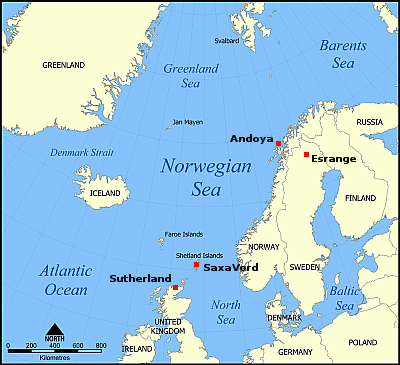
Middle East, showing Oman's proposed spaceport
The Middle East, showing the location of
Oman’s proposed spaceport at Duqm.

A suborbital test launch from Oman’s Duqm spaceport was scrubbed yesterday due to” a technical issue” with the rocket.

DUQM: Etlaq Spaceport’s highly anticipated experimental rocket launch mission “Duqm-2” was aborted due to a technical issue on Sunday, July 13, 2025. Consequently, the launch has been postponed until “a replacement solution is developed,” it stated.

This was the second attempt launch scrubbed at Duqm, officially labeled the Etlaq Spaceport. The first, an attempt by a Middle East startup to do a vertical take-off and landing of a prototype small rocket, was scrubbed in April due to weather and technical issues. No new launch date has been scheduled.

The spaceport had announced in April a schedule of five launches before the end of the year. Two have now been scrubbed. All appear to have major financing from the Oman government. I suspect all have been pushed too hard and too fast by the government for PR reasons, which explains the two scrubs and the lack of a new launch schedule.

1 comment

Dragon capsule undocks from ISS carrying four Axiom’s passengers

After spending 18 days in space, 14 on ISS, the Dragon capsule early this morning undocked from ISS with a splashdown scheduled for early tomorrow.

The mission was financed by the space station company Axiom, and was commanded by former NASA astronaut Peggy Whitson, now employed by Axiom as a professional astronaut. The three paying passengers were all government astronauts from India, Poland, and Hungary.

The capsule, dubbed Grace, is the newest addition to SpaceX’s fleet of five manned reusable capsules, flying on its first mission.

Splashdown is scheduled for the wee hours of July 15th tomorrow off the coast of California. The live stream can be found here.

0 comments

SpaceX launches geosynchronous satellite for unnamed customer

SpaceX tonight successfully launched a geosynchronous satellite for unnamed customer, its Falcon 9 rocket lifting off from Cape Canaveral in Florida.

The first stage completed its thirteenth flight, landing on a drone ship in the Atlantic. The fairings completed their fourteenth and eighteenth flights respectively. No information about the satellite was released, including ending the live stream right after the first stage landed while providing no information about the satellite’s orbit after stage separation.

The leaders in the 2025 launch race:

86 SpaceX
36 China
10 Rocket Lab
8 Russia

SpaceX now leads the rest of the world in successful launches, 86 to 63.

6 comments

First suborbital launch of Taiwan rocket startup fails

The first suborbital launch of the Taiwan rocket startup Tispace failed today shortly after lift-off from a new commercial spaceport on the northern island of Hokkaido in Japan.

The rocket took off from Hokkaido Space Port at 11:40 a.m. local time, but it was soon seen drifting, with smoke escaping. Footage of the launch was shown by NHK News on its website.

Nobody was reported injured in the incident, and the rocket was not carrying any payload. The first launch of a foreign-made rocket from Hokkaido served to test its engine’s capabilities, the report said.

The rocket startup was formed in 2016 and originally wanted to launch from Taiwan. After legal issues blocked that launch site it then attempted to arrange a launch from Australia. It appears similar red tape issues forced it to switch to Japan.

3 comments

Weird drainages on Mars

Weird drainages on Mars
Click for original image.

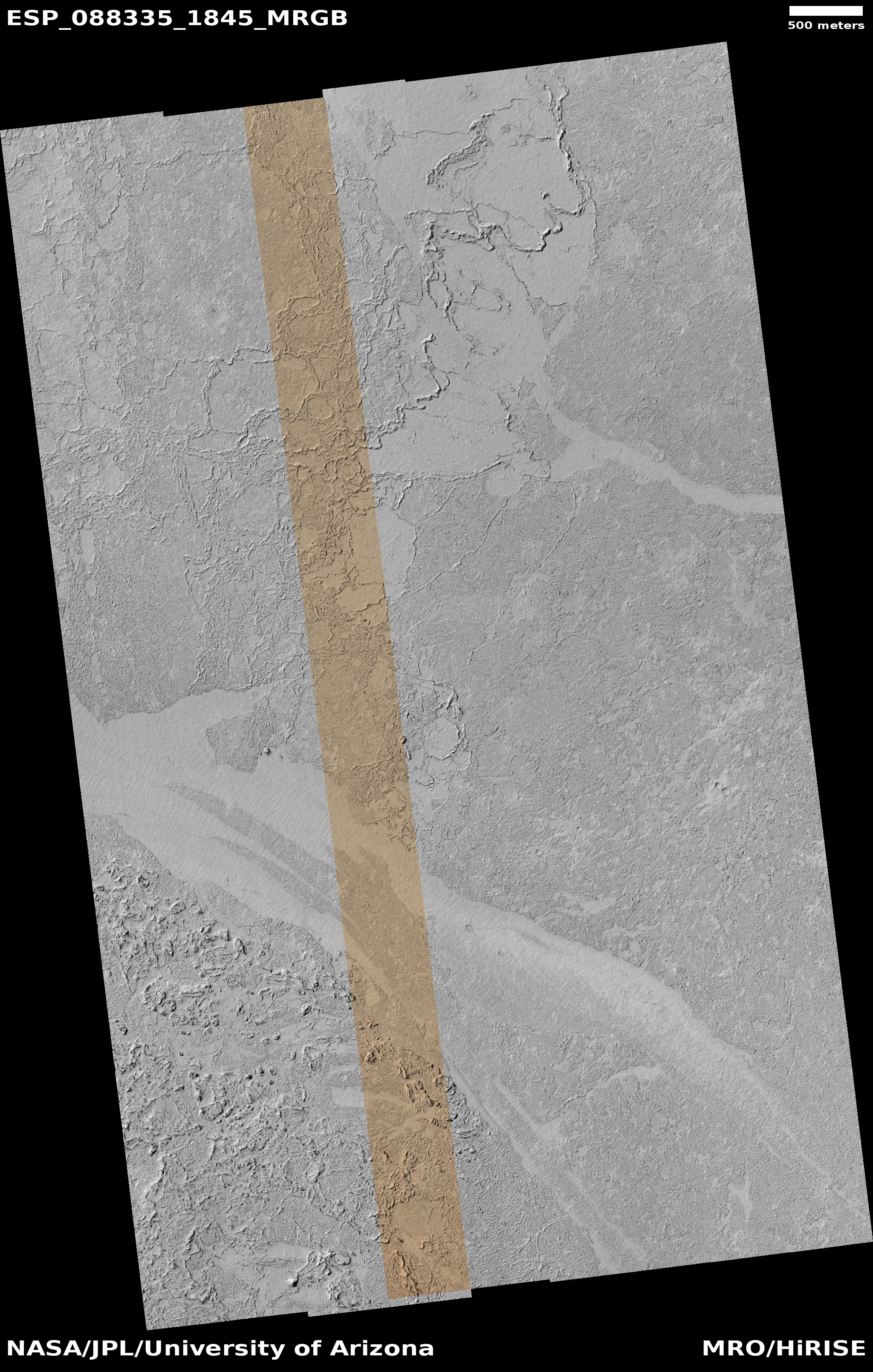
Cool image time! The picture to the right, cropped, reduced, and sharpened to post here, was taken on Februay 11, 2025 by the high resolution camera on Mars Reconnaissance Orbiter (MRO). The camera team posted it yesterday as their own cool image, labeling it “A Fissure and Channel near Pavonis Mons”. From the caption:

A linear trough strikes northeast, then abruptly ends (or changes into a narrow ridge). Where the trough ends, a sinuous channel has an east-southeast strike, trending at almost a right angle to the trough. What happened to form these features?

We can speculate that first there was a southwest-to-northeast trending fracture or fault, perhaps associated with a volcanic vent. Groundwater (or some other runny fluid) coursed through the fault until overflowing and forming the sinuous channel. Continued movement through the fault carved a trough up to the overflow point.

The arrows indicate the downhill grades. Though this caption mentions groundwater, it is far more likely that the “runny fluid” was lava, as shown by the overview map below.
» Read more

1 comment

Varda raises another $187 million in private investment capital

Varda's third capsule, on the ground in Australia
Varda’s third capsule, on the ground in Australia.
Click for original image.

The in-space manufacturing startup Varda has now raised another $187 million in private investment capital, bringing the total cash the company has raised to $329 million.

The $187 million fundraise was led by Natural Capital and Shrug Capital, with participation from Founders Fund, Peter Thiel, Khosla Ventures, Caffeinated Capital, Lux Capital, and Also Capital. Since launching their first mission, W-1, in 2023, Varda has completed three successful launch and return missions, with a fourth, W-4, currently in orbit and a fifth expected to launch before the end of the year.

…”With this capital, Varda will continue to increase our flight cadence and build out the pharmaceutical lab that will deliver the world’s first microgravity-enabled drug formulation,” said Varda CEO Will Bruey.

Varda has expanded its footprint terrestrially as well, opening an office in Huntsville, Ala. and a new 10,000 square foot laboratory space in El Segundo, which will allow its pharmaceutical scientists to begin working on developing processes to crystallize biologics, such as monoclonal antibodies. As of 2022, the market size for monoclonal antibodies is estimated to be $210.06 billion.

As I have noted previously, a real market for pharmaceuticals produced in weightlessness has existed for decades. It appears Varda is now well placed to be the first to make money doing so, using its returnable capsules.

One more note: These products and this industry could have been developed on ISS, but NASA has banned all profit-making commercial manufacturing projects there from the station’s beginning. You can do research, but you are forbidden to create any products for sale later on Earth. This strange policy is left over from before the station, when Reagan discontinued all commercial missions on the shuttle following the Challenger accident.

0 comments

SpaceX gets approval to build oxygen plant at Boca Chica

SpaceX today received the okay from Cameron County to build a plant at Boca Chica to produce oxygen from the atmosphere for use in its Superheavy/Starship rocket.

The commissioners voted, 3-1, to give Elon Musk’s rocket company a beachfront construction certificate and dune protection permit, allowing the company to build a modern-day factory akin to an oil refinery to produce gases needed for space flight launches.

The plant will consist of 20 structures on 1.66 acres. The enclosed site will include a tower that will reach 159 feet, or about 15 stories high, much shorter than the nearby launch tower, which stretches 480 feet high. It is set to be built about 280 feet inland from the line of vegetation, which is where the dunes begin. The factory will separate air into nitrogen and oxygen. SpaceX utilizes liquid oxygen as a propellant and liquid nitrogen for testing and operations.

By having the facility on site, SpaceX hopes to make the delivery of those gases more efficient by eliminating the need to have dozens of trucks deliver them from Brownsville. The company says they need more than 200 trucks of liquid nitrogen and oxygen delivered for each launch, a SpaceX engineer told the county during a meeting last week.

As usual, the same cranks who always complain about this stuff are given space by this news outlet to whine, but the truth is that the commission’s vote well reflects the attitude of the local community. It supports what SpaceX is doing, because of the prosperity the company is bringing to this formerly depressed region.

Moreover, this facility will not only save SpaceX money and make it easier to launch more frequently, it is likely environmentally beneficial. I suspect the facility will be relatively clean compared to the truck convoys it will replace.

Hat tip Robert Pratt of Pratt on Texas.

6 comments

Why did Trump suddenly pick Transportation Secretary Sean Duffy to become temporary head of NASA?

The reason for Trump’s sudden decision yesterday to name Transportation Secretary Sean Duffy as interim NASA administrator, replacing long-time NASA manager Janet Piro — who had held the job since Trump took office — remains unclear.

This article suggests the president wanted someone with more political clout who was also part of his inner circle.

Two articles (here and here) imply the decision was related to the recent clashes politically between Trump and Musk, adding that Duffy and Musk have been reported to be in conflict over air traffic controller issues. Picking Duffy thus directly reduces Musk’s influence at NASA.

The truth is that we really don’t know exactly what motives brought Trump to make this appointment. It could be that Trump wants someone in charge who will have the political clout to push through his proposed NASA cuts. It also could be Trump wants someone with that clout to review those cuts and change them.

The bottom line is that NASA remains a political football, a situation that in the end had done decades of harm to the American space industry. The sooner it can be made irrelevant and replaced by a commercial, competitive, and (most important) profitable space industry, the better.

We really don’t need a “space agency.” We didn’t have such a thing when we settled the American west.

9 comments

SpaceX finally passes final regulatory hurdle to sell Starlink in India

You might get deja-vu from this story, since I have reported repeatedly in the past that SpaceX has finally gotten regulatory approval to sell Starlink in India.

However, India’s complex regulatory framework — leftover from the days of British rule and strengthened for decades after independence when the strongly socialist Congress Party ruled — ended up requiring SpaceX to leap multiple regulatory hurdles to get the Starlink approved. According to news reports today, that last licensing hurdle has now finally been leaped.

The final approval marks a crucial milestone that will pave the way for the Musk-led company to launch its commercial satellite operations in the country. The Elon Musk-led company has been waiting for regulatory approvals since 2022 to operate legally in India. With this approval, Starlink has become the third company to enter the satellite space in India after Reliance Jio and Eutelsat’s OneWeb, in which Bharti Airtel, led by Sunil Mittal, is a shareholder.

Does this mean SpaceX can now sell Starlink in India? Of course not:

The next step for Starlink is to secure spectrum from the government, which will likely be assigned in the coming months. It also needs to set up infrastructure on the ground. One of the most critical aspects of Starlink’s India foray will be its compliance with the country’s security rules.

Since Starlink doesn’t need a complex ground infrastructure, selling terminals directly to customers, the infrastructure mentioned in the quote likely involves partnering Starlink operations with the Indian telecommunications companies Airtell and Jio, so that they get a piece of the action.

0 comments

New census of inverted channels on Mars strongly suggests the planet once had more water

Martian ridges that imitate rivers
Click for original image.

A new review of inverted channels on Mars now strongly suggests that the red planet was once far wetter than presently seen, with the channels implying the existence of liquid rivers.

The discovery of more than 15,000 kilometres of ancient riverbeds on Mars suggests that the Red Planet may once have been much wetter than previously thought. Researchers looked at fluvial sinuous ridges, also known as inverted channels, across Noachis Terra – a region in Mars’ southern highlands. These are believed to have formed when sediment deposited by rivers hardened and was later exposed as the surrounding material eroded.

Similar ridges have been found across a range of terrains on Mars. Their presence suggests that flowing water was once widespread in this region of Mars, with precipitation being the most likely source of this water.

The image to the right is a good example of an inverted channel, a previous cool image posted in April 2025. It is located not in Noachis Terra but in the northern lowland plains.

The researchers argue that these channels suggest that about 3.7 billion years ago there were flowing liquid rivers on Mars, fed by precipitation. This conclusion however still does not explain how this could happen on a planet that is too cold with too thin an atmosphere for liquid water to exist. Every model so far proposed to make Mars warmer with a thicker atmosphere in the distant past remains questionable with many holes.

Could the inverted channels have been created by glacial activity, ice instead of liquid water? At present we don’t know enough about the Mars environment and the physics of such things in the planet’s one-third gravity to answer that question. It is however a question that scientists I think should be asking, based on the extensive evidence of glacial activity in the Martian mid-latitudes.

The big takeaway from this study however is that it adds weight to the overall trend seen in the data, that over time the total amount of water on the planet has declined. We can see this in glaciers, for example, with later glacial flows always falling short of previous flows. This research shows that even in the dry tropics there was once ample water, even if we don’t yet know what form it took.

0 comments

Sightseeing near Starship’s candidate Martian landing sites

An interesting mesa near Starship's Martian landing zone
Click for original image.

Today’s cool image takes us sightseeing in the region on Mars that SpaceX has chosen for its prime landing zone for its Starship spaceship. The picture to the right, cropped, reduced, and sharpened to post here, was taken on May 29, 2025 by the high resolution camera on Mars Reconnaissance Orbiter (MRO), and shows a 465-foot-high unusually shaped mesa in this region.

The full resolution inset at the bottom of the picture focuses at the strange tilted layers on the southern slope of this mesa. Apparently the layers at this spot were pushed sideways so they lie significantly angled to the horizontal. Though it isn’t clear from this picture, it is possible that the mesa itself is made up of similar tilted layers, hidden below the surface. We can see the tilt only on the mesa’s southern flank because erosion has apparently exposed it.

Note also the black stain that surrounds the mesa. Though this might be caused by wind distributing dust, such stains have also been seen at a location where scientists suspect an inactive hot spring might exist, as well as another location where there may have been relatively recent volcanic activity.

Is this stain caused by any of these processes? In situ exploration would probably be necessary to find out. And we may soon actually have spaceships landing here in the relatively near future with the capability to do this.
» Read more

1 comment

ESA tests parachutes and guidance system for its proposed Space Rider reusable mini-shuttle

The engineering
Click for original image.

The European Space Agency (ESA) revealed today that it has completed drop tests from a helicopter of an engineering vehicle of its proposed Space Rider reusable mini-shuttle — similar in concept to the U.S. military’s X-37B — testing the spacecraft’s parachutes and re-entry guidance system.

The drop-test campaign had two objectives: the qualification of the parachutes used to slow the spacecraft during descent, and to test the software that controls the parafoil, guiding the Space Rider’s reentry module to its precise landing site. Space Rider models were dropped from a CH-47 Chinook Italian Army helicopter from altitudes ranging from 1 to 2.5 km, at the Italian military’s training and experimentation area Salto di Quirra.

The press release provides no movie of any of the drop tests, and the images it provides are almost all taken from very far away, making it impossible to see in detail what the engineering vehicle looks like. Only one picture clearly shows it, and that is what I have posted to the right. This is not a model of a spacecraft, but a square box carrying the parachutes and sensors.

Note also that ESA was doing similar drop tests last summer of a similar model. Apparently they aren’t yet ready to test the real thing.

This X-37B copy was first tested by ESA in 2015 and by 2017 the agency was promising it would be flying commercially by 2025. A decade later and they have not yet begun testing a full scale spacecraft. In addition, ESA has established some very complex rules about who can use it commercially, rules so complex I predict few will be interested.

Europe might be trying to adopt capitalism and freedom as its model, but in many ways it behaves as if it hasn’t the foggiest idea what it is doing.

6 comments

ISRO successfully tests thrusters to be used on its manned Gaganyaan capsule

India’s space agency ISRO last week successfully completed two tests of the attitude control thrusters that will be used on its manned Gaganyaan capsule.

In a statement issued on Wednesday, ISRO said that the short-duration tests, lasting 30 seconds and 100 seconds respectively, were aimed at validating the test article configuration. The space agency stated that the overall performance of the propulsion system during the hot tests had been normal and aligned with pre-test predictions.

It was also noted that during the 100-second test, the simultaneous operation of all Reaction Control System (RCS) thrusters in various modes—both steady state and pulsed—along with all Liquid Apogee Motor (LAM) engines had been successfully demonstrated.

The first unmanned test flight of Gaganyaan is presently targeting a launch in the last quarter of 2025, with two more unmanned test flights in 2026. The manned mission of one to three days would follow in 2027.

0 comments

Canadian rocket startup hopes to fly first suborbital launch from its proposed Newfoundland spaceport in August

Nordspace's proposed spaceport
Nordspace’s proposed spaceport. Click for original.

Though details remain slim, the Canadian rocket startup Nordspace now says it is targeting an August launch of its hopes to fly first suborbital launch from its proposed spaceport in August.

NordSpace’s Taiga rocket isn’t going to reach orbit when it launches in August, but it’s a big step toward the company’s ultimate goal. Taiga is a small, liquid-fueled, hypersonic launch vehicle capable of carrying just over 110 pounds (50 kilograms) above the Karman Line. This summer’s shakedown cruise will be a low-altitude demonstration of Taiga’s capabilities.

The map to the right indicates the location of the spaceport, near the town of St. Lawrence on the southern coast of the island of Newfoundland.

Whether this launch occurs is very uncertain. For example, a previous report in January 2025 about this launch site suggested that government approvals were still required. It is not known if those approvals have been obtained.

Nordspace is the second company in Canada to propose offering a combined spaceport/rocket service. The other, Maritime Launch Services, first appeared almost a decade ago, but has never gotten off the ground. Nordspace first announced its plans in July 2024, so achieving a first test launch in 2025 will clearly place it ahead of Maritime.

7 comments

SpaceX gets launch contract from Globalstar

As it appears right now to be the only American rocket company capable of taking on new launch contracts, SpaceX today was awarded a new launch contract from Globalstar to launch its third generation set of satellites.

The press release is not clear about the number of satellites or launches involved, but either way the deal signals SpaceX’s continuing dominance. For larger satellites it has no real competitors. Not only are its launch prices the cheapest, none of its competitors are capable of adding new customers to their launch manifests. In fact, those competitors, ULA, Arianespace, and Blue Origin, are having trouble simply getting their rockets off the ground on a regular basis.

This situation however is likely to change by two years, assuming the new rockets being developed by Rocket Lab, Stoke Space, and Relativity finally begin flying.

0 comments

Spanish high altitude balloon company to fly tourist flights from South Korea

The Spanish high altitude balloon startup Zero-2-Infinity has now established an office in South Korea with the intention of flying tourist flights from there for a ticket price of about $60k per flight.

Zero 2 Infinity plans to begin its Korean operations with a project called “Byul” — the Korean word for star — which offers a symbolic farewell for pet lovers. The initiative will invite volunteers to send the ashes of their deceased furry companions into the stratosphere, carried in star-shaped, biodegradable capsules. The company aims to begin collecting participants this September, with the first near-space release scheduled for December in Korea.

Byul will apparently be a smaller balloon with no human passengers. The company claims it has already test flown a larger helium balloon with humans aboard to an altitude of 6 miles, and again unmanned to 20 miles. If so it has done so with no publicity at all. This announcement today appears more a push to raise the $70 million the company says it needs to develop this manned balloon capsule.

3 comments

SpaceX launches 28 Starlink satellites

After an unusual pause of launches of several days (likely due to the July 4th weekend), SpaceX last night successfully launched by placing another 28 Starlink satellites into orbit, its Falcon 9 rocket lifting off from Cape Canaveral in Florida.

The first stage completed its 22nd flight, landing on a drone ship in the Atlantic.

The leaders in the 2025 launch race:

85 SpaceX
36 China
10 Rocket Lab
8 Russia

SpaceX now leads the rest of the world in successful launches, 85 to 63.

0 comments

Returning to Mars’ glacier country

Overview map

Returning to Mars' glacier country
Click for original image.

Today’s cool image illustrates again why I rail against those who still claim Mars is dry. The picture to the right, cropped, reduced, and sharpened to post here, was taken on June 2, 2025 by the high resolution camera on Mars Reconnaissance Orbiter (MRO).

The picture was labeled simply as a “terrain sample” by the MRO camera team, which almost always signifies that it was taken not as part of any specific science research project or by request by a scientist, but to fill a gap in the camera’s schedule in order to maintain its proper temperature. When such a gap-filler picture is required, the team tries to pick interesting features in that time frame, but don’t always succeed.

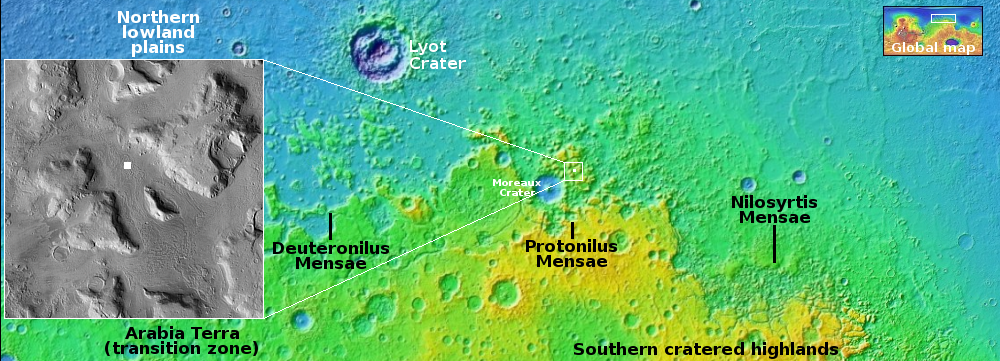
In this case, that time frame placed MRO over the northern mid-latitudes and a region I label “glacier country” because practically every picture taken in this region shows glacial features. This picture is no exception. The white dot in the overview map above marks the location, in the Protonilus Mensae area of the 2,000-mile-long strip of glaciers. The arrow in the picture itself shows the downward grade of the glacial flow. The small 2,000-foot-wide crater appears as if the impact occurred on soft ice, and the stippled terrain surrounding it appears to resemble the feature geologists have labeled “brain terrain”, a surface feature unique to Mars and associated with near surface ice, though its exact formation process is not yet understood.

Nor have I cherry-picked this image to prove my point. Its glacial-like features are very typical for this region of Mars. Note for example the inset with the larger crater to the northeast. It appears almost buried by this glacial material, which has poured through the gap in its southwest quadrant to fill it. A close look at all the low lying terrain shows similar glacial-like flows.

Mars is surely not a paradise. It is bone-chillingly cold almost all the time. Its atmosphere is so thin and lacking in oxygen you would quickly suffocate if you tried to breath it. But the data continues to suggest that the red planet has ample supplies of near-surface ice outside of its dry tropics. All future colonists will need to do is dig a bit and process the water out.

1 comment
1 56 57 58 59 60 814