
Craters, craters, everywhere

Below the fold are two images released today, one from Dawn at Vesta and the other from Messenger at Mercury. What makes them interesting to me is that, though the surfaces of both Vesta and Mercury are crater-packed, there are definitely distinct differences between them that one can spot if you look closely, all highlighting the fundamentally different environments of both worlds.

First, the Vesta photograph. The image looks out past the asteroid’s horizon, showing clearly that this dwarf planet is not spherical, with the south pole depression that puzzles scientists just on the planet’s limb. The parallel long deep grooves that are associated with this depression can be seen on the right. Notice also that the inside walls of all the craters slope downward in a very shallow manner. This gives the impression that the impacts that formed these craters smashed into an almost beachlike sandy surface. Note too the that the center of some craters have what appear to be flat small “ponds,” a phenomenon seen by the spacecraft NEAR when it orbited the asteroid Eros. These ponds are not liquid, but are actually made up of fine-grained particles that settle in the hollows of the asteroid.
» Read more
1 comment

NASA announces awards for three technology demonstration space missions

NASA has announced three awards for technology demonstration space missions, all set to fly within four years. More details here.

The three missions are:

  • A solar sail demonstration mission, flying a sail 38 by 38 meter sail.
  • A demonstration of in-space laser/optical communications technologies.
  • The use of a high-precision atomic clock in space.

I especially like the solar sail mission because of its long range possibilities, though the other technologies would probably be put to practical use more quickly.

0 comments

The new commercial space companies question NASA contracting policies

The new commercial space companies are challenging NASA’s new contracting policy.

The article covers the conflict that I described in this post, whereby NASA is abandoning the more flexible contracting approach used for the commercial cargo contracts of SpaceX and Orbital Sciences and going instead with the contracting system it used for all past NASA subcontracts.

The article is errs badly when it calls the new contracting approach that NASA wants to use “non-traditional.” It is instead the way NASA has been doing things for decades, whereby the agency takes full control of everything and requires contractors to fill out so much paperwork that the costs double and triple.

0 comments

New images from Opportunity

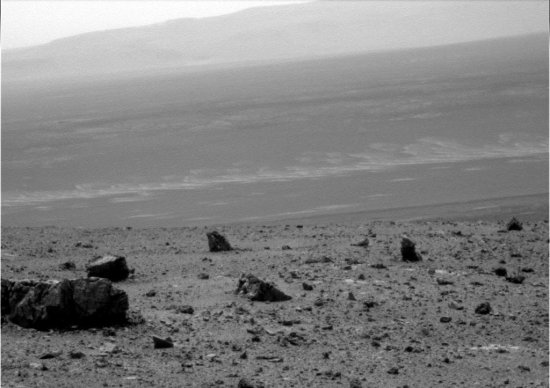
Opportunity begins exploring the rim of Endeavour Crater, taking a bunch of new images . I especially like this one, of which I’ve posted a cropped scaled-down version below. The image looks across the 13-mile-wide Endeavour Crater to its far rim on the horizon. Note the haze. Mars very clearly has an atmosphere, even though it is far thinner than Earth’s. In the foreground are scattered rocks, ejecta produced from the impact that formed a smaller nearby crater now named Opportunity Crater.

Endeavour Crater as seen by Opportunity

1 comment

Space Boat: A Nautical Mission to an Alien Sea

The Titan Mare Explorer: A nautical mission to an alien sea.

If [NASA] green-lights the mission, the capsule will lift off in 2016. By 2023, TiME will be about 800 million miles away in Titan’s north-polar region, home to its biggest lakes and seas. The capsule will take photographs, collect meteorological data, measure depth, and analyze samples. TiME will have no means of propulsion once it is on Titan, so it will float, carried by breezes across the sea’s surface. Then, by the mid-2020s, it will enter a decade-long winter of darkness as the moon’s orbit takes it to the dark side of Saturn, away from the sun and communication. It won’t have a line of sight to Earth to beam back more data until 2035.

1 comment

Using a solar sail to deflect an earth-destroying asteroid

solar sail mission to Apophis

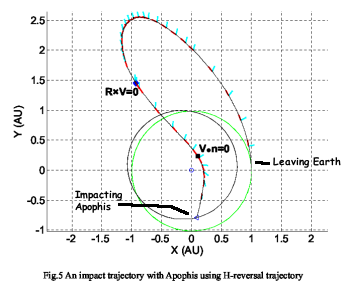
In a paper published today on the Los Alamos astro-ph preprint website, two Chinese scientists have proposed using a solar sail for deflecting any asteroid that happens to be aimed at the earth. The diagram to the right is their simulated mission to impact the asteroid Apophis, which will pass close to the earth in 2029 and — depending on whether that flyby puts it through a very small 600 meter-wide mathematical “keyhole” — could then return in 2036 on a collision course.

The idea is to use the sail to slow the spacecraft down enough so that it starts to fall towards the sun. The sail is then used to maneuver it into a retrograde orbit. When it impacts the asteroid the impact will therefore be similar to a head-on collision, thereby imputing the most energy in the least amount of time with the least amount of rocket fuel. In their Apophis simulation, a mission, weighing only 10 kilograms (about 22 pounds), launched around 2025, and hitting the asteroid in this manner in 2026, would deflect its flyby in 2029 enough to guarantee it will not fly through the “keyhole” and therefore eliminate any chance of it hitting the earth in 2036.

Obviously many questions must be answered before such a mission should fly.
» Read more

1 comment

American manned space: dependent on the Russians in more ways than you think

American manned space: dependent on the Russians in more ways than you think.

As commentators from around the country gnash their teeth at U.S. dependence upon Russia to move cargo and astronauts to the mostly U.S. built/funded International Space Station (ISS), they’ve missed the bigger boat: With one exception, all the commercial spaceflight offerings currently in the works have Soviet or Russian engines as a key part of the rockets involved.

1 comment
1 772 773 774 775 776 814