
New San Francisco Bay Bridge nears completion
New San Francisco Bay Bridge nears completion.
New San Francisco Bay Bridge nears completion.
Good news: The Russians have pinned down a preliminary cause for the Progress launch failure last week.
Solving this quickly appears essential, as the space station was not really designed to fly unmanned.
Past NASA risk assessments show there is a one in 10 chance of losing the station within six months if astronauts and cosmonauts are not onboard to deal with any critical systems failures. The probability soars to a frightening one in two chance — a 50-percent probability — if the station is left without a crew for a year.
Yesterday I posted a link to a story about Al Gore claiming that any expression of skepticism about global warming is to him no different than racism. Here again is what Gore said,
“There came a time when friends or people you work with or people you were in clubs with — you’re much younger than me so you didn’t have to go through this personally — but there came a time when racist comments would come up in the course of the conversation and in years past they were just natural. Then there came a time when people would say, ‘Hey, man why do you talk that way, I mean that is wrong. I don’t go for that so don’t talk that way around me. I just don’t believe that.’ That happened in millions of conversations and slowly the conversation was won. We have to win the conversation on climate.”
More than at any other time, Gore here has very successfully illustrated the differences between how climate skeptics debate the scientific questions of climate change versus how global warming advocates do it.
» Read more
It’s now official: The Russians will postpone the launch of the next crew to ISS, as well as delaying the return of one crew presently on board.
Clark Lindsey has written a very nice and short summary of the present political battles over NASA’s budget and its future manned space rockets.
The space station could be abandoned in November if the Russians haven’t solved their rocket problems by then.
An evening pause: hat tip to George.
Both the FAA and European regulators have certified Boeing’s new 787 airplane for its first commercial flight
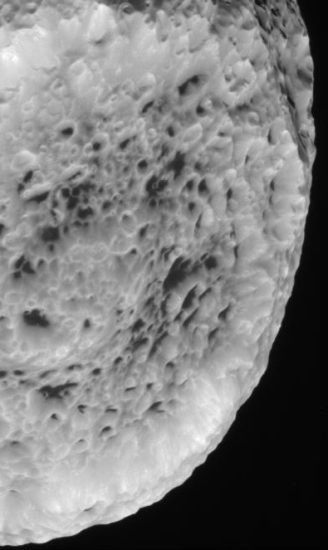
On August 25 Cassini did a close fly-by of the small Saturn moon Hyperion, getting as close as 15,500 miles. The mission has just released images from that fly-by.
Looks like a sponge, doesn’t it? This moon is small, only 168 miles across, which makes it about half the size of the asteroid Vesta that Dawn is presently orbiting. Why it is so peppered with craters is of course the big science question. I would guess this has something to do with the environment around Saturn, with its rings and the innumerable particles that come from it. Yet, other moons of Saturn are not as crater-filled, so there is obviously more to this than meets the eye.
This fly-by was the second closest of Hyperion that Cassini has done, the first passing over the the moon’s surface by only 310 miles. Because the irregularly-shaped moon’s rotation is more like a chaotic tumble, scientists could not predict what part of the surface they would see. To their luck the new images captured new territory.
Another fly-by is scheduled in only three weeks, on September 16, 2011. This time, however, the spacecraft won’t get as close, passing at a distance of about 36,000 miles.
It’s not just space where we are dependent on the Russians: The National Science Foundation has just hired a Russian icebreaker “to escort resupply and refueling ships into McMurdo Station,” the hub of U.S. activities on Antarctica.
Because of this week’s Progress freighter launch failure, Russia plans two unmanned test launches of its Soyuz rockets before flying crews on them to ISS.
One of these test launches will carry a new Progress freighter, with supplies for ISS.
If you are on the east coast, this post is for you: Preparing for Hurricane Irene.
The science team of Lunar Reconnaissance Orbiter released an intriguing picture yesterday of what scientists call a granular flow down the side of a five mile wide crater on the far side of the moon. Looking at the image, one would swear that the darker material flowing down the slope of the crater rim is a lava flow frozen in place.
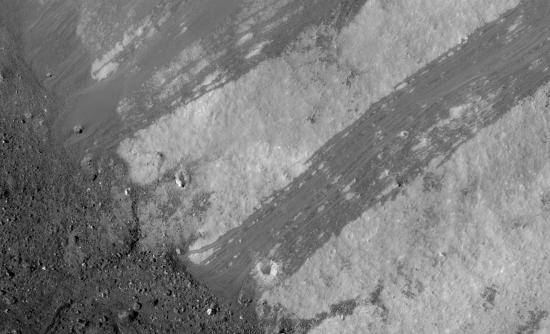
However, according to the scientists, that is not what it is. Instead, this is merely debris left behind from an avalanche.
» Read more
Divers have recovered the telegraph and some of the steering equipment from the Lusitania.
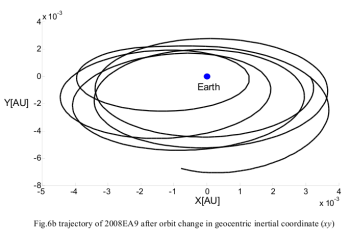
Want to mine an asteroid? Rather than travel to it with all their mining equipment, three Chinese scientists have proposed a better way. In a paper published today on the Los Alamos astro-ph preprint website, they have calculated the energy required to shift the orbits of the six thousand near-Earth asteroids and place them in Earth orbit for later mining. Of these, they found 46 asteroids that had the potential for such an operation, and two likely candidates for a space mission. One 30-foot-wide asteroid, 2008EA9, will actually be in the right place for this technique in 2049. As they write,
It can be seen that the velocity increment of the 2008EA9 is relatively small (-1.00km/s) and it will very close approach [approximately 645,000 miles] to the Earth in [February] 2049. Moreover the size of the NEO 2008EA9 is very small so that the capturing of it is relatively easy.
The real problem, of course, is adding that small “velocity increment” to the asteroid.
» Read more
The launch of a Progress freighter to ISS today has failed, with the freighter ending up crashing into Siberia.
This is very bad news for the station. Everyone in the space industry knows that with the shuttle gone, it will be a challenge to maintain supplies to the station’s the six-person crew. Losing just one supply ship will strain the station’s supplies, if not now in the long run for sure.
Worse, this is the first launch failure of the Soyuz rocket that puts both Progress and manned Soyuz capsule into orbit in more than eleven years. The next manned crew is scheduled for launch on September 21. Whether this failure will delay that launch remains unknown.
Surprise, surprise! An independent analysis of NASA’s budget estimates to build Congress’s heavy-lift rocket, the program-formerly-called-Constellation, are untrustworthy and likely low.
“All three program estimates assume large, unsubstantiated, future cost efficiencies leading to the impression that they are optimistic,” the team said in its key findings. A risk assessment revealed the funding reserves projected for all three programs are insufficient, according to Booz Allen Hamilton. NASA has not disclosed its internal cost estimate for the Space Launch System. “Due to procurement of items still in development and large cost risks in the out years, NASA cannot have full confidence in the estimates for long-term planning,” the executive summary said.
This project is nothing more than Congressional pork. It will never get built. Sadly, it might waste a lot of money before it never gets built.
Buses vs high speed trains: the buses win.
Blue Origin, one of the four commercial companies NASA hopes to use to get crew up and down from ISS, plans to do a test flight tomorrow. Hat tip to SpaceRef.
This company, founded by Jeff Bezos of amazon.com, has generally released very little information about their effort.
Bigelow Aerospace is in negotiations with both NASA and Japan to supply ISS with privately-built modules
The module could be rented out as an ISS storage unit, making the station less dependent on frequent resupply flights, says Hiroshi Kikuchi of JAMSS. To show that the modules are capable of safe, crewed operation, Bigelow is also negotiating with NASA to attach one to a US-owned ISS module.
.