New images of Apollo landing sites on the Moon

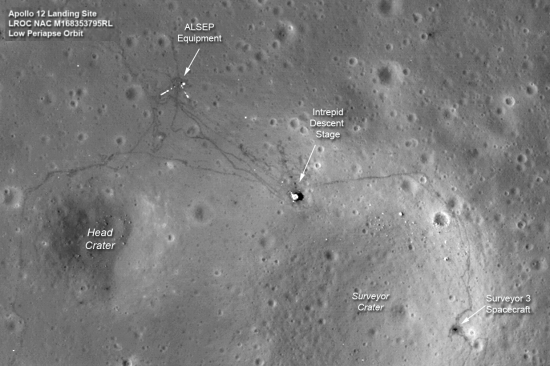
The Lunar Reconnaissance Orbiter team have released new images of the Apollo 12, 14, and 17 landing sites on the Moon. Below is a cropped image of the Apollo 12 site, showing the trails left by astronauts Pete Conrad and Alan Bean when they walked from their lunar module to Surveyor 3, an unmanned lunar lander that had soft landed there two years earlier. The full image shows some incredible detail.

Apollo 12 landing site

0 comments

Some suggestions for keeping ISS occupied

Some suggestions for keeping ISS occupied.

I especially like Harman’s suggestion that the Russians consider landing in the U.S. during the winter, thereby allowing them to extend one crew’s occupancy of ISS into December, January, or even February. Also, he proposes the Russians send an unmanned Soyuz to ISS during testing of the rocket, thereby providing the crews onboard a fresh lifeboat. This is something they have done in the past on their previous space station Mir.

1 comment

Amazon Chief’s Spaceship Misfires

Bad news for commercial space: A test of Amazon chief’s Blue Origin spaceship ended in failure on Friday.

After The Wall Street Journal reported on the failure, Blue Origin Friday posted a brief note on its website stating the spacecraft, while going faster than the speed of sound, suffered a “flight instability” at an altitude of 45,000 feet and the company’s automated “range safety system” shut off all thrust and led to its destruction. The problem appeared to stem from thrusters that didn’t respond properly to the initial commands, according to one industry official.

1 comment

Don’t you dare touch my space junk!

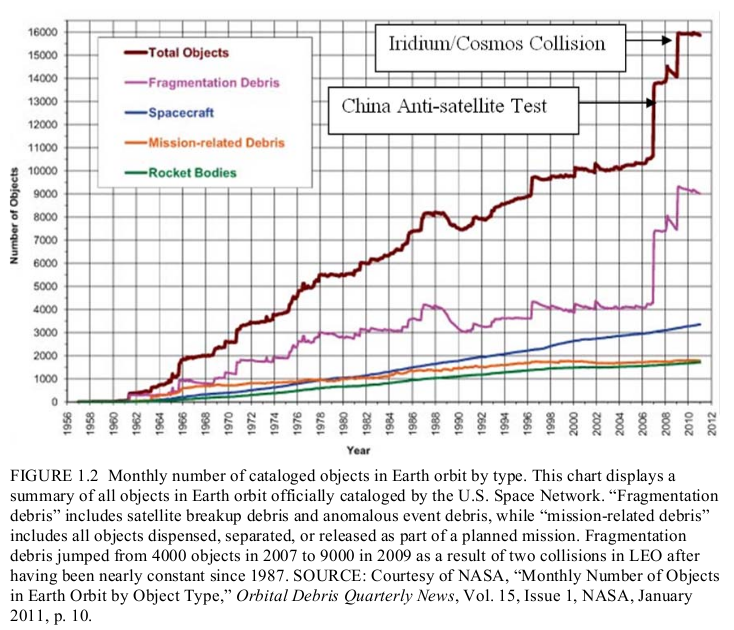
cataloged objects in orbit

A just released National Research Council report on space junk, Limiting Future Collision Risk to Spacecraft: an assessment of NASA’s meteoroid and orbital debris programs, describes in great and worthwhile detail the increasing problem of orbital debris as well as the technical and budgetary problems that exist for removing it. It is especially worth reading for the stories, such as when a Colorado hiker heard a high-pitched sound and then found a still warm thirty-inch diameter sphere in a foot deep crater. The object turned out to be a titanium tank from a Russian upper stage rocket, launched two months earlier.

What I want to focus on here, however, is one issue the report discusses that, as far as I can tell, has generally been missed. Worse, this issue — somewhat ridiculous when you think about a little — will make removing most of the space junk in Earth orbit far more complicated than ever imagined by engineers.

Simply put, under already agreed-to international treaties, no nation can salvage or collect any debris placed in orbit by another nation. To do so will violate international law, and almost certainly cause an international incident. To quote the report:
» Read more

5 comments

The space shuttle program officially ended on Wednesday

The space shuttle program officially ended on Wednesday. Note however:

Closeout of the shuttle program is an enormous effort expected to take two years. The program occupied 640 facilities and used more than 900,000 pieces of equipment with a value exceeding $12 billion, according to NASA. Much of the work will take place at Kennedy Space Center, where orbiters have been maintained and prepared for launch. NASA requested $89 million for shuttle transition and retirement work in the 2012 fiscal year that begins Oct. 1, but Congress has not yet approved a budget.

0 comments

Orbital Sciences gets its launch license for first test of Taurus 2 rocket

Orbital Sciences has gotten its launch license from the FAA for the first test launch of the Taurus 2 rocket, scheduled for later this year.

This rocket is Orbital’s version of the Falcon 9. It is a new rocket, never before flown, yet after this test it is scheduled to fly the Cygnus capsule on its first flight only two months later. Talk about cutting things close!

0 comments

Ground controllers replace a failed circuit box on ISS, using the robot Dextre

Ground controllers successfully replaced a failed circuit box on ISS this weekend, using the two-armed Dextre robot.

Up to now, exchanging the boxes was done by spacewalkers, which always carries a certain level of risk. Dextre was designed to reduce the need for astronauts to conduct spacewalks for routine maintenance, therefore freeing up the crew’s time for more important activities, like conducting science.

1 comment
1 770 771 772 773 774 814