wings in space

James McLane points out that the shuttle shape is not the only way to build a spaceship.

In an email to me Jim noted that he “is still trying to save NASA.” My response to him was that trying to save NASA right now is more hopeless than Don Quixote chasing a windmill. However, the engineering ideas he outlines in his essay are just the kind of innovative thinking required by the new private companies. And the more ideas the merrier!

1 comment

Highest Water in a Decade Expected at Lake Powell

The highest water level in a decade is expected at Lake Powell by August.

Lake Powell’s rising water level is a result of the long and wet winter this year. An above-average snowpack, with late snows and unseasonably cold weather has lead to a slower melt than usual. As of May, the snowpack that feeds Lake Powell was 30 percent higher than average, with only 50 percent of the accumulated snowpack melted. [emphasis mine]

I thought Al Gore told us this wasn’t going to happen anymore.

0 comments

A new image of Vesta from Dawn

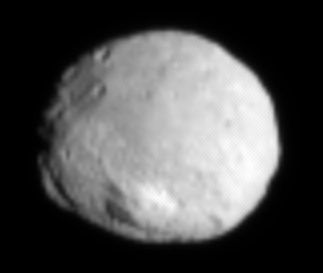
Dawn continues to approach the large asteroid Vesta. Below is an image taken July 1st from about 62,000 miles. The image has a resolution of 5.8 miles per pixel.

Despite Vesta’s large size, 330 miles in diameter, it is nonspherical. This fact, combined with data that says it is differentiated with a core and mantle, suggests that it is the remains of a larger object that subsequently broke up.

Vesta from 62,000 miles

0 comments

Why some space junk is impossible to track

This ISS status update, dated June 28, explains why the piece of space junk that flew past the station that day was such a surprise. (Hat tip to NASA engineer James Fincannon for pointing this out to me.)

Last night at ~6:00pm EDT, NASA Houston FTC (Flight Control Team) received notification of an upcoming “red threshold” conjunction of the ISS with a piece of orbital debris (Object 82618, UNKNOWN), with a TCA (Time of Closest Approach) this morning at 8:08am EDT, – which was too late to begin planning for a DAM (Debris Avoidance Maneuver). Therefore, FTC and crew made preparations for crew sheltering in Soyuz 26S & 27S. PC (Probability of Collision) at last tracking fix (7:20am) remained in the Red box, at ~0.003, with a miss distance of 0.25 km radial, 0.375 km downtrack, 0.570 m crosstrack. The necessary reconfiguration procedures (USOS hatches closed, etc.) began 1.5 hrs before TCA (6:38am EDT), and the six crewmembers ingressed their Soyuz vehicles. At 8:08am the object cleared the ISS with no impact, and shortly thereafter the crew was given the Go for returning to the ISS. [The late notification occurred because of the high air resistance (drag) of the object (~175 times higher than ISS) which made its trajectory very sensitive to small errors in atmospheric density predictions at the current solar flux. Due to the high drag, there is no chance of a recurrence of Object 82618).] [emphasis mine]

In other words, the piece of junk was probably something like a piece of insulation, very light but with a large area, much like a sail. Thus, as it flies through the thin atmosphere at 200 to 400 miles altitude its velocity and direction can easily change, making it difficult, if not impossible, to predict its future trajectory.

The good news is that these same conditions mean that the orbit of the object will quickly decay (“due to high drag”) so that it poses no future threat to the station.

Unfortunately, there are many other objects like this in orbit, and they all pose a threat, mostly because of the difficulty of reliably predicting their orbits.

0 comments

Prime real estate

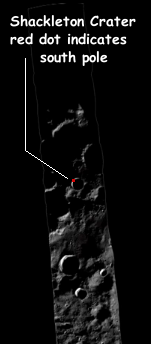
The south pole of the moon

Since the 1990s, scientists have suspected that water-ice might be hidden in the forever-dark floors of the polar craters on the Moon. If so, these locations become valuable real estate, as they not only would provide future settlers water for drinking, the water itself can be processed to provide oxygen and fuel.

Moreover, the high points near these craters, including the crater rims, are hoped to be high enough so that the sun would never set or be blocked by other mountains as it made its circuit low along the horizon each day. If such a place existed, solar panels could be mounted there to generate electricity continuously, even during the long 14-day lunar night.

Below the fold is a six minute video, produced from images taken by Lunar Reconnaissance Orbiter (LRO) from February 6, 2010 to February 6, 2011, in an effort to find out if such a place actually exists. It shows how the sunlight hits the south pole across an entire year.
» Read more

1 comment

Questions raised about the safety of China’s new bridge

Questions have been raised about the safety of China’s new bridge.

[China Central Television] said that workers were tightening bolts that could easily have been loosened by hand on the bridge, which has seen nearly 18,000 cars cross it every day since it was officially opened on June 30, on the eve of the 90th anniversary of the founding of the Communist Party of China.

Why does this remind me of the two shuttle accidents, where managers ignored engineering issues in order to satisfy political concerns?

0 comments
1 776 777 778 779 780 814