
NASA Inspector General notes continuing worries about the Mars Science Lab

A NASA Inspector General report issued today [pdf] notes continuing worries about the Mars Science Laboratory, scheduled for launch later this year.

Remaining Unresolved Technical Issues: Although Project managers have overcome the majority of technical issues that led to the [2009] launch delay, as of March 2011 three significant technical issues remain unresolved. . . . Because of technical issues related to these three and other items, Project managers must complete nearly three times the number of critical tasks than originally planned in the few months remaining until launch. [emphasis mine]
0 comments

Mars 500 mission passes one year

The Russian/ESA Mars 500 mission has completed a year of its 520-day simulated flight to Mars.

The crew, who spent 250 days working on maintenance and scientific experiments before a 30-day stint performing tasks on a simulated Martian surface, are currently on their “return trip” to Earth.

This simulated all-male flight is going better than the last:

In 1999, an experiment in the same Moscow warehouse fell to pieces after a Russian team captain forced a kiss on a Canadian woman, and two Russian crewmembers had a bloody fistfight.

0 comments

TSA testing non-contact system to detect terrorists before they act

And this is good? The TSA is testing a sensor system for detecting terrorists before they act.

The Future Attribute Screening Technology (FAST) security programme is designed to spot people who are planning to commit a terrorist act. The U.S. government system can ‘sense’ when you are planning and measures physiological factors such as heart rates and eye movements.

3 comments

The costs of space cargo

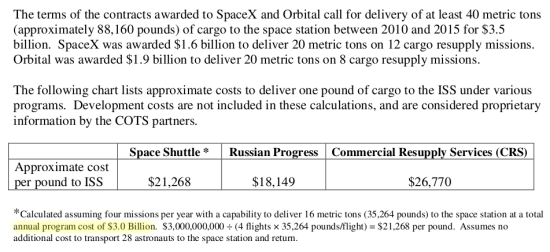
This week there was a bit of a political kerfuffle during House hearings over a House report [pdf] that stated that the cost per pound for launching cargo to ISS was much cheaper using the shuttle versus the new commercial companies under the COTS program. This is shown in this table from page 5 of the report:

House charter graph

The problem is that these numbers are a complete lie, as they are based on a yearly cost of $3 billion to operate the shuttle (highlighted in yellow). I have been following NASA budget battles now for decades, and the shuttle operational budget has never, ever been that low. Routinely, NASA figures the cost to operate the shuttle per year, regardless of number of flights, to be about $4 billion per year.
» Read more

7 comments

First sale for quantum computing

Lockheed Martin buys the first commercial quantum computer. More here on the science of quantum computing.

Quantum computers could revolutionize the way we tackle problems that stump even the best classical computers, which store and process their data as ‘bits’ — essentially a series of switches that can be either on or off. The power of quantum bits — or qubits — is that they can be on and off simultaneously. Connect enough qubits together using quantum entanglement and a computer should be able to zip through a multitude of calculations in parallel, at astonishing speed.

1 comment

Russian greenhouse on ISS ungoes upgrade

The Russian greenhouse on ISS underwent an upgrade today.

The onboard greenhouse was dismantled in April last year, as a need arose to replace the outdated control unit, recalled head of the Rasteniya-2 (Plants-2) experiment, chief of the laboratory of the Institute of Medico-Biological Problems (IMBP) of the Russian Academy of Sciences (RAS) Vladimir Sychev. In early 2010, the crop area of the orbital garden was extended twice – the second leaf chamber was delivered to the ISS in which the crew managed to harvest the Mizuna lettuce, before the greenhouse was dismantled. Now, the cosmonauts will plant in these two chambers different cultures – super-dwarf wheat and dwarf tomatoes.

As I described in detail in Leaving Earth, the Russians have decades of experience in growing plants in space, with the goal of not only providing a natural system to recycle the station’s atmosphere, but also giving the astronauts a morale-boosting activity (gardening) that also gives them something tasty to eat. Though the engineering has still not made it possible to germinate seeds in weightlessness and then have grow there, this will be an absolute requirement if humans are ever to travel to the planets and beyond to the stars.

0 comments
1 780 781 782 783 784 814