The last 800 years of ice cores from Antarctica shows that the icecap has apparently been increasing over the last century.

The uncertainty of science: Ice core data from the last 800 years from Antarctica suggest that the icecap has been growing over the last century.

The changes also appear to correlate with solar fluctuations, though there are so many uncertainties here that no single explanation can yet be accepted as the answer.

16 comments

The Fantasy of Extreme Weather

This week there were three stories describing new research proving that global warming is going to cause an increase in the number and violence of extreme weather events. Each was published in one of the world’s three most important scientific journals.

Sounds gloomy, doesn’t it? Not only will extreme heatwaves, cold waves, and droughts tear apart the very fabric of society, you will not be able to drink your soda in peace on your next airplane ride!

However, one little detail, buried in one of these stories as a single sentence, literally makes hogwash out of everything else said in these three articles.
» Read more

34 comments

Global warming: time to rein back on doom and gloom?

From a global warming advocate: Global warming: time to rein back on doom and gloom?

Prediction, as they say, is tough, especially when it’s about the future – and that’s especially true when it comes to the climate, whose complexity we only partially understand. It is, as we all know, naturally immensely variable. And the effect of human intervention is subject to long timelags: it will be decades, even centuries, before the full consequences of today’s emissions of carbon dioxide become clear.

As a result, scientists and policymakers draw on the past to predict the future. Until now, they have therefore placed much weight on the rapid temperature increases in the Eighties and Nineties. But for at least a decade, these have dramatically slowed, even as carbon dioxide emissions have continued to increase. [emphasis mine]

Or as I like to say, every climate model proposed by every global warming scientist has been proven wrong. They all predicted the climate would warm in lockstep with the increase in CO2. It hasn’t.

This is not to say the climate hasn’t warmed in the past five centuries (though some of the data used in for the past 150 years is sadly suspect). What isn’t clear is why. It might be the rise in carbon dioxide. It might also simply be the lingering warming the Earth is experiencing as the last ice age ends. Or it might be because of the Sun.

The field of climate science is very complex, confusing, and in its infancy. We just don’t know yet, and anyone who says they do is not a good scientist.

10 comments

James Hansen is retiring from NASA and will dedicate his time to global warming activism.

James Hansen is retiring from NASA and will dedicate his time to global warming activism.

All that is really changing is that Hansen will no longer work for the government. The activism has been going on for a very long time.

Also, it is interesting how this New York Times article seems very unaware of this fact, which makes all of Hansen’s global warming claims very suspect. Might the Times not want the public to know this annoying detail?

2 comments

“We’re just not interested in continuing to support bureaucracies and talkfests.”

Canada to the UN environmental movement: “We’re just not interested in continuing to support bureaucracies and talkfests.”

The country has pulled out of a UN program supposedly aimed at “combating desertification,” noting that

only 18% of the roughly CAD$350,000 per year that Canada contributed to the U.N. initiative is “actually spent on programming,” [Canadian prime minister Stephen Harper] told Parliament this week during question period. “The rest goes to various bureaucratic measures. … It’s not an effective way to spend taxpayers’ money.”

As is their normal approach to debate, there is a lot of wailing, gnashing of teeth, and name-calling among the environmentalists, but no substantive response to counter Harper’s point above.

2 comments

“The fact that global surface temperatures have not followed the expected global warming pattern is now widely accepted.”

The uncertainty of science: “The fact that global surface temperatures have not followed the expected global warming pattern is now widely accepted.”

This quote above refers to scientists in the climate field, who are now admitting that for the past 20 years the climate has shown no warming, despite the continuing increase in CO2 in the atmosphere and their computer models that all predicted increased temperatures because of that CO2.

2 comments

More fraud in climate science

Fraudalent data

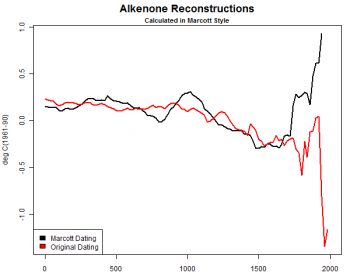
Steve McIntyre, the man who had demonstrated that Michael Mann’s hockey stick graph was a fraud, has now demonstrated that the work of a group of climate scientists attempting to resurrect it is even more fraudulent. It seems that in order to recreate the illusion of warming in the past four hundred years, the scientists, led by geologist Shaun Marcott, changed the dates on a series of ocean cores in order to get the results they wanted.

McIntyre found that Marcott and his colleagues used previously published ocean core data, but have altered the dates represented by the cores, in some cases by as much as 1,000 years.

Most significantly, the scientists made no explanation for changing these dates. It is as if they wanted to hide this decline, y’know?

The chart on the right, by McIntyre, illustrates the fraud. The black line shows the temperature numbers of the ocean cores used by Marcott. The red line shows the temperature numbers, as originally published in the scientific literature, for these ocean cores.

The discrepancy here is so egregious that it screams at you. More important, as John Hinderaker says,
» Read more

28 comments

The dirty little secret of electric cars.

The dirty little secret of electric cars.

A 2012 comprehensive life-cycle analysis in Journal of Industrial Ecology shows that almost half the lifetime carbon-dioxide emissions from an electric car come from the energy used to produce the car, especially the battery. The mining of lithium, for instance, is a less than green activity. By contrast, the manufacture of a gas-powered car accounts for 17% of its lifetime carbon-dioxide emissions. When an electric car rolls off the production line, it has already been responsible for 30,000 pounds of carbon-dioxide emission. The amount for making a conventional car: 14,000 pounds. …

So unless the electric car is driven a lot, it will never get ahead environmentally. And that turns out to be a challenge. Consider the Nissan Leaf. It has only a 73-mile range per charge. Drivers attempting long road trips, as in one BBC test drive, have reported that recharging takes so long that the average speed is close to six miles per hour—a bit faster than your average jogger.

In other words, government subsidies for electric cars are nothing more than another feel-good program, accomplishing nothing.

11 comments

New computer models find that the tropical rain forests will not be harmed by increased carbon dioxide in the atmosphere.

The uncertainty of science: New computer models find that the tropical rain forests will not be harmed by increased carbon dioxide in the atmosphere.

Tropical forests are unlikely to die off as a result of the predicted rise in atmospheric greenhouse gases this century, a new study finds. The analysis refutes previous work that predicted the catastrophic loss of the Amazon rainforest as one of the more startling potential outcomes of climate change.

In the most extensive study of its kind, an international team of scientists simulated the effect of business-as-usual emissions on the amounts of carbon locked up in tropical forests across Amazonia, Central America, Asia and Africa through to 2100. They compared the results from 22 different global climate models teamed with various models of land-surface processes. In all but one simulation, rainforests across the three regions retained their carbon stocks even as atmospheric carbon dioxide concentration increased throughout the century.

The study provides “robust evidence for the resilience of tropical rainforests”, says lead author Chris Huntingford, a climate modeller at the UK’s Centre for Ecology and Hydrology in Wallingford. But uncertainties remain, he adds.

First, this prediction is based on a computer model, which is as likely to be as right as the previous pessimistic predictions. With that in mind, no one should start dancing for joy. The long term consequences of increased carbon dioxide in the atmosphere remain unknown.

Second, I am baffled by the previous predictions that favored catastrophe for the tropical jungles because of increased levels of carbon dioxide. Plants breath CO2. They prosper from it. If you put more in the atmosphere they will thrive. Moreover, the tropical jungles are already hot, and the plant life there is adapted to that heat. Raising the global temperature should not hurt them significantly.

Finally, faced with a result that defuses all the crisis-mongering of the global warming crowd, the author of the article feels obliged at the end to emphasis their new bugaboo: extreme weather! It’s coming! Duck your heads!

But don’t worry. When weather extremes also fail to appear, they will find something else to scream about.

0 comments
1 51 52 53 54 55 82