Earth’s atmosphere cooling as solar minimum arrives

The uncertainty of science: With the early arrival of the solar minimum, the Earth’s atmosphere has quickly shown signs of cooling.

New research shows that Earth’s upper atmosphere is responding. “We see a cooling trend,” says Martin Mlynczak of NASA’s Langley Research Center. “High above Earth’s surface, near the edge of space, our atmosphere is losing heat energy. If current trends continue, it could soon set a Space Age record for cold.”

These results come from the SABER instrument onboard NASA’s TIMED satellite. SABER monitors infrared emissions from carbon dioxide (CO2) and nitric oxide (NO), two substances that play a key role in the energy balance of air 100 to 300 kilometers above our planet’s surface. By measuring the infrared glow of these molecules, SABER can assess the thermal state of gas at the very top of the atmosphere–a layer researchers call “the thermosphere.”

“The thermosphere always cools off during Solar Minimum. It’s one of the most important ways the solar cycle affects our planet,” explains Mlynczak, who is the associate principal investigator for SABER.

What effect this upper atmosphere cooling will have on the surface climate is somewhat uncertain, though there is a great deal of evidence suggesting the surface climate will cool also.

6 comments

Sunspot update October 2018: Deepening minimum

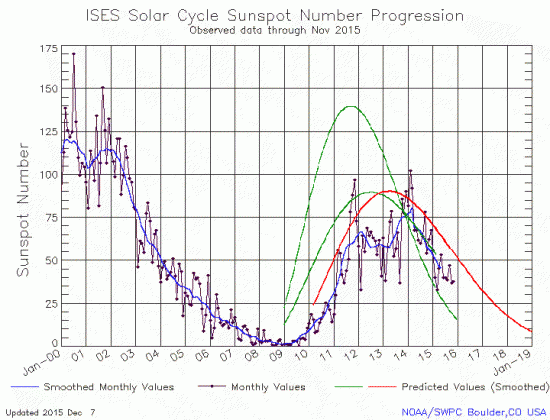
The monthly NOAA update of the solar cycle, covering sunspot activity for October 2018, was released yesterday. As I have done every month since this website began in July 2011, I am posting it below, annotated to give it some context.

Though there was a tiny uptick in sunspot activity on the Sun in October, the uptick was inconsequential. Overall, the activity in the past few months appears to closely match the weak activity seen in late 2007 and early 2008, just when the last solar minimum began.

October 2018 sunspot activity

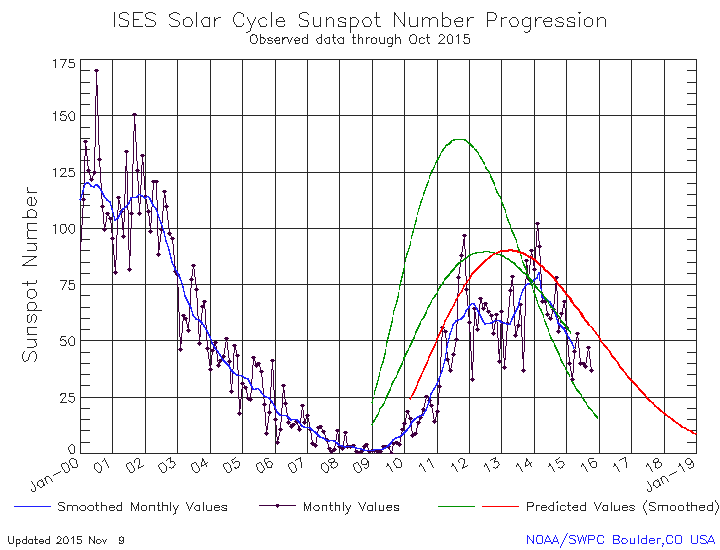
The graph above has been modified to show the predictions of the solar science community. The green curves show the community’s two original predictions from April 2007, with half the scientists predicting a very strong maximum and half predicting a weak one. The red curve is their revised May 2009 prediction.

As I noted in August, the NOAA graph is now getting very close to its right edge, which ends in December 2018. They will very soon have to update this graph so that it can take us into the next solar cycle. While they must do this, it will unfortunately end the standard visual used by them for more than a decade for showing the progress of the solar cycle. Depending on how they change it, I might be able adapt it to include this graph to allow a continuation of the same visual into the future. We will have to see.

Having seen now the full solar maximum for this cycle (weak and short), we are now moving to the next question: Will the developing solar minimum be as long and as deep as the last? Will it evolve into a grand minimum, lasting decades, as some solar scientists believe?

Or will the Sun return to the higher levels of activity seen during most of the 24 solar cycles observed since the last grand minimum in the 1600s?

Since our understanding of these changes is very poor, your guess is likely as good as anyone else’s. All we can really do is keep our eyes open and watch what happens.

1 comment

Strong India monsoons cause more hurricane landfalls in North America

A new study has found a correlation between the strength of the monsoon season in India and the number of hurricanes that make landfall in North America.

According to Kelly, La Niña and the Indian monsoon are correlated, but the strength of the monsoon influences the steering of hurricanes independently of La Niña fluctuations, which are responsible for changes in hurricane frequency. In other words, La Niña fluctuations may result in more Atlantic hurricanes, but strong Indian monsoons steer them further westward, making it more likely they will make landfall in the Americas.

It’s important to account for the correlation when studying hurricane steering and landfall probability.

In reading the article, ignore the propaganda promoting global warming, as the research has zero to do with that subject. It instead now provides meteorologists another clue to predicting the frequency and paths of hurricanes in the Atlantic.

2 comments

Trump scraps academic EPA air pollution panel

The head of EPA in the Trump administration has scrapped the academic EPA air pollution panel that has dominated the agency’s air quality control standards for decades.

Andrew Wheeler, the acting chief of the U.S. Environmental Protection Agency (EPA), yesterday fired a panel of scientific experts charged with assisting the agency’s latest review of air quality standards for particulate matter. He also scrapped plans to form a similar advisory panel to aid in a recently launched assessment of the ground-level ozone limits.

Those steps, coupled with Wheeler’s previously announced decision to concentrate authority in a seven-member committee made up mostly of his appointees, quickly sparked objections that the agency is intent on skewing the outcome of those reviews in favor of industry.

…Under the Clean Air Act, EPA is supposed to review the adequacy of the standards for particulate matter, ozone and four other common pollutants every 5 years with help from outside experts. While the seven-member committee, officially known as the Clean Air Scientific Advisory Committee (CASAC), has the lead in the process, the [scrapped] review panels are supposed to provide additional know-how in assessing the relevant scientific literature, which can span a variety of academic disciplines.

Essentially the acting administrator is continuing the effort of the former EPA head, Scott Pruitt, to de-emphasize the domination of the leftist academic community in these matters. Naturally, the academics are screaming, but then, screaming has recently become the left’s only debating point in all matters of national discussion.

3 comments

Sunspot update September 2018: Minimum!

NOAA yesterday released its monthly update of the solar cycle, covering sunspot activity for September 2018. As I have done every month since this website began in July 2011, I am posting it below, annotated to give it some context.

Sunspot activity on the Sun in September dropped slightly from August. More significantly, the activity continues to match closely the weak activity seen in 2008, when the Sun last went through its last solar minimum. We are unquestionably now in the new minimum, and its arrival in the past few months makes the now-ending solar cycle about one to two years shorter than predicted.

September 2018 sunspot activity

The graph above has been modified to show the predictions of the solar science community. The green curves show the community’s two original predictions from April 2007, with half the scientists predicting a very strong maximum and half predicting a weak one. The red curve is their revised May 2009 prediction.

As I noted last month, the NOAA graph is now getting very close to its right edge, which ends in December 2019. They will very soon have to update this graph so that it can take us into the next solar cycle.

What that new cycle will bring will be the next mystery. I have been following this cycle now since its unusual beginning, with a solar minimum much much longer and more inactive than any solar scientist had ever expected. We can only guess at the surprises the Sun will give us in the coming decade, especially since the science of solar sunspot activity remains superficial and in its infancy. We do not really understand why the Sun’s activity fluctuates. Nor do we understand why it periodically stops producing sunspots for long periods, resulting in what solar scientists call a grand minimum.

There are some scientists who think another grand minimum is coming. We shall have to wait and see. I certainly am going to follow their upcoming observations, as this work remains one of the great scientific studies humans are presently pursuing.

5 comments

New study: Forest cover has blossomed since 1980s

The uncertainty of science: According to new research the world’s tree canopy has grown by almost a million square miles since 1982.

While the area of bare ground and short vegetation is diminishing, forest area is growing. As Ronald Bailey notes in Reason, “Forests in montane regions are expanding as climate warming enables trees to grow higher up on mountains.”

The greatest increase in tree canopy occurred in Europe, including European Russia, where it exploded by 35%. A close second was found in China, where tree canopy gained 34%. In the U.S., tree canopy increased by 15%.

This study confirms numerous other forest and agricultural research that has shown that increased carbon dioxide in the atmosphere encourages plant growth. Numerous other studies have also found that the Earth has been greening in the past century.

My review of the scientific literature on this subject also matches this finding, having found that if global warming is happening, research looking at what has actually happened generally show that increased CO2 and warming have tended to have beneficial effects, despite the endless doomsday predictions by global warming scientists of what might happen.

9 comments

Sunspot update for August 2018: The slide to minimum

As it does the first Sunday of each month, yesterday NOAA posted its monthly update of the solar cycle, covering sunspot activity for August 2018. And as I do every month, I am posting it below, annotated to give it some context.

The Sun in August had a slight uptick in sunspot activity, but not a very significant one. As such, the slide to solar minimum continues. Right now the lack of sunspot activity in 2018 is heading to match or even exceed 2007, the year in which the previous solar minimum began.

August 2018 sunspot activity

The graph above has been modified to show the predictions of the solar science community. The green curves show the community’s two original predictions from April 2007, with half the scientists predicting a very strong maximum and half predicting a weak one. The red curve is their revised May 2009 prediction.

If you look at the original graph at NOAA, you will see that we are getting very close to the right edge of the graph. I expect that sometime in the next few months NOAA will update the graph, a necessary act that will in one sense be a shame, as they have been adding monthly updates to this graph since the beginning of the last solar minimum. This has allowed everyone to see a standard visual, month to month, for comparing solar activity. It has also allowed me to annotate the graph properly to show how the 2007 and 2009 predictions held up against actual activity. Once the graph changes it will be more difficult to do this.

Anyway, it is very clear we are entering solar minimum, and that the solar cycle we are now completing will be both a short and weak cycle. What happens next is really the big question. Will the Sun sunspot activity recover? Or will we enter the first grand minimum since the 1600s? Either way, for solar scientists the coming years are going to be very exciting.

Posted on interstate 10 going from Tucson to Phoenix, on the way to the wooded northern forests of Arizona, where Diane and I will spend a couple of days visiting friends at their upstate cabin/home.

10 comments

Trump EPA proposes new power plant climate rules

The Trump administration has now proposed a revision to the climate rules established by the Obama administration to limit carbon dioxide releases at power plants.

President Donald Trump’s administration released a plan today to regulate carbon dioxide emissions at power plants, undercutting a much broader effort by former President Barack Obama to slash planet-warming gases.

The U.S. Environmental Protection Agency (EPA) proposal would give states wide latitude for determining how to cut greenhouse gases from the power sector, a key contributor in the U.S. to climate change. The proposed rule is far narrower than the Obama plan, which sought to cut emissions across the power sector rather than only at individual plants.

On the campaign trail in 2016, Trump promised to repeal Obama’s rule, called the Clean Power Plan. His administration stopped short of that today and is instead offering a weakened alternative to avoid a potentially damaging defeat in court.

Based on the article and the actual proposal [pdf], I am far from convinced this change reduces regulation that much. It appears to shift the regulation to the states, but whether this simplifies things for power plant operators is very doubtful.

Not surprisingly, the Democrats and various leftist environmental groups oppose the change. Expect lawsuits, since it is absolutely forbidden for any subsequent president to ever change policies set by past Democratic presidents.

1 comment

The failed Arctic Ocean predictions of global warming scientists

Link here. The post at the link carefully documents the endless numbers of failed doomsday predictions foisted upon us for the past decade, claiming that due to global warming the Arctic Ocean icecap would be gone by 2018.

Instead, in the past three years there is evidence that the icecap has begun to thicken and expand, recovering from a two decade decline. Though this is not a certain conclusion, what is certain is that there is no sign of the icecap vanishing, in any sense. Every prediction documented at the link, by so-called experts, is completely bogus.

There is a reason the public does not take global warming very seriously. Its advocates have cried wolf too many times. Their predictions of doom have consistently failed. Every. Single. Time.

11 comments

Sunspot update for July 2018: The Sun flatlines!

Yesterday NOAA posted its monthly update of the solar cycle, covering sunspot activity for July 2018. As I do every month, I am posting it below, annotated to give it some context.

This might be the most significant month of solar activity that has been observed since Galileo. Except for two very short-lived and very weak sunspots that observers hardly noted, the Sun was blank for entire month of July. This has not happened since 2009, during the height of the last solar minimum.

What makes this so significant and unique is that it almost certainly signals the return of the next solar minimum, a return that comes more than a year early. The solar cycle the Sun is now completing has only been ten years long. It is also one of the weakest in more than a hundred years. This combination is unprecedented. In the past such a weak cycle required a long cycle, not a short one.
» Read more

9 comments

Trump administration proposes revisions to Endangered Species Act

The Trump administration has proposed some regulatory revisions to Endangered Species Act that would scale back somewhat its sometime draconian powers.

The proposed regulatory changes are both technical and consequential. One, for instance, bears the deceptively dull title of “elimination of blanket 4(d) rule” (E&E News PM, 4 April). The ESA prohibits the “take” of species designated as endangered, while Section 4(d) of the law allows the agency to establish special regulations for threatened species. In 1978, FWS used this authority to extend the prohibition of take to all threatened species. This is known as the “blanket 4(d) rule.”

Take covers a wide range of actions, including those that “harass, harm, pursue, hunt, shoot, wound, kill, trap, capture or collect” a threatened or endangered species. This blanket 4(d) rule for threatened species can be modified by a species-specific 4(d) rule.

Conservatives and private-property advocates have previously sought to scale back the blanket 4(d) rule, which they say erases what should be a meaningful distinction between threatened and endangered species. The proposal would cover only future listings. “Some of our regulations were promulgated back in 1986, and frankly, a great deal has been learned by the agencies administering the act and by the public,” Deputy Interior Secretary David Bernhardt told reporters today.

Another change would establish that the “foreseeable future” definition used in making ESA listing decisions extends only so far as officials “can reasonably determine that the conditions posing the potential danger of extinction are probable.”

A potentially key change involves critical habitats, which are areas important for recovery of a species. Sometimes an area can be considered important for recovery even when it is not currently occupied by the species in question. Under the new proposal, FWS and NOAA Fisheries will designate unoccupied critical habitat only when the occupied areas are inadequate to ensure the conservation of the species or if inclusion of unoccupied areas would yield certain other specified benefits.

In some “rare” cases, officials say, there may be no critical habitat designated.

The article above, from the journal Science, shocked me by its reasonable discussion of these proposed changes. I had expected an anti-Trump screed, similar to the original version of this Daily Mail article from yesterday. Today it reads more reasonably, but yesterday the article was far more devoted to airing opposition to the Trump proposals.

No matter. There is madness out there, it has taken possession of the entire anti-Trump community. It won’t make a difference how reasonable the administration’s proposals might be, there will be over-the-top declarations about the evils of these proposals and how they will destroy everything.

3 comments

A science journal describes how evil Trump is destroying EPA

Link here.

If you have no idea why we have Trump, and why we are likely to get more of him, read this article from the science journal Nature. It is a carefully written screed, written entirely from the point of view of those hostile to Trump and his effort to rein in the EPA’s regulatory culture. No one is interviewed to give the Trump perspective, and even if some had been, the author is so certain that Trump is evil and wrong in his efforts that I am sure the Trump perspective would have been misinterpreted, or even slandered. (This I am sure is why the article says that EPA management did not “respond to requests to comment on the article’s allegations.” The allegations were already set. Nothing anyone said from the administration would change those conclusions.)

Still, I am certain the author could have gotten opinions from some of the skeptical scientists whom the Trump administration has brought in to advise EPA. None however were interviewed.

What is most embarrassing about the article is its description of two of the main changes the Trump administration has imposed on EPA to widen and make more transparent the scientific work it does. First,
» Read more

4 comments
1 17 18 19 20 21 73