Scientists: Europa’s theorized plumes of water vapor might simply be statistical noise
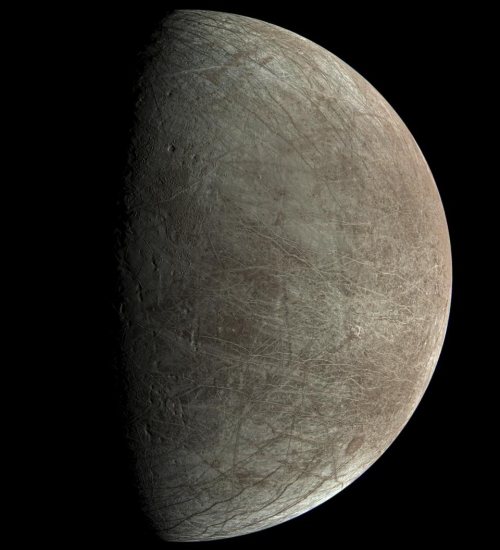
Europa in true color
Europa in true color, taken by Juno September 2022.
Click for full image.

The uncertainty of science: Based on a re-analysis of data from the Hubble Space Telescope, scientists now say that the plumes of water vapor that Hubble had supposedly detected erupting from the surface of the Jupiter moon Europa might not exist, and could instead simply be statistical noise in the data.

The new paper looks at the last 14 years of data from the Hubble Space Telescope’s Space Telescope Imaging Spectrograph (HST/STIS) focused on Europa’s Lyman-alpha emissions. Lyman-alpha is a specific wavelength of ultraviolet light emitted and scattered by hydrogen atoms. From 2012-2014, the team was pushing the limits of the Hubble telescope’s capabilities.

“One of the difficulties in interpreting the data back then was determining where to place Europa within its context,” Retherford said. “The way Hubble works left some uncertainty in terms of placement relative to the center of the image. If Europa’s placement was off even just by a pixel or two, it could affect how the data gets interpreted.”

As a result, what they thought could be evidence of a water vapor plume could also just be statistical noise. “Our reanalysis took our original 99.9% confidence in the plumes’ existence and reduced it to less than 90% confidence,” said Dr. Lorenz Roth (KTH Royal Institute of Technology, Sweden), the paper’s lead author. “That’s simply not enough evidence to support the certainty of claims we made at the time.”

The plumes might still exist, but the data used here is simply more uncertain that previously thought. It is hoped that when Europa Clipper and Juice both enter Jupiter orbit in a few years they will be able to settle this issue more definitively.

3 comments

Scientists produce new estimate of the thickness of Europa’s icy crust

Europa in true color
Europa in true color, taken by Juno during that
September 2022 fly-by
. Click for full image.

Using data produced by Juno during a 2022 close-fly of Jupiter’s moon Europa, scientists have made a new estimate of the thickness of Europa’s icy crust, approximately 18 miles thick with a 6-mile margin of error.

In other words, their estimate could be as small as 12 miles thick, or as large as 24 miles thick.

You can read their paper here. From their abstract:

For the idealized case of pure water ice, the data are consistent with the existence of a thermally conductive ice shell with a thickness of 29 ± 10 km [18 ± 6 miles] and with the presence of cracks, pores or other scatterers extending to depths of hundreds of metres below the surface with a characteristic size smaller than a few centimetres in radius. An ice-shell salinity of 15 mg kg−1, as indicated by models based on terrestrial marine ice, would reduce our estimate of the thickness of the ice shell by about 5 km, substantially less than our 10 km uncertainty. The low volume fraction, small size and shallow depth of the scatterers indicate that the fracture interfaces observed at Europa’s surface are alone unlikely to be capable of carrying nutrients between the surface and the ocean. [emphasi mine]

The highlighted sentence is the important one. If this new estimate is right, than the unidentified reddish material that appears to leak out of the long ridgelike cracks on Europa’s surface, clearly visible in the picture to the right, are not coming from any underground ocean. The distances are too large.

Other estimates have suggested that ice crust could be as thin as 2 miles, but like this research the uncertainties are very large.

Meanwhile, the Juno mission is still alive, though essentially winding down operations. The mission was expected to officially end at the end of September 2025, when its budget ran out, but the just passed budget included enough money to keep it going, albeit at a relatively low level. According to the orbiter’s webpage, it will continue to orbit Jupiter, its orbit degrading naturally until it falls into Jupiter to burn up. As it does so data will continue to be collected, though at a much lower rate.

7 comments

Study: If Europa has an underground ocean, it is lifeless and dormant

Scientists analyzing the conditions that are believed to exist in Europa’s theorized underground ocean have concluded there is little geological activity within that ocean, reducing significantly the chances there is life there.

A new study led by Paul Byrne, an associate professor of earth, environmental and planetary sciences, at Washington University in St. Louis, throws cold water on the idea that Europa could support life at the seafloor. Using calculations that consider the moon’s size, the makeup of its rocky core and the gravitational forces from Jupiter, Byrne and a team of scientists conclude that Europa likely lacks the tectonic motion, warm hydrothermal vents or any other sort of underwater geologic activity that would presumably be a prerequisite for life.

“If we could explore that ocean with a remote-control submarine, we predict we wouldn’t see any new fractures, active volcanoes or plumes of hot water on the seafloor,” Byrne said. “Geologically, there’s not a lot happening down there. Everything would be quiet.” And on an icy world like Europa, a quiet seafloor might well mean a lifeless ocean, he added.

You can read the paper here [pdf]. It admits in its conclusion that these results have a lot of uncertainty, and the Europa Clipper mission, set to arrive in orbit around Jupiter in 2031, will reduce that uncertainty but not eliminate it, adding that “Ultimately, however, the true test of our results here will require directly accessing the ocean and, perhaps one day, the ocean floor itself.”

9 comments

New data suggests Europa’s surface is constantly changing

Webb data showing variations on Europa's surface
Click for original graphic.

The uncertainty of science: Using data collected by the Webb Space Telescope combined with modeling and lab experiments, scientists now think they have found evidence that Europa’s surface is constantly changing, with materials from its interior being brought to the surface.

This new study found crystalline ice on the surface as well as at depth in some areas on Europa, especially an area known as Tara Regio. “We think that the surface is fairly porous and warm enough in some areas to allow the ice to recrystallize rapidly,” said Dr. Richard Cartwright, lead author of the paper and a spectroscopist at Johns Hopkins University’s Applied Physics Laboratory. “Also, in this same region, generally referred to as a chaos region, we see a lot of other unusual things, including the best evidence for sodium chloride, like table salt, probably originating from its interior ocean. We also see some of the strongest evidence for CO2 and hydrogen peroxide on Europa.”

…“Our data showed strong indications that what we are seeing must be sourced from the interior, perhaps from a subsurface ocean nearly 20 miles (30 kilometers) beneath Europa’s thick icy shell,” said [Dr. Ujjwal Raut of the Southwest Research Institute and co-author of the paper]. “This region of fractured surface materials could point to geologic processes pushing subsurface materials up from below. When we see evidence of CO2 at the surface, we think it must have come from an ocean below the surface.”

The graphic to the right shows the detected variations across the surface of Europa, based on the Webb spectroscopic data. It also illustrates nicely the coarseness of this data, its lack of resolution, and the uncertainties involved. The scientists have found evidence that suggests the surface is changing, but the key word here is “suggests”. They have not yet directly seen any actual changes, such as changes between two images taken at different times.

Nonetheless, the data does point in the right direction. Moreover, it would be far more unlikely if nothing on Europa changed. The fundamental question that remains unanswered is how fast things change there. And we won’t have any chance to answer this question until Europa Clipper enters Jupiter orbit in 2030 and begins multiply fly-bys of Europa.

0 comments

The Europa Clipper team prepares for Mars fly-by

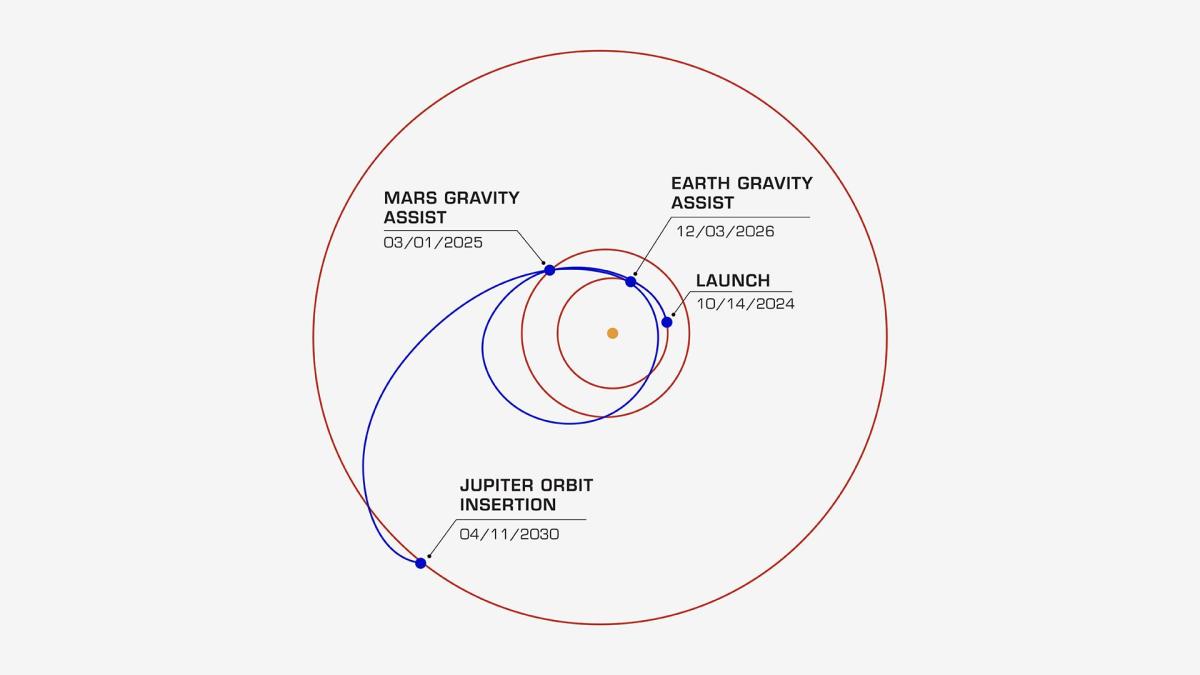
Europa Clipper's route to Jupiter
Click for original image.

As planned, Europa Clipper is set to do a very close fly-by of Mars on March 1, 2025, zipping past the red planet at a speed of 15.2 miles per second only 550 miles above its surface. The graphic to the right shows the spacecraft’s planned route to Jupiter, including an additional fly-by of Earth in 2026.

During this first fly-by the science team will test two of Europa Clipper’s instruments.

About a day prior to the closest approach, the mission will calibrate the thermal imager, resulting in a multicolored image of Mars in the months following as the data is returned and scientists process the data. And near closest approach, they’ll have the radar instrument perform a test of its operations — the first time all its components will be tested together. The radar antennas are so massive, and the wavelengths they produce so long that it wasn’t possible for engineers to test them on Earth before launch.

The spacecraft launched with transistors not properly hardened for the hostile environment around Jupiter. Engineers claimed these would “heal” themselves once in Jupiter orbit. No word on whether there has been any issue from these components since launch.

0 comments

Io’s volcanoes get their lava from separate magma chambers, not a global underground ocean of magma

Io's interior as presently theorized
Click for original animation.

Using data collected from Juno’s multiple fly-bys of the Jupiter moon Io, scientists now hypothesize that the moon does not have a global underground ocean of magma, feeding its many volcanoes, but that instead each volcano is fed its lava from a separate magma chamber.

The graphic to the right illustrates the present conclusion. You can read the paper here [pdf]. From the press release:

The Juno team compared Doppler data from their two flybys with observations from the agency’s previous missions to the Jovian system and from ground telescopes. They found tidal deformation consistent with Io not having a shallow global magma ocean.

“Juno’s discovery that tidal forces do not always create global magma oceans does more than prompt us to rethink what we know about Io’s interior,” said lead author Ryan Park, a Juno co-investigator and supervisor of the Solar System Dynamics Group at JPL. “It has implications for our understanding of other moons, such as Enceladus and Europa, and even exoplanets and super-Earths. Our new findings provide an opportunity to rethink what we know about planetary formation and evolution.” [emphasis mine]

The highlighted words indicate the significance of this data. It possibly suggests that the underground oceans of water that have been theorized for these other moons — where life could possibly exist — might be mistaken. Instead, they might have smaller pockets of water, similar to Io’s many magma chambers.

Everything here however is uncertain, including these new conclusions about Io. We just don’t have enough data from any of these moons to make any definitive conclusions.

0 comments

JPL unveils website for viewing all high resolution imagery so far taken of Europa

In anticipation of the eventual arrival of Europa Clipper in orbit around Jupiter to begin its close investigation of that planet’s moon Europa, JPL yesterday unveiled a website that allows a view to quickly find and review all the high resolution imagery so far taken of Europa by the Jupiter orbiters, Voyager, Galileo, and Juno.

You can visit the Europa Trek portal website here.

The announcement touts the webpage’s ability to take viewers on “fly-overs” of the terrain, but that’s just a bell and whistle claim of little importance. More significant is the easy access this webpage provides to all that imagery, organized in context with a global map of the planet. Not only can anyone quick find interesting features, you can do so within the global context of the whole planet. In addition, the page provides detailed commentary about each image.

When Europa Clipper arrives this portal will be invaluable in deciphering the significance of every new image and datapoint.

0 comments

SpaceX’s Falcon Heavy launches NASA’s Europa Clipper mission

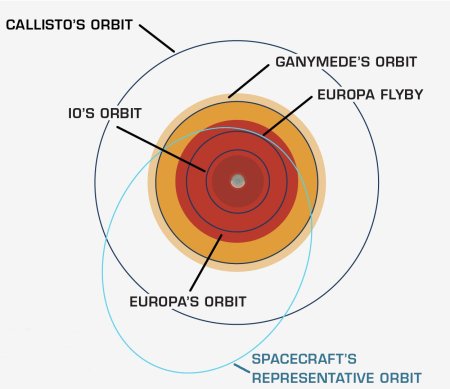
Europa's approximate orbit around Jupiter
Click for original image.

SpaceX’s Falcon Heavy rocket this morning successfully launched NASA’s Europa Clipper mission on its way to Jupiter, the rocket lifting off from the Kennedy Space Center in Florida.

In order to get the energy to reach Jupiter, none of the Falcon Heavy’s first stage boosters were recovered today. The two side boosters completed their sixth and final flights with this mission, while the core booster completed its first launch. The only parts of the rocket that will be recovered and reused were the two fairing halves.

To get to Jupiter, the spacecraft will make first a fly-by of Mars in February 2025, and then a fly-by of Earth in December 2026. It will arrive in Jupiter orbit in April 2030, where its orbit will be adjusted to fly close past Europa many times in order to study it closely, as shown by the graphic on the right. It will not going into orbit around the planet because that would place it permanently inside the high radiation environment around Jupiter. This is especially important because the spacecraft has installed transistors that were not properly hardened for that environment.

The leaders in the 2024 launch race:

98 SpaceX
45 China
11 Russia
11 Rocket Lab

American private enterprise now leads the rest of the world combined in successful launches 115 to 68, while SpaceX by itself now leads the entire world, including American companies, 98 to 85.

9 comments

In approving Europa Clipper’s launch, NASA and JPL claim its non-spec transistors will “heal” themselves in Jupiter orbit

Europa in true color
Europa in true color, taken by Juno September 2022.
Click for full image.

In making the decision to allow Europa Clipper to be launched on a Falcon Heavy on October 10, 2024, NASA and JPL officials explained that after several months of testing, they believe the improperly hardened transistors installed throughout the orbiter will “heal” themselves while in the low radiation portions of its orbit around Jupiter.

[The testing] showed the transistors in question will, in effect, heal themselves during the 20 days between the high radiation doses the probe will receive during each of 49 close flybys of Europa, all of them deep in Jupiter’s powerful magnetic field and radiation environment.

In addition, onboard heaters can be used as needed to raise the temperature of affected transistors, improving the recovery process. “After extensive testing and analysis of the transistors, the Europa Clipper project and I personally have high confidence we can complete the original mission for exploring Europa as planned,” said Jordan Evans, Europa Clipper project manager at NASA’s Jet Propulsion Laboratory.

I hope this analysis is right, though I fear there is a lot of wishful-thinking involved. It could be however that this testing, in combination with what engineers have learned during Juno’s so-far 64 orbits around Jupiter, might have reassured them.

We however will not know for sure until Europa Clipper is on its way and reaches Jupiter in 2030.

6 comments

NASA confirms Europa Clipper launch on October 10, 2024 with questionable transistors

NASA yesterday confirmed that it has decided to go ahead with the October 10, 2024 launch of its $5+ billion Europa Clipper mission to Jupiter, despite the installation of transistors on the spacecraft that the agency knows are not properly hardened for that harsh environment.

Those transistors were built by a German company as part of equipment used by the spacecraft’s electrical system. Apparently that company hired a subcontractor to furnish the transistors, which failed to make them to the right specifications. Subsequent testing found that it is quite likely that at least some of the transistors will fail when Europa Clipper reaches Jupiter orbit.

It appears that NASA decided that the issue risk was small enough for the mission to achieve its minimal expected results, and decided the cost of delay and bad publicity replacing the transistors before launch would be worse than the limited science payoff and bad publicity that would take place years hence, when those transistors fail.

Remember this story in in 2030 when Europa Clipper enters Jupiter orbit and begins to experience problems.

3 comments

NASA leans toward launching Europa Clipper as scheduled, despite transistor issue

Though the final decision will be made in early September, NASA revealed today in a short post that management is leaning towards launching the multi-billion Europa Clipper mission as scheduled on October 10, 2024, despite a very recently discovered transistor issue where the transistors were not properly hardened in construction for the harsh radiation environment surrounding Jupiter.

The next major milestone for Clipper is Key Decision Point E on Monday, Sept. 9, in which the agency will decide whether the project is ready to proceed to launch and mission operations. NASA will provide more information at a mission overview and media briefing targeted for that same week.

The Europa Clipper mission team recently conducted extensive testing and analysis of transistors that help control the flow of electricity on the spacecraft. Analysis of the results suggests the transistors can support the baseline mission. [emphasis mine]

The highlighted sentence suggests NASA officials have weighed the option between launching on time with a limited ability to do science once at Jupiter versus delaying the launch years to fix the transistors, and are now favoring the former option. The cost of delay would be high and long, and NASA officials might believe the bad press for that option would be much greater than a mission that only achieves its bare minimum results. For example, to admit publicly that NASA installed transistors that were not space-hardened when that necessity has been known about since the 1960s would be as embarrassing to the agency as it was for Boeing when it discovered it had installed flammable tape in its Starliner capsule. NASA management might be leaning to letting a flawed multi-billion dollar project launch, knowing its capabilities are quite limited, in order to avoid that embarrassment.

5 comments

Computer models suggest there is no life in Europa’s underground ocean

The uncertainty of science: Several different computer simulations now suggest that the underground ocean inside the Jupiter moon Europa is inert and likely harbors no existing lifeforms.

He and his colleagues constructed computer simulations of Europa’s seafloor, accounting for its gravity, the weight of the overlying ocean and the pressure of water within the seafloor itself. From the simulations, the team computed the strength of the rocks about 1 kilometer below the seafloor, or the stress required to force faults in the seafloor to slide and expose fresh rock to seawater.

Compared with the stress applied to the seafloor by Jupiter’s gravity and by the convection of material in Europa’s underlying mantle, the rocks comprising Europa’s seafloor are at least 10 times as strong, Byrne said. “The take home message is that the seafloor is likely geologically inert.”

A second computer model also suggested that the moon’s deep magna is not capable to pushing upward into that sea, further reinforcing the first model that the sea is geological inert, lacking the heat or energy required for life.

Though unconfirmed and uncertain, these results when looked at honestly make sense. Europa is a very cold world. An underground ocean might exist due to tidal forces imposed by Jupiter, but that dark and sunless ocean is also likely to be very hostile to life. Not enough energy to sustain it.

Like the water imagined to exist at poles of the Moon, we go to Europa on the hope of finding life, even if that hope is very ephermal.

7 comments

Scientists: Europa produces oxygen on its surface, but less than expected

Graphic of Europa
Click for original image.

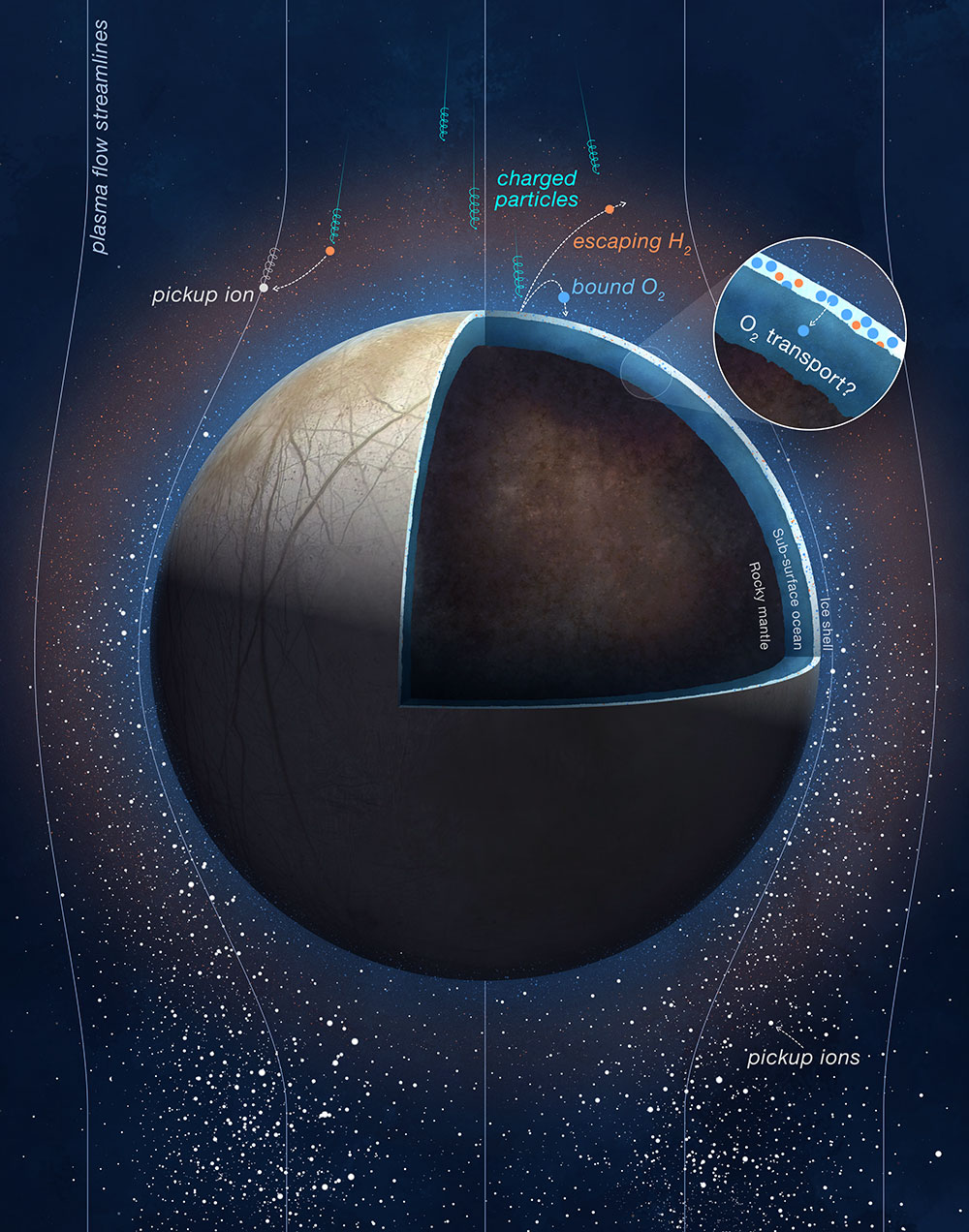
The uncertainty of science: Scientists using data from a 2022 flyby of the Jupiter moon Europa by the orbiter Juno have determined that the moon produces about 1,000 tons of oxygen every 24 hours on its surface, a large amount but less than most predictions based on previous indirect observations.

The paper’s authors estimate the amount of oxygen produced to be around 26 pounds every second (12 kilograms per second). Previous estimates range from a few pounds to over 2,000 pounds per second (over 1,000 kilograms per second). Scientists believe that some of the oxygen produced in this manner could work its way into the moon’s subsurface ocean as a possible source of metabolic energy.

You can read the paper here. The graphic shows the basic process, as presently theorized. What remains unknown is how or even if that oxygen is transported downward to the theorized underground ocean of liquid water. That the amount created is on the very low end of previous estimates suggests that there will be less free oxygen to support life in that ocean than expected.

2 comments

Juno’s closest image of Europa suggests recent surface activity

Juno's best image of Europa
Click for original image.

Analysis by scientists of the closest image of Europa taken during Juno’s close-fly on September 29, 2022 suggests that a particular strange feature, dubbed the “platypus” due to its shape, might be very young and indicate recent surface activity that could be related to underground liquid water.

That picture, reduced and sharpened to post here, is to the right. It is figure 2 of the paper. The description of this photo from the abstract:

Intricate networks of cross-cutting ridges and lineated bands surround an intriguing 37 km (east-west) by 67 km (north-south) chaos feature with a concentric fracture system, depressed matrix margins, and low-albedo materials potentially associated with brine infiltration. The morphology and local relief of the chaos feature are consistent with formation in the collapse of ice overlying a salt-rich lens of subsurface water. Low-albedo deposits, similar to features previously associated with hypothesized cryovolcanic plume activity, flank nearby ridges. The SRU’s high-resolution view of many types of features in a single image allows us to explore their regional context and greatly improve the geologic mapping of this part of Europa’s surface. The image reveals several relatively youthful features in a potentially dynamic region, providing baselines for candidate locations that future missions can investigate for present day surface activity.

SRU is Juno’s Stellar Reference Unit camera, designed to take pictures using only the low light of Jupiter reflected onto nighttime surfaces of Jupiter’s moons. It took this photo when Juno was only 256 miles above the surface.

This feature will obviously become a prime target for Europa Clipper when it arrives into orbit around Jupiter in April 2030. From this vantage point — safer than continuous exposure to Jupiter’s magnetosphere while in orbit around Europa — the spacecraft will do 44 close-flys of the moon.

0 comments

Webb infrared data suggests Europa’s C02 comes from within

Europa as seen by Webb's near-infrared camera
Europa as seen by Webb’s near-infrared camera.
Click for original image.

Two different research papers, using infrared data from the Webb Space Telescope, have independently concluded that the carbon dioxide previously detected on the surface of Europa is found concentrated in the same region, and has the earmarks of coming from beneath the surface.

In one study, Samantha Trumbo and Michael Brown used the JWST [Webb] data to map the distribution of CO2 on Europa and found the highest abundance of CO2 is located in Tara Regio – a ~1,800 square kilometer region dominated by “chaos terrain,” geologically disrupted resurfaced materials. According to Tumbo and Brown, the amount of CO2 identified within this recently resurfaced region – some of the youngest terrain on Europa’s surface – indicates that it was derived from an internal source of carbon. This implies that the CO2 formed within Europa’s subsurface ocean and was brought to the surface on a geologically recent timescale. However, the authors say that formation of CO2 on the surface from ocean-derived organics or carbonates cannot be entirely ruled out. In either interpretation, the subsurface ocean contains carbon.

In an independent study of the same JWST data, Geronimo Villanueva and colleagues found that the CO2 on Europa’s surface is mixed with other compounds. Villanueva et al. also find the CO2 is concentrated in Tara Regio and interpret that as demonstrating that the carbon on the moon’s surface was sourced from within. The authors measured the ice’s 12C/13C isotopic ratio, but could not distinguish between an abiotic or biogenic source. Moreover, Villanueva et al. searched for plumes of volatile material breaching moon’s icy crust. Although previous studies have reported evidence of these features, the authors did not detect any plume activity during the JWST observations. They argue that plume activity on Europa could be infrequent, or sometimes does not contain the volatile gasses they included in their search.

As always, these conclusion must be viewed with some skepticism, as the data is somewhat sparse and coarse. Webb’s resolution is not enough to truly pinpoint the source location with great accuracy, and the conclusion that the CO2 comes from underground depends on many assumptions. For example, in the image above, the white area roughly corresponds to Tara Regio, but with very large margins.

1 comment

Jupiter and two of its Moons, as seen by Cassini during 2018 fly-by

Cool video time! Back in December 2000 the spacecraft Cassini made a fly-by of Jupiter on its way to Saturn, which it then orbited from 2004 to 2017. In 2018 JPL scientist Kevin Gil took the images from that flyby to create a short movie, first showing two of Jupiter’s moons, Io and Europa, as they drifted above the Great Red Spot.

Then, for the second half of the movie Gil used Cassini images taken when in orbit around Saturn to show the moon Titan moving across the rings of Saturn.

I have embedded this short video below. If I had posted this back in 2018, I don’t remember. No matter. It is amazing enough to watch again.

Hat tip BtB’s stringer Jay.
» Read more

5 comments

Delays threaten Europa Clipper mission

A variety of issues delaying completion of the science instruments on the Europa Clipper mission are now threatening to prevent the spacecraft from meeting its 2024 launch date.

[W]ith less than two years to go before launch, only three of those instruments have been installed on the main spacecraft body, and five haven’t yet arrived at JPL.

Some context: Europa Clipper has been under development since 1997, though actual design work did not begin until 2013, nine years ago. It presently has a budget of $4.25 billion (more than double its first proposed budget of $2 billion). Yet now, less than years from launch, seven of ten instruments are behind schedule?

What is really disgusting about this story is that it is par for the course for NASA, which almost never finishes anything on time or on budget.

3 comments

Europa in true color

Europa in true color
Click for full image.

The photo to the right, cropped and reduced to post here, was taken on September 29, 2022 by the Jupiter orbiter Juno during its close fly-by of Europa. Citizen scientist Bjorn Jonsson has processed it to bring out the details. From his caption:

This is an approximately true color/contrast, reprocessed version of Europa image PJ45_1. It is more carefully processed than the version I posted very shortly after the raw image data was released. The color should be fairly close to Europa’s real color and probably slightly more accurate than the color of the earlier version I posted. North is up.

The Sun is coming from the right, so those are craters in the upper left, close to the shadowed limb of the planet. The red color has been known for decades, and appears in many cases to be seepage coming up from the many meandering ridges that criss-cross the planet’s surface. Their chemistry/make-up is not fully known at this time.

Juno came within 219 miles of Europa, the closest any spacecraft has come since the Galileo orbiter circled Jupiter in the 1990s. I was expecting close-up images of the surface, from that close distance, but have not yet seen any. Instead, most of the images released and processed by citizen scientists have been global images from farther away. Thus, at this moment it does not appear Juno took pictures at this closest distance.

2 comments

NASA releases first Juno image from the first close fly-by of Europa in decades

First released Juno image of Europa
Click for full image.

Kevin Gill's processed Juno image of Europa
Click for full image.

NASA yesterday released the first image from the successful close fly-by by Juno of Jupiter’s moon Europa since the 1990s. That photo, reduced and sharpened, is above.

The first picture NASA’s Juno spacecraft took as it flew by Jupiter’s ice-encrusted moon Europa has arrived on Earth. Revealing surface features in a region near the moon’s equator called Annwn Regio, the image was captured during the solar-powered spacecraft’s closest approach, on Thursday, Sept. 29, at 2:36 a.m. PDT (5:36 a.m. EDT), at a distance of about 219 miles (352 kilometers).

This is only the third close pass in history below 310 miles (500 kilometers) altitude and the closest look any spacecraft has provided at Europa since Jan. 3, 2000, when NASA’s Galileo came within 218 miles (351 kilometers) of the surface.

Meanwhile, the raw images have been pouring in, and citizen scientists have been quickly processing them. The photo to the right is only one example, created by Kevin Gill. I have cropped it to show one section in full resolution.

Expect many more processed images, especially those taken at closest approach, in the coming days.

2 comments

Webb infrared image of Jupiter & Europa

Jupiter and Europa as seen by Webb
Click for full image.

During the commissioning phase after deployment, the James Webb Space Telescope took images of Jupiter and several asteroids in order test the telescope’s instruments. The photo to the right, cropped and reduced to post here, shows both Jupiter and its moon Europa to the left.

Fans of Jupiter will recognize some familiar features of our solar system’s enormous planet in these images seen through Webb’s infrared gaze. A view from the NIRCam instrument’s short-wavelength filter shows distinct bands that encircle the planet as well as the Great Red Spot, a storm big enough to swallow the Earth. The iconic spot appears white in this image because of the way Webb’s infrared image was processed.

…Clearly visible at left is Europa, a moon with a probable ocean below its thick icy crust, and the target of NASA’s forthcoming Europa Clipper mission. What’s more, Europa’s shadow can be seen to the left of the Great Red Spot. Other visible moons in these images include Thebe and Metis.

The false color differences indicated differences in heat but it is not explained whether brighter is colder or warmer in this photo.. As one of my readers below correctly notes, Europa’s shadow tells us that darker is cooler. This one image shows that the Red Spot and Jupiter’s equatorial regions and poles are generally warm.

13 comments
1 2 3