
SpaceX demolishes SLC-6 launchpad at Vandenberg
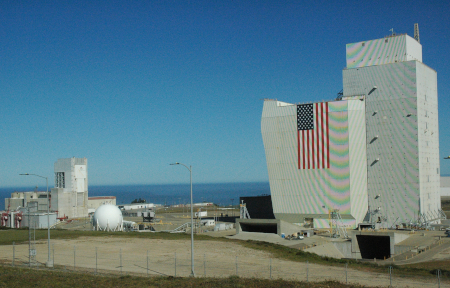
The SLC-6 launchpad during my 2015 tour of Vandenberg
As part of its plan to launch both Falcon 9 and Falcon Heavy from Vandenberg Space Force Base in California, SpaceX today demolished the SLC-6 launchpad there that had been built in the 1980s for space shuttle launches (but never used) and then leased to ULA for its Delta rocket (now retired).
Below the fold is a video showing the controlled demolition. The quality is very poor, as it was taken on a smart phone looking at a live stream of the demolition, broadcast inside a nearby auditorium. Vandenberg officials did not allow anyone access to any nearby location to watch live.
SpaceX will now rebuild the pad for its own Falcon rockets. Once completed, it will have two launchpads at Vandenberg, allowing it to up its launch rate there to as much as 100 launches per year.
To get a sense of the size and scale of SLC-6 prior to today, see the photos from my 2015 tour of Vandenberg. The picture to the right attempts to capture it, with its mobile launch tower on left and larger assembly building on the right. As I wrote then when taken inside the rocket assembly building:
I can sum up the experience however in one word: Big! The interior space was incredibly large, so large they have repeated problems chasing birds and raccoons from within it. When we took the elevator to the 20th level, almost the highest point inside, the room echoed with the sounds of birds whistling away. I wonder how they react when a rocket takes off.
It is now gone. It will however be replaced by something better. The history of SLC-6 was that of a largely expensive and under-used facility. SpaceX intends to change that.
Hat tip BtB’s stringer Jay.

On Christmas Eve 1968 three Americans became the first humans to visit another world. What they did to celebrate was unexpected and profound, and will be remembered throughout all human history. Genesis: the Story of Apollo 8, Robert Zimmerman's classic history of humanity's first journey to another world, tells that story, and it is now available as both an ebook and an audiobook, both with a foreword by Valerie Anders and a new introduction by Robert Zimmerman.
The print edition can be purchased at Amazon or from any other book seller. If you want an autographed copy the price is $60 for the hardback and $45 for the paperback, plus $8 shipping for each. Go here for purchasing details. The ebook is available everywhere for $5.99 (before discount) at amazon, or direct from my ebook publisher, ebookit. If you buy it from ebookit you don't support the big tech companies and the author gets a bigger cut much sooner.
The audiobook is also available at all these vendors, and is also free with a 30-day trial membership to Audible.
"Not simply about one mission, [Genesis] is also the history of America's quest for the moon... Zimmerman has done a masterful job of tying disparate events together into a solid account of one of America's greatest human triumphs."--San Antonio Express-News
Took Delta IV to break the “curse.”
An Athena launched there first, according to Wikipedia.
Did SpaceX pass out any Thorazine for the California Coastal Commission? Between this demolition/construction, and the SpaceX IPO, I imagine the Coastal Commission is already self-medicating.
I was going to make a joke about California imposing a “launch tax.”
I decided to do a little research first, and lo and behold, they already have it. A Google search turned up this:
“””California’s Franchise Tax Board applies a mileage-based formula to determine how much in-state income is taxed for commercial space transportation, similar to rules used for terrestrial logistics companies.
Specific details regarding the aerospace and rocket launch tax system include:
The Mileage Formula:
For companies generating more than 50% of their revenue from space transportation, taxes are calculated by the proportion of miles a rocket travels in California’s airspace before reaching the internationally recognized edge of space (62 miles up).
No Tax Once in Space:
The state calculates taxes based only on the mileage traveled within the state boundary. Once a rocket or payload passes that edge of space, it is deemed to be in space and does not incur further tax, as stated by the California Department of Tax and Fee Administration.”””
I think CA might have outsmarted itself with this tax being only for “companies generating more than 50% of their revenue from space transportation.” That no longer applies to SpaceX.
I’m sure the law will be modified to suit SpaceX’s new circumstances.
How far from Vandenburg to Sacramento?
Gosh, Governor, we didn’t mean for it to come down on the Statehouse
Asa soldier, it pains me to see Old Glory collapse into the dirt
Like the Phoenix, it will rise again.
Thank you
Musk must be feeling a bit of satisfaction over this. Eric Berger tells the whole story in his excellent book Liftoff how Musk tried to get a small pad built at Vandenberg for the fledgling launch campaign of the Falcon 1 and the Air Force basically kicked him out to the remote South Pacific Kwajelein Atoll–a much more difficult logistical challenge.
After passing that trial by fire and now taking over and making over the largest launch complex at VAFB; the storied “Slick 6” which was to be the Air Force’s crown jewel for launching their Manned Orbital Laboratory in the 1960s–it just has to give Musk great satisfaction.
I find it interesting that they are planning to build a new Falcon 9/Falcon Heavy pad at this point. Just a few months ago there were stories in the media describing “the beginning of the end” for Falcon 9 and the start of the transition to Starship. And Musk has repeatedly said that he sees no future for Falcon once Starship is operational.
The military will continue to have Falcon- and Falcon Heavy-class payloads to launch for some time. Given how busy Starship will be with Starlink, Starlink Mobile and AI1 deployments over the next few years, plus all of the logistics launches needed to support both the NASA Moon Base and SpaceX’s own Moon Base, it will probably be more economical to launch legacy payloads on Falcons for the next several years so that Starship can concentrate exclusively on stuff only it can do.
It might be that Starship will be a good but not omnipotent launch system for the foreseeable future. Falcon is known and trusted. Starship is TBD which, especially for military, is not good enough. Given the time to bring this new Falcon facility into service, it seems likely that some parties expect a few years before Starship becomes reliable enough to depend on.
I don’t think anyone expects Starship to be… I think omnipresent might be a better word than omnipotent where space launch is concerned. But, a decade ago, I don’t think many expected Falcon 9 to dominate launch as it has and does either. Starship will find its place and that place is likely to be at least as dominant as F9’s current place – especially anent its share of total annual launched mass.
About the institutional conservatism of the military, you might be right about that, though the Space Force seems comparatively frisky in its youth. In any case, if the military doesn’t make some significant early use of Starship I don’t see any way it will have even a minimally-viable Golden Dome up by the time Trump leaves office.
That seems like a good summary of its history over the past 4 decades. Very impressive, but seldom actually used to launch rockets, alas.
Ironically, though, SpaceX is now converting it to launch Falcons right as it’s on the cusp of shifting away from Falcon to Starship. But I’m sure they’ve thought all this through.
I have always hated the Air Force… convinced that they had a hand in the death of the ABMA by proxy.
I hope Vandenberg becomes Gateway West.
It took them awhile, here is the video the Space Force’s video of SLC-6
I did call the Public Affairs office the day of the demolition about getting video, but they never returned my call.