SpaceX officials provide cause of loss Falcon 9 first stage after successful landing
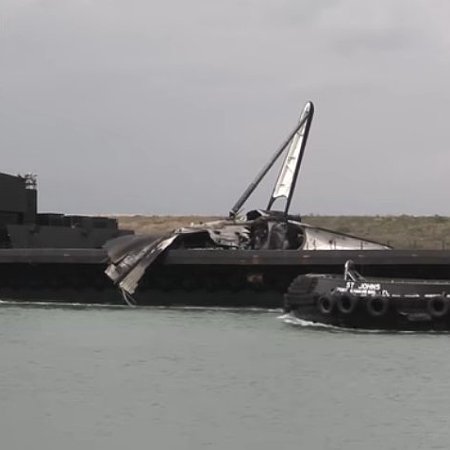
Damaged Falcon 9 booster laying on its side on drone ship as it returns to port
The damaged Falcon 9 booster laying on its side
on its drone ship as it returns to port.

At a press conference yesterday, SpaceX officials outlined the results of its investigation into the loss of Falcon 9 first stage when it fell over on its drone ship shortly after a successful landing.

Speaking at a news conference following a flight readiness review for the Crew-10 mission to the International Space Station, Bill Gerstenmaier, vice president of Build and Flight Reliability at SpaceX, said about 85 seconds into the launch of the Starlink 12-20 mission, there was a fuel leak in the first stage booster, tail number B1086, and kerosene sprayed onto a hot component of the engine. He said that caused it to vaporize and become flammable.

Because there wasn’t enough oxygen to interact with the leaked fuel, it didn’t catch fire during the ascent, he said. But about 45 seconds after B1086 landed on their droneship, ‘Just Read the Instructions,’ there was enough oxygen available to get into the engine compartment and a fire broke out. “It subsequently blew out the barrel panel on the side of the rocket, just like it was designed to. The fire was all contained in the engine compartment,” Gerstenmaier said. “Even if we would’ve had a problem during ascent, this shows that the fire and the damage would be contained in just a single engine out, which still allows us to accomplish the entire mission.”

The company is still working to determine the cause of the leak itself.

Though the article and video at the link make a big deal about the FAA grounding SpaceX’s Falcon 9 fleet, the agency’s actions here were quite trivial compared to its behavior when Biden was president. It grounded the fleet for only a few days, while SpaceX did its initial investigation, and then immediately accepted the above conclusions from SpaceX and lifted the grounding, even though the company has not yet determined the leak’s cause.
1 comment

Anonymous sources: Starship will need a major rebuild after two consecutive failures

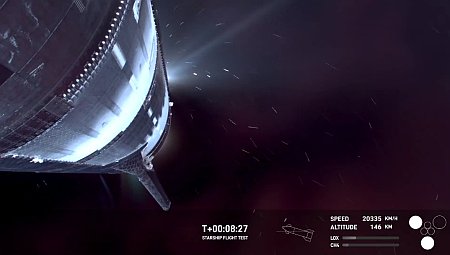
Starship just before loss of signal
Starship just before loss of signal on March 6, 2025

According to information at this tweet from anonymous sources, parts of Starship will likely require a major redesign due to the spacecraft’s break-up shortly after stage separation on its last two test flights.

These are the key take-aways, most of which focus on the redesign of the first version of Starship (V1) to create the V2 that flew unsuccessfully on those flights:

  • Hot separation also aggravates the situation in the compartment.
  • Not related to the flames from the Super Heavy during the booster turn.
  • This is a fundamental miscalculation in the design of the Starship V2 and the engine section.
  • The fuel lines, wiring for the engines and the power unit will be urgently redone.
  • The fate of S35 and S36 is still unclear. Either revision or scrap.
  • For the next ships, some processes may be paused in production until a decision on the design is made.
  • The team was rushed with fixes for S34, hence the nervous start. There was no need to rush.
  • The fixes will take much longer than 4-6 weeks.
  • Comprehensive ground testing with long-term fire tests is needed. [emphasis mine]

It must be emphasized that this information comes from leaks from anonymous sources, and could be significantly incorrect. It does however fit the circumstances, and suggests that the next test flight will not occur in April but will be delayed for an unknown period beyond.

I think the tweet however is much too pessimistic. If the problems are all within the fuel lines, engine wiring, and the power unit, they are well localized. Moreover, the design of these components on version 1 of Starship apparently worked reasonably well, which gives them a good basis for that redesign. Nonetheless, if these facts are correct, my guess is the next test flight won’t occur before June.

The one saving grace is that FAA red tape is clearly no longer an additional obstacle. It is very clear now that with the change from Biden to Trump it is letting SpaceX lead all investigations, and immediately accepting its conclusions and fixes, rather than sitting on those conclusions as it retyped them for weeks or months in its own report.

Hat tip to reader Richard M.

26 comments

FAA issues launch license for 8th Starship/Superheavy test flight

The FAA yesterday announced that it has given SpaceX the launch license for its 8th orbital test launch of Starship/Superheavy, presently scheduled for March 3, 2025 at 5:30 PM (Central).

“After completing the required and comprehensive safety review, the FAA determined the SpaceX Starship vehicle can return to flight operations while the investigation into the Jan. 16 Starship Flight 7 mishap remains open,” the FAA’s emailed statement reads. [emphasis mine]

The highlighted phrase reveals much. There is a new boss in Washington now who will not tolerate unnecessary red tape that stymies private enterprise unnecessarily. SpaceX is the only entity qualified to investigate the loss of Starship in the seventh flight, and it has completed its investigation. All the FAA can really do in its own “investigation” is retype SpaceX’s conclusion. It might have some clean-up work of its own relating to clearing the air space after Starship was destroyed, but even there SpaceX’s conclusion note that the plan worked out before launch between the company and the FAA worked perfectly.

Under Biden the FAA would have made SpaceX wait while that retyping took place, likely assigned to someone who can only hunt and peck at an old manual typewriter. No more.

5 comments

Musk: Verizon’s upgrade of air traffic system failing; proposes Starlink instead

In a series of statements in the last few days Elon Musk has claimed that the $2.4 billion upgrade of the FAA’s air traffic system by Verizon is failing, and further suggested, in a proposal fraught with conflict-of-interest issues, that SpaceX take over the contract instead.

The CNN article that I link to above is surprisingly well written. It describes the situation fairly, and includes no slanderous asides on Musk or SpaceX, as I have found typical of almost every other article written by the propaganda press about this particular subject (or any about Musk).

If Musk says Verizon’s upgrade is failing, I would tend to believe him. That Verizon has barely begun work installing the upgrades, two years after winning the contract, reinforces his accusations. SpaceX has already provided the FAA at no cost three Starlink terminals for testing, and if it does get the job we can be sure the upgrade would be installed far quicker than this.

The conflict-of-interest issue however remains. I am not sure how, or even if, Musk or SpaceX can get around it.

6 comments

SpaceX reschedules the 8th Starship/Superheavy orbital test flight to March 3, 2025

SpaceX has rescheduled the 8th Starship/Superheavy orbital test flight from today to March 3, 2025, with the launch window opening at 5:30 pm (Central).

The company gave no reason for the delay, but it also indicated that the FAA has still not closed out the investigation of the Starship failure on the last test in January, nor issued the launch license.

That SpaceX is pushing for this quick launch date suggests it either expects the FAA to issue the permit momentarily, or it is purposely highlighting continuing delay tactics and is applying pressure on the agency. Unlike the Biden administration, which was very hostile to Musk and SpaceX and worked to harass it with lawfare, Trump will not take kindly to such tactics. By making such tactics patently obvious Musk and SpaceX will force Trump to step in.

4 comments

SpaceX engineers given task to review FAA air traffic operations

On February 16, 2025 the new head of the Department of Transportation revealed that he had invited SpaceX to review its air traffic control operations in Virginia and make recommendations.

Tomorrow, members of @elonmusk’s SpaceX team will be visiting the Air Traffic Control System Command Center in VA to get a firsthand look at the current system, learn what air traffic controllers like and dislike about their current tools, and envision how we can make a new, better, modern and safer system.

Because I know the media (and Hillary Clinton) will claim Elon’s team is getting special access, let me make clear that the @FAANews regularly gives tours of the command center to both media and companies.

Many propaganda news reports immediately did exactly what Duffy predicted, quickly finding people to attack both Musk and Duffy for this action and giving them a bull horn for those attacks:

That prompted criticism from some aviation professionals. “SpaceX put people in danger yesterday and their for-profit corporation should reimburse every other for-profit corporation that had to divert, change course or delay because of their operations in the national airspace system,” wrote Steve Jangelis, aviation safety chair for the Air Line Pilots Association, in a social media post after the incident.

Like many in the propaganda press, this article made a big deal about the debris that fell in the Caribbean during the January Starship/Superheavy test flight when Starship broke up soon after stage separation. It however buried this fact to the very end of the article:

In the case if January’s launch, Diez said SpaceX coordinated “debris response areas” with ATO [the FAA’s Air Traffic Organization] beforehand, as it had done on past flights, but this was the first time the areas were activated. “It was only a matter of minutes from when it was activated to when airspace began to be cleared,” she said, sufficient given the time it would take for debris to fall into the airspace. The airspace was cleared in about 15 minutes, she added.

Those debris response areas are developed in coordination with the FAA’s Office of Commercial Space Transportation, or AST, said Katie Cranor, acting deputy director of AST’s office of operational safety, on the same panel. After the mishap, she said “only certain sections of the debris response areas were activated to allow traffic to still move freely.”

To put it more bluntly, SpaceX did the proper due diligence before launch — anticipating the possibility of such a failure — and worked well with the FAA to prepare for it. These facts have been conveniently left out of all the reports on that January launch, and we should at least give kudos to this article for finally mentioning it, albeit reluctantly.

Nonetheless, the insane hostile reaction to this invitation for help by the Transportation Department illustrates once again the stupidity of the left. In every case they attack blindly and without any thought at all, hoping such attacks will win them support and hurt their opponents. Instead, it simply makes them look petty and stupid, and is likely convincing their moderate supporters to rethink that support.

4 comments

German startup Atmos gets FAA approval to launch its orbital research capsule

The German startup Atmos Space Cargo has now gotten its FAA launch license for testing the re-entry capability of its first orbiting research capsule, dubbed Phoenix.

That payload review was the final regulatory step needed for the mission, Sebastian Klaus, chief executive and co-founder of Atmos, said in an interview. The company doesn’t need a separate FAA reentry license because the spacecraft is planned to reenter over international waters, he said, and there are no licensing requirements by Germany, where the company is based.

Phoenix is fully assembled and has completed environmental testing, although the company is continuing to update software for the vehicle. “Physically and from a testing point of view, the spacecraft is ready for launch,” he said.

The capsule will be deployed immediately after the Falcon 9’s upper stage completes its de-orbit burn, so that it can then test that re-entry capability using an “inflatable decelerator”, likely a larger heat shield that can be used to protect a larger capsule.

This mission will be the first in a series of flights to test that inflatable system. If successful, the capsule will then be made available for orbital manufacturing for return to Earth, similar to the American startup Varda and its capsule.

2 comments

FAA demands SpaceX do “mishap investigation” into the loss of Starship yesterday

The FAA today announced that it is going to require SpaceX “to perform a mishap investigation into the loss of the Starship vehicle during launch operations on Jan. 16.”

Will this demand involve the same delays seen during the Biden years? I strongly believe they will not, for several reasons.

First, the FAA’s announcement seemed to me to have a decidedly different tone than in the past. It didn’t say “The FAA needed to complete a mishap investigation,” it said SpaceX had to do it. During the Biden administration the FAA made believe it was qualified to investigate any issues on a Starship/Superheavy launch, when in reality it had no such qualifications at all. It simply waited for SpaceX to complete its investigation, then would spend one to three months as it retyped SpaceX’s report.

Before Biden, the FAA let the company do the investigation, and quickly accepted its conclusions. That appears to be what it is doing now.

Second, Musk’s own response in announcing the preliminary results of the SpaceX investigation yesterday suggests he already expects the FAA to change its approach in this manner. “Nothing so far suggests pushing next launch past next month.” Right away he is signaling us that when SpaceX completes its work it expects the FAA to quickly okay the next flight. No long waits for paper work.

Third, there is Trump. If any FAA bureaucrats still try to play power games against SpaceX they will quickly discover they have no allies in the chain of command. Musk will make these games public, and Trump will come down hard against them.

That’s my hopeful prediction. We shall shortly see if my optimism has merit.

Hat tip to BtB’s stringer Jay.

17 comments

FAA cancels one of three public meetings on the Starship/Superheavy environmental reassessment

The FAA today announced that it has canceled one of three meetings that it plans to hold in the Brownsville region next week to obtain public feedback on SpaceX’s request to increase its Starship/Superheavy launch rate at Boca Chica to 25 launches per year.

The FAA was scheduled to hold in-person public meetings on January 7th and 9th, 2025. However, due to the designation of January 9, 2025 as a National Day of Mourning to honor the late former President Jimmy Carter, the January 9th meetings are now cancelled.

The meeting schedule is now as follows:

  • In-person meeting: Tuesday, January 7, 2025; 1:00 PM–3:00 PM & 5:30 PM–7:30 PM CDT at the Texas Southmost College, Jacob Brown Auditorium, 600 International Boulevard, Brownsville, TX 78520
  • Virtual on-line meeting: Monday, January 13, 2025; 5:30 PM–7:30 PM CDT Registration Link here. Dial-in phone number: 888-788-0099 (Toll Free), Webinar ID: 879 9253 6128, Passcode: 900729

As I noted in November when the new environmental reassessment and these meetings were announced, it is practically certain that the fringe anti-Musk activists groups SaveRGV, Sierra Club, the Friends of Wildlife Corridor, and the fake Indian Carrizo/Comecrudo Nation of Texas (which never existed in Texas) are organizing to be there in force, demanding SpaceX’s Boca Chica operations be shut down.

If the rest of the public, which is the vast majority of the Brownsville community, does not show up to counter these fringe activists, it will make it much easier for the bureaucrats who hate Musk at the FAA to take action against SpaceX. It is essential that the business community at least make an appearance, as the arrival of SpaceX has brought billions of dollars and tens of thousands of jobs to Brownsville.

0 comments

Seventh Starship/Superheavy test launch now targeting January 10, 2025

Based on a single word tweet by Elon Musk as well as the FAA’s license approval, it now appears that SpaceX is targeting January 10, 2025 for the seventh Starship/Superheavy test orbital launch.

According to the FAA license, the launch window that day opens at 4 pm (Central), with backup launch opportunities each day through January 15th.

Reading that license is very illuminating. The depth in which the FAA now demands compliance from SpaceX is beyond daunting, and illustrates the mission creep the agency has used to grow its power. Based on a recent Supreme Court ruling, the company likely has grounds to sue and win, correctly claiming that Congress never gave it such power over so many things, and that its regulatory oversight is unconstitutional.

4 comments

Blue Origin finally gets FAA license to launch New Glenn, now targeting January 6, 2025

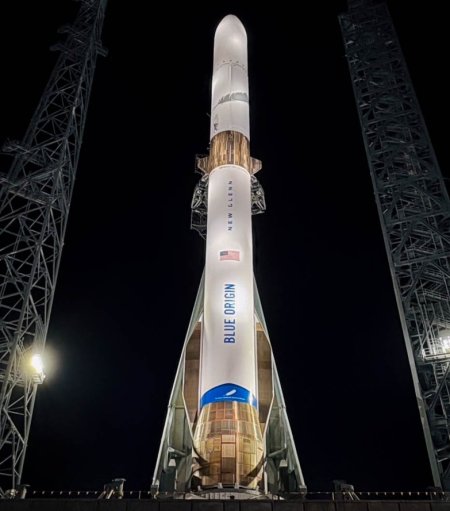
The first completely assembled New Glenn, on the launchpad
The first completely assembled New Glenn,
on the launchpad

The FAA, after months of apparent delays, today finally issued Blue Origin a license to launch its New Glenn rocket for a period covering the next five years.

As has now become the FAA’s custom, in issuing this license it also brags about its success in issuing the license “well in advance of the statutory deadline” for doing so.

What a crock. Blue Origin and NASA were originally targeting an October launch of New Glenn carrying two Mars orbiters, but had to cancel when the rocket couldn’t lift off during the six-day launch window. Though delays at Blue Origin certainly contributed to this cancellation, I suspect the FAA’s red tape played a major factor as well.

According to another source, Blue Origin is now targeting a launch date of January 6, 2025. The company is presently doing a static fire test on the launchpad.

Hat tip to BtB’s stringer Jay.

7 comments

FAA issues license for SpaceX’s seventh test flight of Starship/Superheavy

My, what a difference an election makes! FAA today proudly announced that it has issued the launch license for SpaceX’s seventh test flight of Starship/Superheavy at Boca Chica, now tentatively set for mid-January.

I say “proudly” because of this quote in the announcement:

“The FAA continues to increase efficiencies in our licensing determination activities to meet the needs of the commercial space transportation industry,” said the Associate Administrator for Commercial Space Transportation Kelvin B. Coleman. “This license modification that we are issuing is well ahead of the Starship Flight 7 launch date and is another example of the FAA`s commitment to enable safe space transportation.”

For the past three years it was like pulling teeth to get the FAA to issue these licenses for Starship/Superheavy test flights. Every time SpaceX had to wait from one to six months extra, and would only get the license mere hours before launch. During that time the FAA made no effort to “increase efficiencies” in its licensing process. Instead it found more ways to slow things down, not just for SpaceX but for the entire launch industry.

Trump gets elected and now suddenly the agency is interested in reducing red tape? What you are seeing instead a lot of bureaucrats desperately trying to convince the incoming administration that the delays for the past three years were not their fault, that they were really against red tape!

Or to put it more bluntly: “Please don’t fire us!”

I hope Trump doesn’t fall for this. A major house-cleaning in management and regulations is necessary at the FAA, and it must be done fast.

6 comments

FAA eliminates a stupid licensing requirement imposed when it “streamlined” its launch licensing regulations

We’re from the government and we’re here to help! The Federal Aviation Administration (FAA) announced last week that it will stop demanding rocket companies redo a flight safety analysis that have already been done by the rocket’s spaceports, a new bit of red tape that was apparently added when the agency introduced its Part 450 “streamlined” licensing regulations in 2021.

The FAA announced Dec. 13 that it will accept flight safety analyses performed by federal launch ranges in California, Florida and Virginia in applications for launch licenses under regulations known as Part 450. That decision means that companies will no longer have to perform similar analyses specifically for the FAA as part of the licensing process. Launch companies had complained of the duplication of work needed to carry out FAA analyses in addition to those required by the ranges they were launching from.

The FAA’s own bureaucracy had recognized the stupidity of this requirement (as well as many others) in July 2023 report [pdf], but the agency’s management did nothing. Apparently the political appointees who ran the agency during the Biden administration either liked this red tape — slowing American business — or were too dense to take action.

Trump’s election victory has now obviously forced some action. Not only has the agency suddenly recognized this particular problem, one week after Trump’s victory it announced the formation of an independent committee of industry and academia to review, once again, its Part 450 regulations.

It seems this committee is largely a Potemkin Village to make the Trump leadership think the agency is doing something. Instead, the FAA should do what it did last week, and adopt the many recommendations of the July 2023 report, now. The committee can then move forward cleaning up Part 450 in other areas instead of simply repeating that past work.

4 comments

Rocket startup Stoke Space completes static fire test of first stage engine

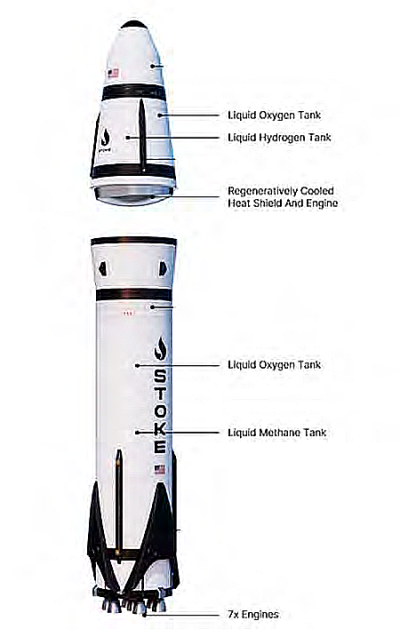
Stoke's Nova rocket
Stoke’s Nova rocket

The rocket startup Stoke Space revealed yesterday that it has completed a static fire test of the first stage engine it will use on its Nova rocket, shown in the graphic to the right.

The test, which was not the first for this engine, proved out several new technologies.

Stoke Space called the test significant for several reasons. It’s the first hotfire of the company’s Block 2 (flight layout) stage 1 engine, and this engine architecture — called full-flow staged combustion (FFSC) — is considered particularly challenging. Only two entities in the world — Stoke and SpaceX — have successfully developed FFSC engines. … Stoke’s stage 1 engine is a liquified natural gas/liquid oxygen engine capable of producing 100,000 pounds of thrust. The duration of the test was not revealed.

It was the first time Stoke has tested on its new vertical test stand in Moses Lake. The company’s testing philosophy is that you must “test like you fly,” and it believes vertical testing is key to engine development.

Nor is the first stage engine the only technological innovation. Nova’s second stage uses a radical design whereby the engine releases its thrust through a ring of small nozzles on the outside perimeter of the stage, rather than a single central nozzle. This design is what the company hopes will allow it to return that upper stage intact for reuse.

The four year old company has raised $100 million in investment capital, but has also faced environmental red tape from the Space Force for its launch facility at Cape Canaveral. It had previously targeted 2025 for the first test flights of Nova, but that schedule appears unlikely because of this red tape.

1 comment

Head of FAA resigns

You could leave now for all I care: Mike Whitaker, who has been director of the Federal Aviation Administration (FAA) under the Biden administration and who has apparently been the main source of that agency’s increased red tape that has almost destroyed the new rocket industry that had been emerging during the first Trump administration, announced today that he is stepping down next month.

Mike Whitaker announced his pending resignation in a message to employees of the FAA, which regulates airlines and aircraft manufacturers and manages the nation’s airspace. He became the agency’s administrator in October 2023.

Since then, the challenges confronting Whitaker have included a surge in close calls between planes, a need for stricter oversight of Boeing. antiquated equipment and a shortage of air traffic controllers at a time of high consumer demand for air travel.

The article at the link is from PBS, so of course it makes this federal bureaucrat appear a hero. Instead, he was a disaster for America’s space industry, forcing unnecessary delays in SpaceX’s Starship/Superheavy program, imposing new regulations that claimed to streamline the launch licensing process but did exactly the opposite, and generally forcing FAA regulators to take a fearful attitude to any new technology, so much so that it became almost impossible for that new technology to launch.

As for the aviation industry, Whitaker’s term did little to change things. For example, he did nothing to shut down the DEI programs at major airline and airplane companies that were causing the hiring of unqualified people.

All I can say is good riddance.

5 comments

Two congressmen demand FAA streamline its launch licensing process

In a letter [pdf] sent to the FAA on December 6, 2024, two congressmen have called for the FAA to fix what it calls its Part 450 launch licensing process, established in 2021, that has been choking off rocket development in the U.S.

The congressmen, Sam Graves (R-Missouri) and Rob Wittman (R-Virginia), specifically focused on the problems these new regulations have imposed during what the FAA calls its “pre-application review.” From the letter:

In November of 2024, the FAA indicated that 98 percent of applications are met within the statutory 180 day timeline. However, this timeframe does not include the months, and oftentimes years, of pre–application review that create extensive delays for companies seeking a launch and reentry license. [emphasis mine]

Consider the implications of this one quote. The FAA is proud of the fact that it approves license applications within six months — an ungodly long time for a startup — but doesn’t mention that the approval process is actually far longer because it requires new applications to be reviewed at length, before they can even be submitted.

In November, a week after Trump’s election victory, the FAA announced that it was forming a committee made up of people from the launch industry as well as academia to review Part 450. In their letter the congressmen approved of this new committee, but noted its work would not be completed until mid-2025, and that “the system is broken and must be fixed” immediately.

We, however, urge the FAA to act now and ensure that all actions short of rulemaking that can help mitigate the deficiencies of the part 450 regulation are taken in advance of any necessary regulatory changes to ensure that the commercial space industry does not have to wait years for relief.

I suspect we shall see some real action at the FAA come January 20, 2025, after Trump takes office.

1 comment

FAA approves revised launch rate for Boca Chica; schedules public meetings

The FAA today announced that it has issued a revised draft environmental assessment [pdf] of SpaceX’s operations at Boca Chica in which the agency approves the company’s request to increase its Starship/Superheavy launch rate from 5 to 25 launches per year.

This does not mean that SpaceX can now launch that many times in 2025. The draft still has to go through more red tape, including public meetings and a comment period, then reviewed again by the FAA. In this announcement the FAA rescheduled those public meetings, as follows:

  • Tuesday, January 7, 2025; 1:00 PM–3:00 PM & 5:30 PM–7:30 PM CDT at the Texas Southmost College, Jacob Brown Auditorium, 600 International Boulevard, Brownsville, TX 78520
  • Thursday, January 9, 2025; 1:00 PM–3:00 PM & 5:30 PM–7:30 PM CDT at the Port Isabel Event & Cultural Center, Queen Isabella Room, 309 E Railroad Avenue, Port Isabel, TX 78578
  • Virtually on Monday, January 13, 2025; 5:30 PM–7:30 PM CDT. Registration Link: https://us02web.zoom.us/webinar/register/WN_6f5su5mtTne_vBr8MqJOLA
    Dial-in phone number: 888-788-0099 (Toll Free),
    Webinar ID: 879 9253 6128, Passcode: 900729

I strongly suggest that local businesses and citizens in the Brownsville area organize to show up en masse at these meetings to express their approval of SpaceX, because I can guarantee that the fringe anti-Musk activists groups SaveRGV, Sierra Club, the Friends of Wildlife Corridor, and the fake Indian Carrizo/Comecrudo Nation of Texas (which never existed in Texas) are organizing to be there to demand SpaceX be shut down.

3 comments

Rocket startup ABL abandons its effort to build a rocket

The rocket startup ABL, which had one failed launch attempt and a second failure during a static fire test, announced yesterday in a long tweet on X that it is abandoning its effort to build a rocket and will instead use its assets to provide products to the military.

[W]e have made the decision to focus our efforts on national defense, and specifically on missile defense technologies. We’ll have more to share soon on our roadmap and traction in this area. For now, suffice to say we see considerable opportunity to leverage RS1, GS0, the E2 engine, and the rest of the technology we’ve developed to date to enable a new type of research effort around missile defense technologies.

In other words, they are repurposing their RS1 rocket for missile technology.

The company’s announcement claims this decision is partly because the competition from established companies diminished its opportunity to gain market share, but I think its real problem was twofold. First, failure breeds failure. ABL’s rocket failures, combined with its very slow response after each failure, probably caused a shrinkage in investment capital. For example, one of its biggest investors had been Lockheed Martin, which had signed ABL up for a big launch contract. ABL’s failure to get its rocket off the ground however had Lockheed switch rocket companies, signing a new launch deal with Firefly in 2024. ABL had thus lost its biggest customer.

Second, as a new company with a rocket under development, it probably faced heavy regulatory burdens getting new launch licenses. The FAA under its “steamlined” Part 450 regulations probably required new license applications every time the company realized it needed to redesign something, and that red tape made it difficult to move forward.

In any new industry one must expect a shake-out to occur whereby many of the startups fail or get absorbed by others. This is natural. It is unfortunate however that government regulation has become an unnecessary and unnatural factor in this shake-out.

0 comments

Next Starship/Superheavy test flight now targeting November 18th

SpaceX today announced its plan to fly the next and sixth orbital test flight of its Starship/Superheavy rocket on November 18th, less than two weeks from today.

The next Starship flight test aims to expand the envelope on ship and booster capabilities and get closer to bringing reuse of the entire system online. Objectives include the booster once again returning to the launch site for catch, reigniting a ship Raptor engine while in space, and testing a suite of heatshield experiments and maneuvering changes for ship reentry and descent over the Indian Ocean.

The success of the first catch attempt demonstrated the design feasibility while providing valuable data to continue improving hardware and software performance. Hardware upgrades for this flight add additional redundancy to booster propulsion systems, increase structural strength at key areas, and shorten the timeline to offload propellants from the booster following a successful catch. Mission designers also updated software controls and commit criteria for the booster’s launch and return.

As noted earlier, the FAA has made it clear that no new license is required since this flight plan is essentially the same as the fifth flight.

17 comments

SpaceX rolls out the next Superheavy for sixth test orbital launch

SpaceX in a tweet on October 22, 2024 announced the roll out to the launch tower of the next Superheavy to be used in the sixth orbital test flight, only nine days after that launch tower had successfully caught a Superheavy at the end of the fifth orbital test flight.

Though no launch date has been announced, the company is clearly wants to do it soon. Though its present launch license allows it go when ready, it remains unclear whether it will get that approval from the FAA when requested. FAA upper management has repeatedly indicated a desire to delay its approvals to SpaceX, and until there is a change in the White House — thus forcing a change in that FAA upper management — there is no reason to expect the agency to change its behavior.

12 comments
1 2 3 4 13