NASA switches launch provider from ULA to SpaceX for its SunRise solar mission

NASA yesterday announced that it has switched the rocket it will use to launch its SunRise six-cubesat mission to study the Sun’s corona, from ULA’s Vulcan rocket to SpaceX’s Falcon Heavy, becoming a secondary payload on a Space Force launch.

NASA’s SunRISE (Sun Radio Interferometer Space Experiment) mission will launch on a SpaceX Falcon Heavy rocket from the agency’s Kennedy Space Center in Florida, shifting from its original ride into space aboard a United Launch Alliance Vulcan Centaur vehicle. NASA will share updated launch timing in the near future. The heliophysics mission will fly as a rideshare sponsored by the United States Space Force’s Space Systems Command.

The launch was originally supposed to take place now, in the summer of 2026, but at present the Vulcan rocket is grounded due to problems with its solid-fueled strap-on boosters. NASA apparently decided it would be better to switch to the Falcon Heavy launch, even though as a secondary payload it loses control over exactly when it can launch, and at present the Space Force’s next Falcon Heavy launch is scheduled for 2027.

The switch means a loss of more income for ULA due to its inability to get Vulcan launching regularly and reliably. It also suggests Vulcan repairs remains stalled, and that it will not resume regular launches until next year.
10 comments

SpaceX demolishes SLC-6 launchpad at Vandenberg

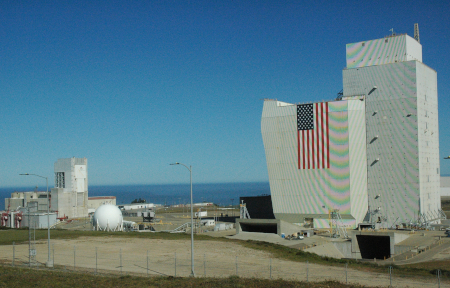
The SLC-6 launchpad during my 2015 tour of Vandenberg

As part of its plan to launch both Falcon 9 and Falcon Heavy from Vandenberg Space Force Base in California, SpaceX today demolished the SLC-6 launchpad there that had been built in the 1980s for space shuttle launches (but never used) and then leased to ULA for its Delta rocket (now retired).

Below the fold is a video showing the controlled demolition. The quality is very poor, as it was taken on a smart phone looking at a live stream of the demolition, broadcast inside a nearby auditorium. Vandenberg officials did not allow anyone access to any nearby location to watch live.

SpaceX will now rebuild the pad for its own Falcon rockets. Once completed, it will have two launchpads at Vandenberg, allowing it to up its launch rate there to as much as 100 launches per year.

To get a sense of the size and scale of SLC-6 prior to today, see the photos from my 2015 tour of Vandenberg. The picture to the right attempts to capture it, with its mobile launch tower on left and larger assembly building on the right. As I wrote then when taken inside the rocket assembly building:

I can sum up the experience however in one word: Big! The interior space was incredibly large, so large they have repeated problems chasing birds and raccoons from within it. When we took the elevator to the 20th level, almost the highest point inside, the room echoed with the sounds of birds whistling away. I wonder how they react when a rocket takes off.

It is now gone. It will however be replaced by something better. The history of SLC-6 was that of a largely expensive and under-used facility. SpaceX intends to change that.

Hat tip BtB’s stringer Jay.
» Read more

16 comments

SpaceX’s Falcon Heavy launches Viasat communications satellite

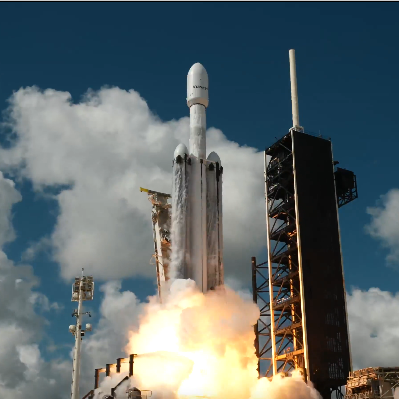
Falcon Heavy at lift-off today

SpaceX this morning successfully placed a Viasat communications satellite into orbit, its Falcon Heavy rocket lifting off from Cape Canaveral Space Force Station in Florida.

This was the first Falcon Heavy launch in about eighteen months. The two side boosters completed their 2nd and 22nd flights respectively, landing back at Cape Canaveral. Fairings completed their 18th and 25th flights respectively.

The leaders in the 2026 launch race:

51 SpaceX
23 China
8 Russia
6 Rocket Lab

For the third straight year SpaceX continues to lead the entire world combined in total launches, 51 to 43.

4 comments

Space Force awards nine launch contracts to SpaceX

In announcing its next round of satellite launch awards, the Space Force’s Space Systems Command (SSC) has awarded all nine launches (valued at $739 millon total) to SpaceX, bypassing both Blue Origin and ULA.

SSC awarded the [three] SDA-2 missions to SpaceX for launches projected to begin in [the fourth quarter of fiscal year ’26], and awarded the [two] SDA-3 missions to SpaceX for launches to begin in [the third quarter of fiscal year ’27]. SSC also awarded the [four] NTO-5 launches to SpaceX projected to occur in [the first quarter of fiscal year ’27 and the second quarter of fiscal year ’28]. The total value of these awards is $739M.

It is surprising that SpaceX got all nine contracts. Even though SpaceX charges less than ULA, and Blue Origin’s New Glenn rocket is not yet certified by the Pentagon for operational launches, it has been military policy in recent years to distribute this work to more than one launch provider so as to guarantee a redundancy. ULA exists today for expressly that reason. In the past it would have certainly gotten at least one of these launches.

As for Blue Origin, the Space Force could have awarded it at least one of the later launches in ’27 and ’28, contingent on getting New Glenn certified.

That the Space Force bypassed both companies entirely speaks volumes. It appears it has decided to simply go with the best product now available, and to heck with redundancy.

20 comments

Blue Origin announces plans to upgrade New Glenn to match SLS

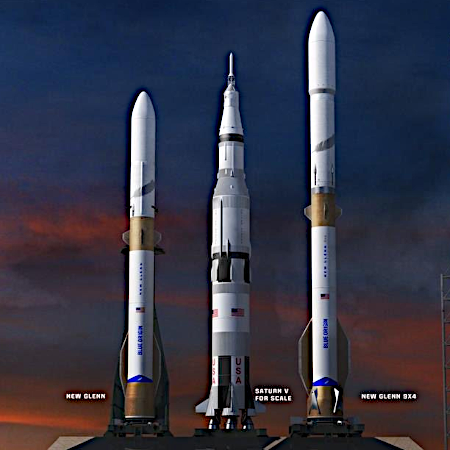
New Glenn compared to the Saturn-5
Graphic issued by Blue Origin’s CEO comparing
New Glenn to the Saturn-5. Click for source.

In an update posted today, Blue Origin announced that it is planning to begin upgrades to its New Glenn orbital rocket as soon as its very next launch early in 2026, with those upgrades eventually raising the rocket’s capabilities to that of NASA’s overpriced, cumbersome, and poorly designed SLS rocket.

One of the primary enhancements includes higher-performing engines on both stages. Total thrust for the seven BE-4 booster engines is increasing from 3.9 million lbf (17,219 kN) to 4.5 million lbf (19,928 kN). BE-4 has already demonstrated 625,000 lbf on the test stand at current propellant conditions and will achieve 640,000 lbf later this year, with propellant subcooling increasing the current thrust capability from the existing 550,000 lbf.

The total thrust of the two BE-3Us powering New Glenn’s upper stage is increasing from the original design of 320,000 lbf (1,423 kN) to 400,000 lbf (1,779 kN) thrust over the next few missions. BE-3U has already demonstrated 211,658 lbf on the test stand.

These numbers are a little more than half that put out by the Saturn-5 in the 1960s. New Glenn however has a reusable first stage, so it will cost far less to launch, and will be able to do so frequently. These changes will also make it comparable to SpaceX’s Falcon Heavy.

These engine upgrades however are only a start. Blue Origin also plans to offer a second more powerful version of New Glenn by adding two BE-4 engines to the first stage and two BE-3U engines to the upper stage.
» Read more

45 comments

Space Force approves Vandenberg environmental assessment, allowing SpaceX’s to launch as much as 100 times annually

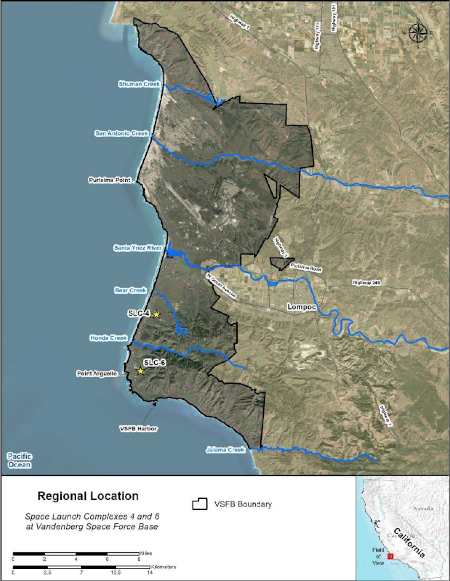
Map of Vandenberg Space Force Base, showing SpaceX's two launchpads
Figure 2.1-1 of the final environmental assessment report

The Space Force on October 10, 2025 announced it has now finalized and approved the environmental assessment that will permit SpaceX’s to increase its launch rate at Vandenberg to as much as 100 times per year.

The DAF [Air Force] has decided to increase the annual Falcon launch cadence at VSFB [Vandenberg] through launch and landing operations at SLC-4 and SLC-6 [the two SpaceX launchpads], including modification of SLC-6 for Falcon 9 and Falcon Heavy launch vehicles to support future U.S. Government and commercial launch service needs. The overall launch cadence will increase from 50 Falcon 9 launches per year at SLC-4 to up to 100 launches per year for Falcon 9 and Falcon Heavy at both SLCs combined. Falcon Heavy, which has not previously launched from VSFB, would launch and land up to five times per year from and at SLC-6. The DAF will authorize SpaceX to construct a new hangar south of the HIF [SpaceX’s horizontal integration facility] and north of SLC-6 to support Falcon 9 and Falcon Heavy integration and processing.

You can read the full environmental assessment here [pdf]. The map to the right, from the assessment, shows the location at Vandenberg of the two SpaceX launch sites. SLC-4 (pronounced “slick-four”) is the pad SpaceX has been using for years to launch Falcon 9s. SLC-6 was originally built for the space shuttle but never used for that purpose. Subsequently ULA leased it to launch its Delta family of rockets. When that rocket was retired SpaceX won the lease to reconfigure the site for both Falcon 9 and Falcon Heavy launches.

The Space Force apparently decided to ignore the objections of the California Coastal Commission as well as a number of anti-Musk leftwing activist groups. And its decision is well grounded in facts. The report documents at length the lack of any consequential environmental impacts from the increase of launches, which is further supported by almost three quarters of a century of actual use.

The decision is also well founded in basic American culture and law. The Space Force as a government agency must act as a servant of the American people, in this case represented by the private company SpaceX. It must therefore do whatever it can to aid and support that company, not put up roadblocks because it doesn’t like what the company proposes.

At least under Trump, this is the approach the Space Force is taking. I fear what will happen if a Democrat regains the presidency, based on the radical and enthused communist make-up of that party today.

4 comments

SpaceX: We are targeting 170 launches in 2025

According to a statement by a SpaceX official during a telephone press conference on May 28, 2025, the company is now hoping to complete 170 total launches in 2025.

“We’re targeting 170 launches by the end of the year,” Anne Mason, director of national security space launch at SpaceX, said during a call with reporters on Wednesday (May 28).

…”I always find it amazing that this cadence has become somewhat normal,” Mason added during Wednesday’s call, which served to preview SpaceX’s planned Friday (May 30) launch of the GPS III SV08 satellite for the U.S. Space Force. “But if we look back just five years ago, in 2020 when we launched roughly 25 times, which is still a healthy rate at twice a month, and now launching on average every two to three days — I think this demonstrates how Falcon’s reusability and reliability, plus the hard work and dedication of the SpaceX team, has been critical to supporting assured access to space,” she said.

Last year SpaceX set a record of 137 successful orbital launches, a number that also exceeded what the entire world had accomplished yearly for most of the space age since Sputnik in 1957. This new goal however appears to be a reduction from its earlier hopes. Near the start of the year SpaceX officials had predicted it would complete 180 launches.

There is also the possibility that Mason above was only referring to Falcon 9 and Falcon Heavy launches, and not counting the test flights of Starship and Superheavy.

Either way, SpaceX continues to prove that freedom and private enterprise can do far more than government, and do it faster and cheaper as well.

2 comments

Air Force issues draft approval of second SpaceX launchpad at Vandenberg

Air Force last week issued a draft environmental impact statement approving SpaceX’s plans to rebuild the old Space Launch Complex 6 (SLC-6, pronounced “slick-six”) at Vandenberg that was first built for the space shuttle (but never used) and later adapted for ULA’s Delta family of rockets, now retired.

The plan involves rebuilding SLC-6 to accommodate both Falcon 9 and Falcon Heavy launches, including the addition of two landing pads. With its already operational launchpad at Vandenberg, SLC-4E, the company hopes to increase its annual launch rate from 50 (approved by the FAA earlier this month) to as much as 100.

The estimated launch cadence between SpaceX’s existing West Coast pad at … SLC-4E and SLC-6 would be a 70-11 split for Falcon 9 rockets in 2026 with one Falcon Heavy at SLC-6 for a total of 82 launches. That would increase to a 70-25 Falcon 9 split in 2027 and 2028 with an estimated five Falcon Heavy launches in each of those years.

The draft assessment is now open to public comment through July 7, 2025, with a final version expected to be approved in the fall. It appears the Air Force wants it approved, as it needs this capacity for its own launch requirements. It also appears it no longer cares what the California Coastal Commission thinks about such things, as it has no authority and its members appear motivated not by environmental concerns but a simple hatred of Elon Musk.

An annual launch rate of 100 however exceeds what the FAA approved in May, doubling it. In order to move forward either the FAA will have to issue a new reassessment of its own, or some legislative or executive action will be needed to reduce this red tape. Since Vandenberg is a military base, the military in the end makes all the final decisions. The FAA simply rubber-stamps those decisions.

1 comment

Space Force awards SpaceX, ULA, and Blue Origin $13.7 billion in launch contracts

The Space Force yesterday awarded a combined $13.7 billion in launch contracts to SpaceX, ULA, and Blue Origin, covering military launches through 2032.

The contracts, announced April 4 by the U.S. Space Force’s Space Systems Command, are part of the National Security Space Launch (NSSL) Phase 3 Lane 2 procurement, a cornerstone initiative designed to bolster the Pentagon’s access to space for its most sensitive and risk-averse missions.

SpaceX emerged as the leading contractor, securing $5.9 billion in anticipated awards, followed by ULA at nearly $5.4 billion and Blue Origin at nearly $2.4 billion. The three companies are expected to collectively perform 54 launches under the agreement between fiscal years 2025 and 2029.

Based on the contracts, SpaceX will do 28 launches, ULA 19, and Blue Origin 7. Since these launches include many military payloads that must go on “risk-adverse” rockets, the distribution of launches makes sense. While SpaceX’s rockets (Falcon 9 and Falcon Heavy) are well proven to be reliable, both ULA and Blue Origin launch with new rockets, Vulcan and New Glenn respectively, that have barely yet left the factory. Vulcan has done only two launches, with the second having technical issues (supposedly resolved). Blue Origin has done only one successful launch, though it failed to land the first stage as planned.

The distribution however serves the needs of both the military and the American rocket industry. It gives the Pentagon redundancy, multiple launch providers. And it gives America the same, three competing rocket companies striving for business and profit.

The result is going to be a very vibrant American space effort, doing a lot of things having nothing to do with the Pentagon.

13 comments

SpaceX wins launch contract for Dragonfly mission to Titan

NASA yesterday announced that it has awarded the launch contract for sending its Dragonfly mission to Titan to SpaceX’s Falcon Heavy rocket.

The firm-fixed-price contract has a value of approximately $256.6 million, which includes launch services and other mission related costs. The Dragonfly mission currently has a targeted launch period from July 5, 2028, to July 25, 2028, on a SpaceX Falcon Heavy rocket from Launch Complex 39A at NASA’s Kennedy Space Center in Florida.

Dragonfly is a truly cutting edge mission. Though we have relatively limited information about Titan’s atmosphere and the environment on its surface, it will attempt to fly there like a helicopter, landing and taking off multiple times.

And though there are certainly additional costs required for such a mission, that quarter-billion dollar contract price probably triples what it normally costs SpaceX for a Falcon Heavy mission. Even if it requires the expending of all three first stages, the company is almost certainly getting a big windfall from this deal.

6 comments

SpaceX’s Falcon Heavy launches NASA’s Europa Clipper mission

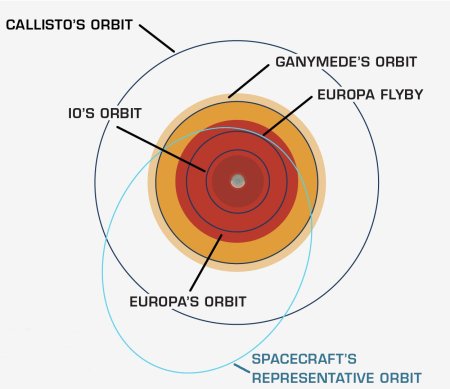
Europa's approximate orbit around Jupiter
Click for original image.

SpaceX’s Falcon Heavy rocket this morning successfully launched NASA’s Europa Clipper mission on its way to Jupiter, the rocket lifting off from the Kennedy Space Center in Florida.

In order to get the energy to reach Jupiter, none of the Falcon Heavy’s first stage boosters were recovered today. The two side boosters completed their sixth and final flights with this mission, while the core booster completed its first launch. The only parts of the rocket that will be recovered and reused were the two fairing halves.

To get to Jupiter, the spacecraft will make first a fly-by of Mars in February 2025, and then a fly-by of Earth in December 2026. It will arrive in Jupiter orbit in April 2030, where its orbit will be adjusted to fly close past Europa many times in order to study it closely, as shown by the graphic on the right. It will not going into orbit around the planet because that would place it permanently inside the high radiation environment around Jupiter. This is especially important because the spacecraft has installed transistors that were not properly hardened for that environment.

The leaders in the 2024 launch race:

98 SpaceX
45 China
11 Russia
11 Rocket Lab

American private enterprise now leads the rest of the world combined in successful launches 115 to 68, while SpaceX by itself now leads the entire world, including American companies, 98 to 85.

9 comments

SpaceX finds a way to extend the launch window for Europa Clipper

The launch window for SpaceX’s launch of NASA’s Europa Clipper to Jupiter has now been extended a full week because the company has revised the launch process and made hardware changes.

The new launch window runs from October 10th to November 6th.

Usually the two side boosters come back to land at Cape Canaveral Space Force Station so they can be reused and sometimes the core booster is recovered at sea, but not this time. All their fuel will be used to get Europa Clipper on its way to Jupiter. Piloto said SpaceX “made some hardware modifications that enable the launch vehicle to utilize all the fuel in the boosters,” but couldn’t go into detail about what they are because the information is proprietary.

[The NASA official] added that SpaceX has gained experience in flying this configuration — it’s the 11th Falcon Heavy launch — and the company has “come up with a strategy to optimize throttling of the launch vehicle to get more performance out of it.”

NASA and SpaceX have also decided to use NASA’s orbiting communications constellation during the launch instead of ground stations, which increases their flexibility and margins.

I wonder if the FAA has approved these changes. Or even if anyone there even understands them.

13 comments

SpaceX’s Falcon Heavy launches NOAA weather satellite

SpaceX’s Falcon Heavy rocket today successfully launched a NOAA weather satellite, completing its first flight in 2024 and its tenth flight overall.

The two side boosters completed their first flight, with both landing back at Cape Canaveral. The core stage was allowed to fall into the ocean.

The leaders in the 2024 launch race:

67 SpaceX
28 China
8 Russia
8 Rocket Lab

American private enterprise now leads the world combined in successful launches, 78 to 42, while SpaceX by itself still leads the entire world, including other American companies, 67 to 53.

7 comments

SpaceX’s Falcon Heavy rocket launches the Space Force’s X-37B

SpaceX’s Falcon Heavy rocket tonight successfully launched one of the two X-37B reuseable mini-shuttles in the Space Force’s fleet, lifting off from Cape Canaveral.

This was the seventh X-37B flight. It is not clear which of the two vehicles was flying, and how many flights it has completed previously. The previous X-37B flight stayed in orbit for a record 908 days, landing safely in November 2022.

The two side boosters completed their fifth flight, landing safely back at Cape Canaveral. The center core was treated as expendable, and was not recovered.

The leaders in the 2023 launch race:

95 SpaceX (with another launch scheduled later tonight)
65 China
19 Russia
8 Rocket Lab
7 India

American private enterprise now leads China in successful launches 109 to 65, and the entire world combined 109 to 102. SpaceX in turn trails the rest of the world (excluding other American companies) 95 to 102.

6 comments

Launch of Intuitive Machines Nova-C lunar lander delayed until February

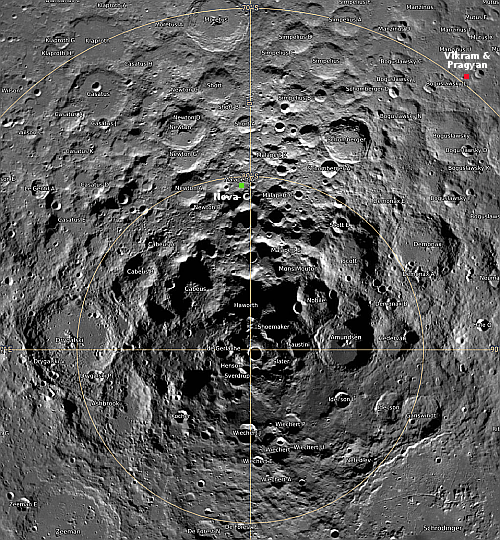
South Pole of Moon with landing sites

Because of scheduling conflicts impacting other SpaceX launches now, SpaceX and Intuitive Machines have delayed the launch of the latter’s Nova-C lunar lander from a mid-January to a mid-February launch window.

The conflict involves the use of the launchpad, that the Falcon Heavy also uses. Technical issues had forced SpaceX to reschedule its next launch to December 28, 2023, leaving little time afterward to reconfigure the pad for the Falcon 9 Nova-C mid-January launch window. Any Falcon Heavy launch delays due to weather would likely make that mid-January window impossible, so the companies have decided better to reschedule now.

Nova-C is targeting a crater rim near the Moon’s south pole, as shown on the map to the right. The floor of that crater is thought to be permanently shadowed, but Nova-C does not have the capability to enter it. This mission is mostly an engineering test mission, to prove Intuitive Machine’s design. If it works, it will operate on the Moon surface for one lunar day, about two weeks. The company then has two more lunar missions contracted with NASA, with the next mission aiming to fly in 2024 as well.

0 comments

The scrub of this week’s Falcon Heavy launch of X-37B

In what has become quite rare, SpaceX was forced to scrub its December 11, 2023 launch of its Falcon Heavy rocket, carrying one of the Space Force’s X-37B spacecraft, due to technical problems.

Initially, the cause of the scrub was linked to a problem with the company’s ground systems, not the rocket itself. This in itself is significant, because of the almost hundred launches SpaceX has done this year, almost none have been scrubbed, and the few that have been scrubbed were almost always because of weather conditions. The company has gotten its launch ground systems and rockets working like clockwork, so to have a problem with the ground systems on this Falcon Heavy launch was quite unusual.

SpaceX officials initially thought they would be able to fix the problem and launch after only one or two days delay. However, shortly thereafter unstated additional problems were identified that required the company to roll the rocket back to its assembly building for more work.

As a result, the launch date is now to be determined, and could even be delayed to early next year. The article at the link focuses on how this rescheduling could impact two other launches that carry commercial lunar landers. This I think is unlikely, since both work under much more restrictive launch windows, for this reason are almost certain to get priority in scheduling.

More important is the question as to what caused the initial scrub and then the need to roll the rocket back for more checkouts. Are the problems with the Falcon Heavy or with the X-37B spacecraft, or with some issue involving both? Neither SpaceX nor the Space Force would release any details. The fact that SpaceX now so rarely has technical issues at launch suggests some problem with the X-37B, but that conclusion is pure speculation.

3 comments

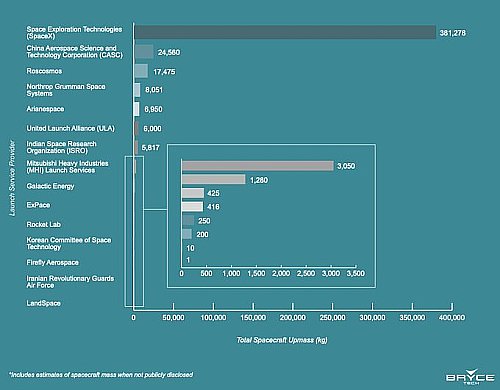
Musk touts SpaceX’s gigantic lead in sending mass to orbit in 2023

The mass sent to orbit in 2023
Click for original image.

In a tweet Elon Musk sent out yesterday, he noted that “SpaceX is tracking to launch over 80% of all Earth payload to orbit this year.”

The graphic to the right was included in Musk’s tweet. Despite the delays in developing its heavy-lift Starship/Superheavy rocket, mostly caused by government red tape since the arrival of Joe Biden in the White House, the company’s smaller Falcon 9 and Falcon Heavy rockets have still been able to launch more than fifteen times the mass into orbit that its nearest competitor, the nation of China.

I count launches by company or nation as a indicator of rocketry success. The mass-to-orbit metric is as important, if not more so, though the two are without doubt linked. Both measure the success of those trying to become major players in the launch market.

And in both metrics, SpaceX is wiping the floor with its competition.

3 comments

Space Force awards SpaceX and ULA new launch contracts worth $2.5 billion

Space Force yesterday awarded both SpaceX and ULA new launch contracts worth $2.5 billion and totaling 21 launches over the next two to three years.

The final batch of assignments were split almost evenly, according to Col. Doug Pentecost, the deputy program executive officer of the Space Force’s Space Systems Command. ULA received 11 missions, valued at $1.3 billion, and SpaceX received 10 missions, valued at $1.23 billion.

Space Systems Command said the missions are scheduled to launch over the next two to three years. ULA, a joint venture of Boeing and Lockheed Martin, will use its soon-to-debut Vulcan rocket for the 11 missions, while SpaceX will fly seven missions with its Falcon 9 rocket and three missions with its Falcon Heavy rocket.

For SpaceX this award is no surprise. The ULA contract is more puzzling. Supposedly the Space Force was not going to award any launch contracts for ULA’s new Vulcan rocket until it successfully launched twice and was certified by the military as operational. Yet, it has now awarded ULA this contract for Vulcan launches. Has the military awarded the contract on a contingency basis? What happens if Vulcan has a failure on one of its first two launches?

The Space Force’s present arrangement limits bidding for launches to just these two companies. If Vulcan fails will it open bidding to other companies, or will it transfer launches to SpaceX?

7 comments

Falcon Heavy successfully launches Psyche asteroid mission

SpaceX’s Falcon Heavy rocket this morning successfully launched the Psyche mission to the metal asteroid Psyche, lifting off from Cape Canaveral.

The two side boosters successfully landed at their landing zones at the cape, each completing their fourth flight.

Psyche will now spend the next six years traveling to the asteroid Psyche, first flying by Mars in 2026 to gain some speed to get there. It will then go into orbit around the asteroid for almost two years.

The leaders in 2023 launch race:

72 SpaceX
45 China
13 Russia
7 Rocket Lab
7 India

American private enterprise now leads China in successfully launches 84 to 45, and the entire world combined 84 to 73. SpaceX by itself only trails the entire world combined (excluding American companies) 72 to 73.

13 comments

Launch of Psyche asteroid mission delayed by weather

NASA and SpaceX today scrubbed the launch of the Psyche asteroid mission because of poor weather, rescheduling the Falcon Heavy launch to tomorrow, October 13, 2023 at 10:19 am (Eastern).

“For our first backup window, Friday morning, 50% chance for go conditions, with our concerns still being associated with storms in the area, where we have anvil clouds, some thick clouds, which are layered clouds, as well as cumulus clouds we get associated with storms,” Moses explained during the briefing.

“Looking at Saturday morning, a third backup window, there is still about the same probability, about 50% chance of go, and fairly similar conditions here, where there may be some storms around, but we expect most of any storms to be after our morning launch window,” she added.

The launch window for the mission closes on October 25, after which a major mission rescheduling will be required to get the probe to the asteroid Psyche, likely causing a year delay.

0 comments
1 2 3 8