SpaceX’s files FCC application for 100,000 satellites in third generation Starlink constellation

On July 7, 2026 SpaceX filed an application with the Federal Communications Commission (FCC) for permission to expand its Starlink constellation to 100,000 satellites, an a third generation upgrade that will include data and AI capabilities.

According to the technical attachment, these satellites would operate lower than the current Starlink satellites, in two bands of thin shells with nominal altitudes between 323 and 327.5 kilometers and 473 and 477.5 kilometers. The Gen3 satellites described in the filing will be equipped with advanced phased array beam-forming and digital processing technologies, as well as optical inter-satellite links.

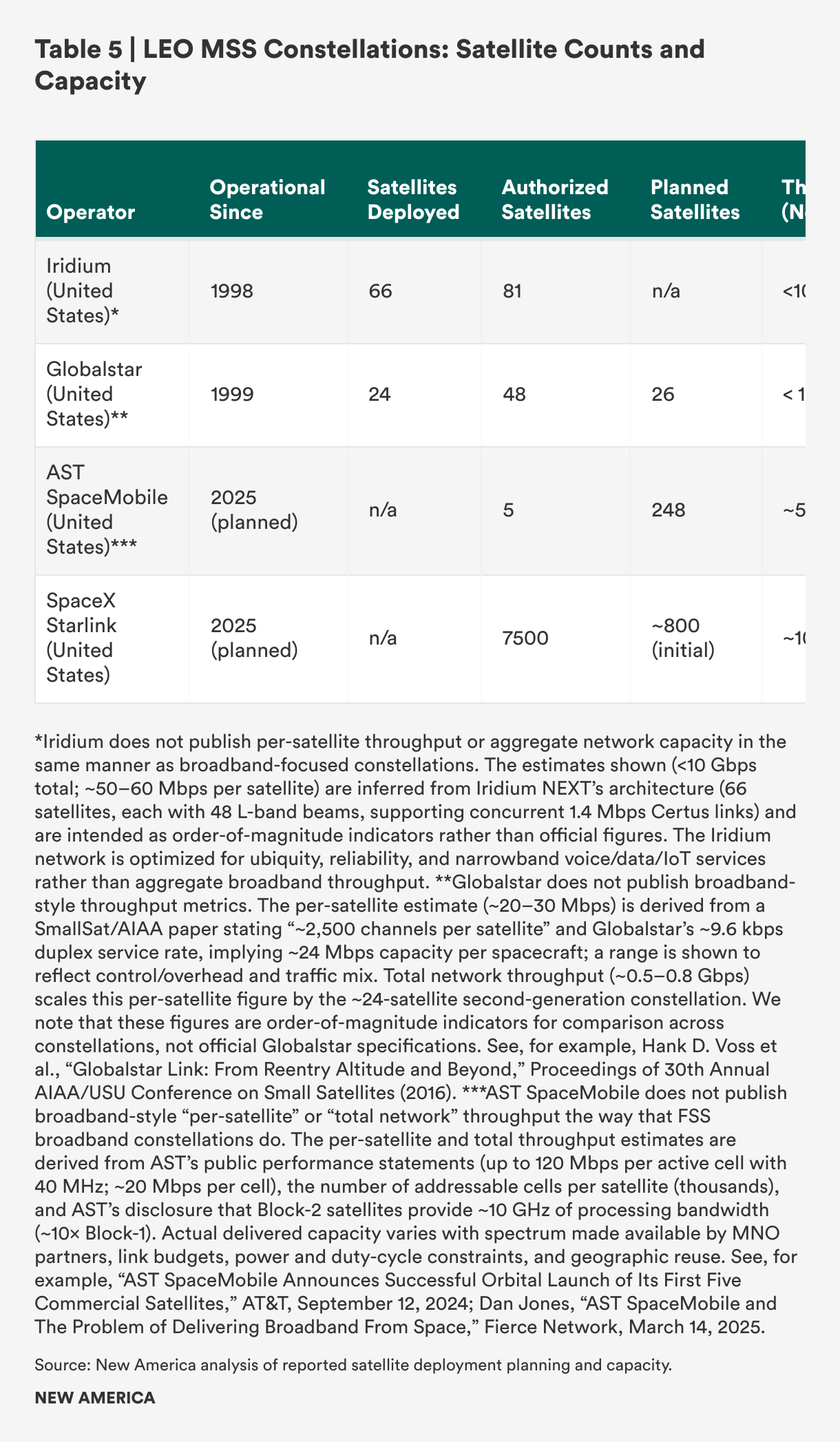
SpaceX has authorization to deploy up to 15,000 Gen2 Starlink satellites after receiving approval from the FCC in January of this year. SpaceX has said this authorization will allow the Gen2 system to deliver “gigabit-speed service.”

The application does not actually name this new upgrade “Starlink”, even though it describes in connection with the first two Starlink generations. This filing is also separate from SpaceX’s earlier FCC filing for its proposed million satellite data center “Starmind” constellation.

It is clear that the company is looking to put Starship to use aggressively, once it becomes operational.

0 comments

FCC grants waiver to Amazon Leo constellation, despite its failure to launch on time

Amazon Leo logo

The Federal Communications Commission (FCC) yesterday granted [pdf] a license waiver to Amazon, allowing it to continue deploying its Leo constellation even though the company will fail to meet its license requirement to get half its constellation (1,616 satellites) into orbit by July 2026.

While granting the waiver, the FCC also made it clear Amazon still needs to meet the license’s deadline for full deployment of all 3,232 satellites by July 30, 2029.

In the event Amazon Leo fails to satisfy the final milestone on July 30, 2029, this will result in reduction of the total number of Amazon Leo’s authorized satellites to the total number of satellites that are operational on that date.

In other words, the Leo constellation will be truncated if Amazon fails to get the full constellation up on time.

To further encourage Amazon to meet future deadlines, the FCC also stated that the satellites of Amazon’s first-half constellation that are launched late — after the July 2026 deadline — will lose certain spectrum rights for the next 20 months, “or until 50% of the constellation is launched and operational, whichever occurs first.” This order is expressly designed to encourage the company to accelerate its launch pace.

Finally, the FCC declared that Amazon will forfeit its surety bond for not meeting its July 30, 2026 launch obligation.

Launching almost 3,000 satellites in the next three years is still going to be challenging. Right now Amazon is dependent mostly on two grounded and as yet unproven rockets (Vulcan and New Glenn) and a third (Ariane-6) that cannot launch at a very quick pace for at least another two years. And its additional a ten-launch contract with SpaceX won’t be sufficient to get the entire constellation in orbit on time.

In other words, unless Vulcan and New Glenn get fixed quickly and resume launches, Amazon is going to have trouble meeting the FCC’s final deadline.

14 comments

FCC approves new spectrum rules to give new constellations more capacity

The Federal Communications Commission (FCC) yesterday approved new spectrum rules proposed by SpaceX that will increase the capacity of all the new low-Earth-orbit constellations by as much as seven times.

The commission introduced the new rules earlier this month before approving them at a Thursday meeting. The revamp targets the Equivalent Power Flux Density (EPFD) rules, which were developed in the late 1990s and limited the amount of energy satellite systems could transmit to and from ground equipment. The regulations were also designed to prevent radio signal interference between higher-orbiting geostationary satellites and lower-orbiting systems. But during the vote, Carr said the decades-old existing rules were “holding back” newer satellite internet offerings.

“Modern satellite designs make it far easier to share spectrum than what yesterday’s regulations assumed. We can do a lot better,” he said. Carr touted the 7x increase when the commission found the revamped rules could enable “eight satellites to provide service simultaneously in a given geographic area and frequency band, instead of being effectively limited to one satellite under current EPFD limits.”

The FCC was sold on this change after SpaceX conducted its own tests in orbit, using Starlink satellites, to demonstrate it could work. The rule change will benefit all the new constellations, which is why Amazon’s Leo constellation supported the change as well.

The speed in which the FCC acted on this matter must also be noted. It did not bother with long studies of its own. It quickly reviews SpaceX’s work, realized it made sense, and scheduled the vote at its very next meeting. This constrasts starkly with the FCC during the Biden administration, which routinely slow-walked or even opposed such suggestions.

4 comments

The FCC’s agenda at its next meeting includes an item for “Weird Space Stuff”

FCC logo

In releasing its agenda for its upcoming March 26, 2026 open meeting, the Federal Communications Commission (FCC) included one very intriguing item entitled “Spectrum Abundance for Weird Space Stuff.”

In reviewing the fact sheet [pdf] for this particular agenda item, it appears the commission is focused on finding ways to maximize the use of some communications spectrum for more than one purpose. The commission wants to do this because it is anticipating a lot of new demand coming from what it calls “emergent space activities or emergent space operations.” As the fact sheet then notes:

In the geopolitical race to commercialize and dominate the Final Frontier, historic levels of private investment have paved the way for the engineering marvels and daring endeavors that now take place in outer space. Once the province of science fiction, American companies are now upgrading, relocating, and servicing satellites; 1. manufacturing pharmaceuticals in space; 2. building private inhabitable spacecraft; 3. and conducting private robotic missions to the surface of the Moon. 4. Emergent space operations like these depend on the use of radiocommunications for their spacecraft, but they are not the type of communications satellites that have traditionally commanded much of the Commission’s regulatory attention.

Spectrum is a critical component of all space operations. Even for spacecraft that do not provide radiocommunications services to the public, reliable spectrum access is mandatory for safety functions like telemetry, tracking, and command (TT&C) to control spacecraft in orbit. American innovators, however, currently face an acute shortage of usable and readily accessible spectrum for TT&C, and that spectrum crunch threatens to delay — or even prevent — the growth of domestic space technologies and jeopardize U.S. leadership in the booming global space economy. [emphasis mine]

In other words, the FCC is trying to find other spectrum, allocated for other purposes but available at other times, that can be provided to these new in-space operations for this telemetry, tracking, and command functions. To do this it appears it will need to rewrite some of its regulations, and this agenda item raises the issues involved in doing so.

And most interestingly, it is even considering allowing the marketplace solve the problem, by allowing licensees to lease their allocated spectrum to others. The FCC would limit such actions to the spectrum the FCC determines best for these multiple uses, but it is considering setting up rules to allow such freedom.

What an idea! Let free enterprise find a way to use the electromagnetic spectrum in the most efficient way possible.

No decision has been made, and we should expect the Democrats on the commission to oppose this, simply because. Nonetheless, it is a refreshing policy proposal.

Hat tip to reader Steve Golson, who notes quite correctly, “It’s good to see FCC trying to help rather than hinder.” Amen to that.


5 comments

Blue Origin files FCC application for its own 51,600 data center satellite constellation

Blue Origin yesterday filed with the Federal Communications Commission (FCC) an application to launch 51,600 satellites, dubbed Project Sunrise, aimed at creating its own data center constellation in orbit.

The proposed constellation includes up to 51,600 satellites operating in sun-synchronous orbits at altitudes ranging from 500 to 1,800 kilometers. To manage data traffic, the system will primarily use optical links and mesh backhaul networks, supplemented by Ka-band spectrum for telemetry, tracking, and command operations. The spacecraft will utilize multiple antenna variations to maintain efficient coverage across various orbital planes.

You can read the full application here [pdf].

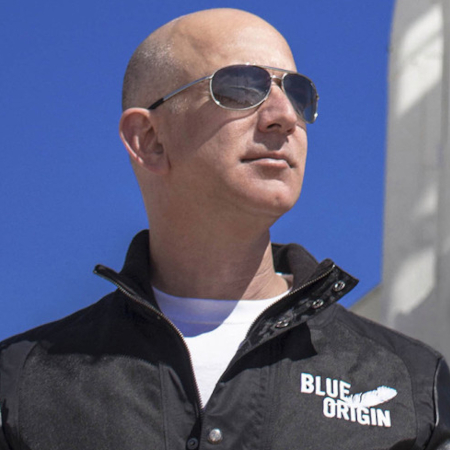
Jeff Bezos
Jeff Bezos, maybe the world’s leader in chutzpah.

Blue Origin also requests several waivers from the FCC’s normal new satellite license requirements, including what I think is a request to waive the FCC’s normal requirement that the applicant launch half its constellation within six years of license approval and complete the constellation three years later. Failure to do so results in financial penalties. The rules were created to prevent companies from getting licenses to grab spectrum from competitors with no intent to launch.

That this Jeff Bezos company is requesting this waiver is what in Yiddish is called chutzpah! Bezos’ other company, Amazon, is clearly going to fail to meet its own license timetable in launching its Leo internet constellation, and was recently lambasted by FCC chairman Brenden Carr for doing so. For Blue Origin to now request this waiver truly is an example of unbelievable gall. I can’t imagine the FCC will do so.

Either way, the competition to put up a lot of satellites continues to grow, with SpaceX and Blue Origin in the best position to make their constellations profitable, because both have their own launch vehicles.

0 comments

Real change at the FCC?

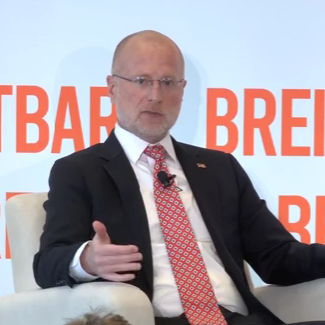
Brendan Carr during Breitbart interview

FCC chairman Brendan Carr this week didn’t simply make a public statement yesterday against Amazon, as I reported earlier today. The day earlier, on March 10th, he did an hour-long interview with Breibart News, providing a more complete summary of the FCC’s overall agenda since the change of administrations from Joe Biden to Donald Trump.

You can watch that interview here. To put it mildly, the shift in policy and approach at the FCC is significant, and appears to be generally moving in the right direction.

To understand the context, we need to first review the FCC’s approach during the Biden administration. My regular readers will remember the many stories during that time describing the FCC’s aggressive effort to expand its regulatory power, in many cases in areas completely exceeding its fundamental statutory authority. For example, it proposed new regulations designed to tell satellite companies how and when to de-orbit their satellites. It also wanted to its own bureaucracy for imposing those regulations, and went ahead and created it without any congressional approval. It also under Biden attempted to limit satellite operations that the astronomy community opposed, an action that was once again outside its statute authority.

Overall, the goal of the FCC under Biden was to expand the power of the administrative state, in as many areas as possible. And though there was push back from Congress, as long as a Democrat was president it was clear that this power-grab was going to grow exponentially.

After the 2024 election, however a Democrat was no longer president. Trump quickly moved in 2025 to squash the FCC’s power grab, with a stated public goal to instead streamline FCC regulations and speed license approvals.

Carr’s interview earlier this week essentially gave us an update on that Trump policy, and it appears this new anti-regulatory policy is moving forward, with a goal to eliminate ten regulations for every one regulation added. According to Carr:
» Read more

7 comments

FCC chairman blasts Amazon and its Leo satellite constellation

FCC logo

Brendan Carr, the chairman of the Federal Communications Commission, yesterday harshly criticized Amazon for filing papers opposing SpaceX’s application to place a million new satellites into orbit while failing to meet its own FCC license requirement to get 1,600 Amazon Leo satellites in orbit by July 2026.

Amazon should focus on the fact that it will fall roughly 1,000 satellites short of meeting its upcoming deployment milestone, rather than spending their time and resources filing petitions against companies that are putting thousands of satellites in orbit.

To put it mildly, Carr’s point is well taken. In legally protesting SpaceX’s proposed constellation while failing to launch on time as promised, Amazon is following what appears to be standard Jeff Bezos’ practice, epitomized by his rocket company Blue Origin. When customers begin favoring others because the Bezos company either submits a poor bid or fails to meet schedules, the Bezos companies routinely go to court in an attempt to squelch that better competition.

Carr is demanding Amazon stop this, and focus instead on getting its own job done for once. Carr is also signaling the FCC’s position on both SpaceX and Amazon. It is likely going to reject Amazon’s filing and give its okay to SpaceX’s million-satellite constellation, in one form or another.

Carr is also telling Amazon that it faces some push back for failing to launch the required number of Amazon Leo satellites on time. Though it is extremely unlikely the FCC will cancel Amazon’s Leo license, the FCC might fine it heavily. Or it could impose new limits on the constellation. Carr is also indicating the FCC will treat future Amazon license applications much more stringently.

7 comments

A new American satellite constellation gets FCC approval

The satellite startup Logos has won approval from the Federal Communications Commission (FCC) for its proposed 4,178 satellite internet constellation.

The Federal Communications Commission partially granted the Redwood City, California-based venture’s constellation proposal Jan. 30, clearing operations in K-, Q- and V-band spectrum under certain conditions while deferring and denying parts of its higher-frequency requests. The satellites would operate across seven orbital shells ranging from 870 kilometers to 925 kilometers above Earth, with inclinations spanning 28 to 90 degrees.

Under FCC rules, Logos must deploy and operate half of the constellation within seven years, with the remainder in place by Jan. 30, 2035.

The company last year raised $50 million in private investment capital, and hopes to launch its first satellite by 2027.

It seems this constellation is coming to the game very late.

3 comments

Amazon asks FCC for time extension for launching its Leo constellation

Amazon yesterday submitted a request to the Federal Communications Commission to extend the July deadline on its license for its Leo internet satellite constellation, which presently requires it to have 1,616 satellites in orbit by that date.

At present Amazon has 181 satellites in orbit, all launched in the last ten months. At that pace there is no chance the company can meet its FCC requirement. From its FCC submission:

While Amazon Leo will meet the deadline for full deployment of its constellation established by its license and the Commission’s rules, launch delays will cause it to fall short of the interim milestone requirement to deploy half of its originally authorized constellation by July 30, 2026. The Commission’s rules provide for extension of such milestones where, as here, delay arises from unforeseeable circumstances beyond an operator’s control or overriding public interest considerations favor an extension.

Because it meets both criteria, Amazon Leo respectfully requests a 24-month extension of its 50% milestone to July 30, 2028, or alternatively, a waiver of this interim requirement.

In its submission Amazon claims the delay is entirely the fault of the rocket companies it was relying on to launch the satellites, but that is a bogus claim. It initially choose to depend almost entirely on three new rockets (Blue Origin’s New Glenn, ULA’s Vulcan, and Arianespace’s Ariane-6), all of which had not launched and were still under development. To expect these to launch on time was absurd.

Furthermore, its ULA contract also called for launches using company’s already operational Atlas-5 rocket, which Amazon claims were delayed because of “unexpected anomalies and delays caused by issues with its vehicle fairings and solid rocket boosters.” I don’t buy it, and suspect the real cause was that Amazon was unable to produce the satellites on time.

Faced with these delays and a stockholder lawsuit, Amazon subsequently signed SpaceX to do three launches, which that company did quickly, in less than four months. If Amazon had truly wanted to get its Leo satellites in orbit on time, it would have given SpaceX more launches and gotten it done.

Nonetheless, it is likely the FCC will agree to Amazon’s extension request. The company has now shown it is committed to the process and intends to get its constellation in orbit. It is not sitting on its license doing nothing. I would not be surprised however if the FCC imposes some new requirements in an effort to force Amazon to launch more satellites more quickly.

8 comments

FCC approves SpaceX request to expand Starlink by 7,500 satellites

The Federal Communications Commission (FCC) yesterday approved SpaceX’s request to both expand its Starlink constellation by 7,500 satellites as well as use additional bands of spectrum.

The Federal Communications Commission on Friday approved SpaceX’s request to launch an additional 7,500 of its Starlink Gen2 satellites, bringing the total allowed Gen2 constellation to 15,000. The agency also granted the company’s request to operate in additional spectrum bands and to operate at higher power in other bands between 10.7-30 GigaHertz (GHz), pending the completion of an existing FCC rulemaking where the question is being considered.

…The order also allows SpaceX satellites to use lower orbits, down to 340 kilometers, and provide direct-to-cell service. The company is seeking approval for a separate 15,000-satellite constellation that would provide upgraded direct-to-cell service using spectrum it’s purchasing from EchoStar.

The article notes that under the Trump administration has also revamped the FCC’s grant program, that under Biden canceled an $886 million grant, claiming absurdly that Starlink did not provide service to rural areas. Under the new program “SpaceX is set to serve the most locations of any ISP under the $42.45 billion Broadband Equity, Access, and Deployment program after new Trump administration rules that made it easier for satellite providers to compete for funding.”

Not that SpaceX or any of the other constellations need this government grant. Trump would serve the country better to shut the program down.

9 comments

A think tank releases its detailed review of the American satellite communications industry

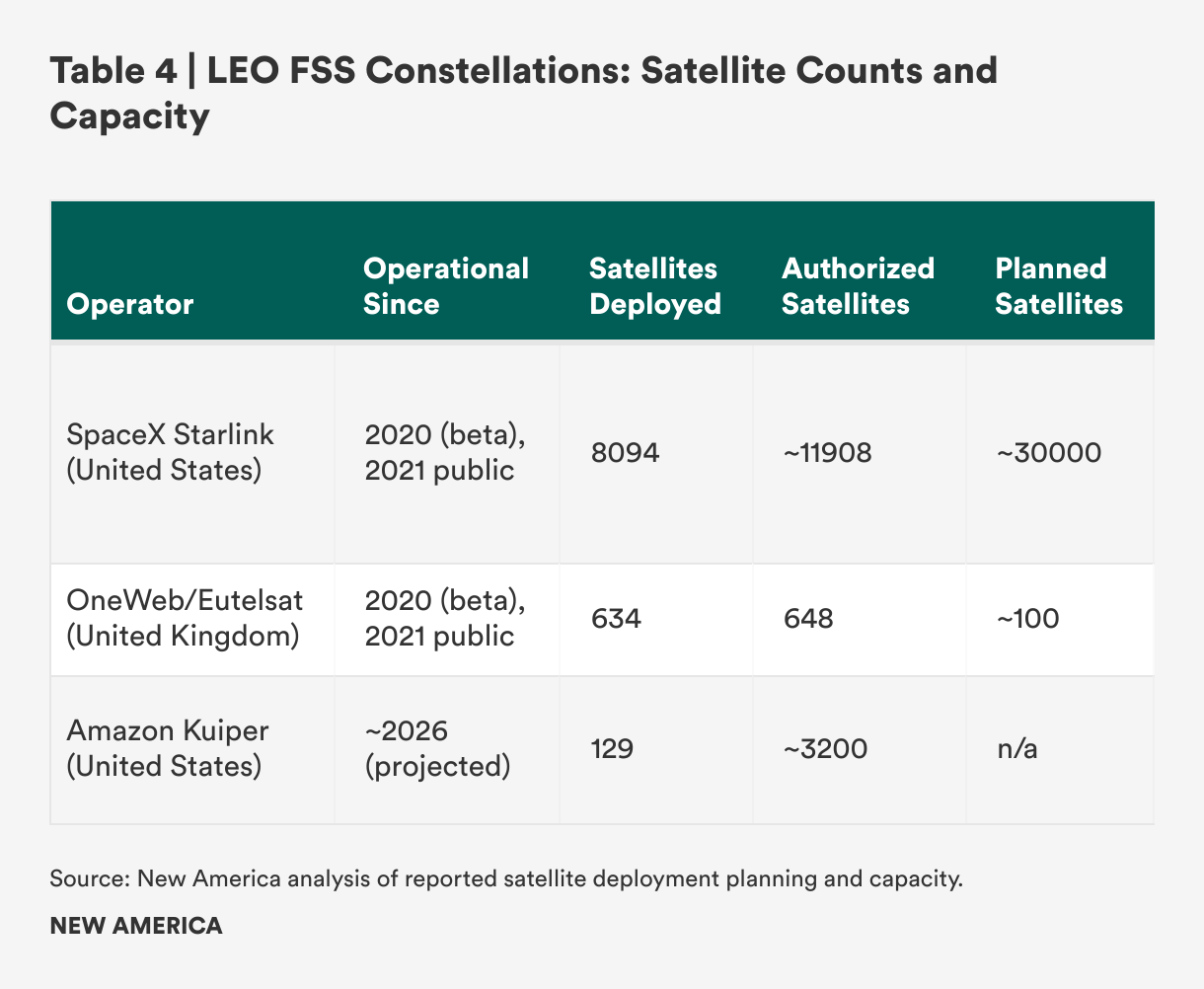
The state of the satellite constellation industry
Go here and here for originals.

Link to the press release is here. To read the actual report go here.

The report was issued by the LEO Policy Working Group, which calls itself “an independent body dedicated to providing forward-looking, data-driven analysis and policy recommendations to ensure the successful and sustainable deployment of next-generation Low Earth Orbit satellite systems.” In reviewing the membership of this group, I noticed that only one member appeared drawn from the industry itself (a former OneWeb advisor). The rest of the members were from lobbying groups, government agencies, academia, or DC think tanks.

Thus, I immediately wondered if this report was aimed against SpaceX and its present dominance, designed to justify further government regulation against it.

In reviewing the report however it does not seem so, at least on the surface. The report very accurately and detail describes the present state of the industry and all the players, including all the present constellations in orbit or under construction. It also describes the state of the launch industry on which they depend, including the risks entailed by SpaceX’s present dominance. At the same time it also notes at length that there is no evidence that SpaceX is doing anything to take advantage of that dominance.

Its recommendations are generally vague, and can be summed up simply as “Government should remain vigilant but do nothing drastic at this time.”

The report’s main benefit however its overall summary of the industry, as well as its detailed description of how the spectrum is regulated by government agencies.
» Read more

6 comments

EchoStar sells spectrum licenses to SpaceX for $17 billion while buying into Starlink

EchoStar today announced it has sold two of its spectrum licenses to SpaceX for $17 billion, in a deal that will also allow EchoStar’s customers to access Starlink.

EchoStar has entered into a definitive agreement with SpaceX to sell the company’s AWS-4 and H-block spectrum licenses for approximately $17 billion, consisting of up to $8.5 billion in cash and up to $8.5 billion in SpaceX stock valued as of the entry into the definitive agreement. Additionally, the definitive agreement provides for SpaceX to fund an aggregate of approximately $2 billion of cash interest payments payable on EchoStar debt through November of 2027.

In connection with the transaction, SpaceX and EchoStar will enter into a long-term commercial agreement, which will enable EchoStar’s Boost Mobile subscribers – through its cloud-native 5G core – to access SpaceX’s next generation Starlink Direct to Cell service.

Essentially, in exchange for the spectrum EchoStar is investing in SpaceX.

EchoStar also today canceled a contract it had signed in early August with the satellite company MDA to build its own 100 satellite constellation designed to provide direct-to-cellphone service, competing with Starlink and AST SpaceMobile. EchoStar will no longer build a rival constellation.

Wall Street apparently liked this deal, as EchoStar’s stock value quickly rose about 19%. It also appears the deal resolves questions the FCC had raised about EchoStar recent activities.

13 comments

FCC eliminates red tape for both satellite companies and space stations

The Federal Communications Commission (FCC) this week announced [pdf] that it has changed a number of regulations to streamline its licensing in connection with satellite constellations, ground stations, and new space stations.

Today’s reforms intend to boost the nascent Ground-Station-as-a-Service (GSaaS) business model that allows multiple satellite systems to share the same ground station. The new rules eliminate needless paperwork and clear regulatory barriers to GSaaS, a business model that gives satellite operators—especially startups and emerging growth companies—the ability to send and receive signals without having to build their own ground infrastructure.

…The Order establishes a new process for ground station operators to receive a baseline license without first identifying a specific satellite point of communication. For each new point of communication, only a simple FCC notification will be needed. This one change would eliminate approximately 49% of earth station modification applications.

Today’s action further streamlines and expedites the application process for space stations and earth
stations by moving away from regulations that require FCC approval for making even the smallest
changes to a satellite system.

The direction of regulation has shifted 180 degrees since Trump’s election. Under Biden, federal agencies were constantly tasked to increase oversight so that it often took years to get approvals. Under Trump, those same agencies are now beginning to eliminate regulation across the board.

Elections matter. Anyone who says all politicians are the same is either ignorant or lying.

1 comment

Under Trump FCC shifts from regulating satellite construction and de-orbit to streamlining red tape

FCC seal

According to a Space News article yesterday, the FCC’s regulatory focus since January and the advent of the Trump administration has shifted significantly from its focus during the Biden administration.

The article describes in detail the present focus to streamline regulations and speed license approvals.

One early result of this push is a reduction in the FCC’s licensing backlog. Schwarz said the space bureau has reduced pending applications by 35 percent since January, including those for new space stations and ground infrastructure.

Modernizing regulations for non-geostationary satellite systems is another priority. The FCC is considering revising so-called “power limit” rules aimed at preventing interference between low-orbit constellations and traditional geostationary satellites and earth stations. Schwarz said these reforms could help pave the way for higher-throughput services that rival terrestrial broadband.

This focus appears correctly centered on the FCC’s actual legal statutory authority to regulate the limited bandwidth of the electromagnetic spectrum to avoid conflicts in its use.

Under Biden, the FCC instead focused on expanding its power beyond that statutory authority, claiming it had the right to determine how satellites were built, when they would be de-orbited, and in what manner. None of those activities have anything to do with bandwidth and the FCC’s legal responsibilities.

There was some legislative push back from Congress during the Biden administration, but it was slow and relatively weak. Now that push back has become unnecessary, because the FCC under Trump is back to doing its actual job instead of trying to build empires of regulation.

The agency also appears, for the moment, to have ended its partisan abuse of red tape for political reasons. Under Biden it used its regulatory power against SpaceX in retaliation to Elon Musk’s decision to publicly support Biden’s political opponents. It appears the present effort to speed license approvals for everyone has ended this practice.

0 comments

FCC approves use of Starlink for direct cell-to-satellite T-Mobile service

Despite objections from all of SpaceX’s competitors, the FCC has now approved the use of its Starlink constellation for direct cell-to-satellite service as part of T-Mobile’s cellular network.

The decision noted that many technical issues still must be cleared.

There are a few limitations on how this type of service (which the FCC calls “supplemental coverage from space,” or SCS) can work. Right now it officially has to operate as an extension of an existing terrestrial provider, in this case T-Mobile. That’s because the regulations on how you broadcast stuff in space are different from those for how you broadcast stuff to and from a phone (as opposed to a base station antenna). AT&T, for its part, is partnering with AST SpaceMobile.

SpaceX must also be sure that its service does not interfere with other services on the ground, while the ground services do not have to worry about whether they might interfere with the satellite signals.

Nonetheless, this approval likely means that soon users of T-Mobile (as well as AT&T) will no longer have any dead zones. When there are no cell towers available, their phones will simply access the orbiting constellations of either Starlink or AST SpaceMobile.

1 comment

Judge rules that Ligado’s $39 billion lawsuit against federal government can proceed

A federal judge has now ruled that the $39 billion lawsuit by the satellite company Ligado against the federal government can move forward.

In October 2023, Ligado sued the government for $39 billion over claims that officials at the Departments of Defense and Commerce took “unlawful actions” to, in effect, improperly seize without compensation the firm’s L-band spectrum. In January, the government had asked a judge to dismiss the suit. Today Judge Edward J. Damich of the US Federal Claims Court ruled in part in favor of Ligado and in part for the government over aspects of the case, but ultimately said the case “may proceed.”

Essentially, after the FCC had awarded this spectrum to Ligado, the feds stepped in to take it away for its own use. The company argued that once it was given that spectrum to use for its satellites it was essentially its property, and that the seizure without due compensation was an illegal taking under the Fifth Amendment to the Constitution. This court decision allows this lawsuit to proceed.

The reason these federal agencies seized the spectrum this that they believe Ligado’s satellite constellation would interfere with GPS, something the FCC disputed in awarding the spectrum. Whether the company will win in court remains unclear.

2 comments

FCC issues first deep space communications license to private asteroid mining company

The Federal Communications Commission (FCC) on October 18, 2024 issued the first deep space communications license to the private asteroid mining startup company Astroforge for its planned Odin mission to an asteroid.

Asteroid prospecting company AstroForge has been awarded the first-ever commercial license for operating and communicating with a spacecraft in deep space, ahead of its Odin mission that’s set to launch and rendezvous with a near-Earth asteroid in early 2025.

The license, granted by the U.S. Federal Communications Commission (FCC) on Oct. 18, pertains specifically to setting up a communication network with radio ground stations on Earth, to enable commands to be sent up to Odin and data to be transmitted back to Earth. In this case, deep space is defined by the International Telecommunications Union as being farther than 2 million kilometers (1.2 million miles) from Earth.

Other private companies have sent missions to the Moon, but this will be the first to go beyond. Odin will orbit and map the asteroid — not yet chosen — in advance of a larger AstroForge spacecraft, dubbed Vestri, that will land on the asteroid.

1 comment

European phone companies demand the FCC stop SpaceX’s cell-to-satellite Starlink plans

Several European phone companies have now submitted a request to the Federal Communications Commission (FCC) to block a waiver that would allow SpaceX to operate its new cell-to-satellite Starlink satellites at radio frequencies normally not permitted.

This request follows similar requests by Verizon and AT&T to the FCC. The fear is that the use of these frequencies in the low orbit of Starlink satellites will interfere with satellites in the much higher geosynchronous orbits that these phone companies presently use.

While those concerns might be valid (SpaceX says no), these companies also fear the competition of Starlink itself, as its low orbit means it can provide better service, and are clearly hoping the FCC will act to protect them from that competition.

In a more sane world, the FCC would decide this issue on purely technical grounds. It was formed expressly to police the frequencies so that users would not interfere or pirate each others licenses, and had done that job quite well for decades.

Sadly, the FCC no longer confines itself to this one job. For the past four years the FCC has arbitrarily decided its job should include many other things not listed in its statutory authority, such as policing the de-orbiting of satellites and determining the acceptable lifespans of orbiting spacecraft, while also making many decisions based entirely on political factors, sometimes even favoring some companies over others for partisan reasons.

Thus we should have no confidence that the FCC will make this decision on purely technical grounds, especially since it has shown a clear hostility to SpaceX in its recent decisions.

3 comments

FCC commissioner slams FCC for its partisan hostility to SpaceX

The FCC proves its partisan hostility to SpaceX

Even as the FAA has increasingly appeared to be harassing SpaceX with red tape, FCC commissioner Brendan Carr this week slammed his own agency for what appears to be clearly partisan hostility to SpaceX in its recent decisions and public statements.

Carr noted how only last year the FCC had canceled an almost $900 million grant that it had previously awarded to SpaceX for providing rural communities internet access. When it did so, the FCC claimed that the company had failed to “demonstrate that it could deliver the promised service.”

That claim of course was absurd on its face, considering that Starlink was the only available commercial system that was actually doing this, directly to individual rural customers.

Carr noted however that this absurd FCC decision was made even more ridiculous this week by the FCC’s chairperson, Jessica Rosenworcel, who accused SpaceX of being a “monopoly” because of its success in launching Starlink satellites and providing this service ahead of everyone else.
» Read more

11 comments

A space journalist suddenly notices that the FCC has no legal authority to regulate space junk

An article posted yesterday at Space News was unusual in that this mainstream media space news source and its reporter suddenly recognized, more than a year late, that the FCC’s effort to impose regulations on all satellite companies requiring they build satellites a certain way to facilitate their de-orbit at the end of their lifespan, is based on no statutory authority and is thus illegal.

[A] Supreme Court ruling in June struck down a principle widely known as “Chevron deference,” which gave agencies greater latitude in interpreting ambiguities in laws they enforced. The move has raised questions over the FCC’s space sustainability jurisdiction without a federal law that explicitly authorizes it or other agencies to establish and enforce debris mitigation rules.

Still, the FCC is seen as the logical agency to handle the risk of orbital debris. If courts rule that the FCC has not been granted the authority, Congress will likely address this once it gets around to tackling the issue.

My, my! You mean a federal bureaucrat doesn’t have the right to make law out of thin air, just to facilitate what that bureaucrat thinks should be done? Who wudda thought it!

As an old-fashioned American who believes in freedom and limited government (as clearly established by our Constitution) I had recognized this legal fact immediately in January 2023, when the FCC first made its power grab. That our young modern journalists don’t understand this is both tragic and disgraceful.

What makes this even more disgraceful is that the entire article lobbies hard for the FCC, claiming with no real evidence that “the FCC is seen as the logical agency to handle the risk of orbital debris.”

What this reporter should have known and reported is that both the House and the Senate have disgreed, forcefully. In the House one bill was introduced to give the de-orbit regulatory power to the FAA, while later rejecting a second bill that would have given that power to the FCC. The Senate meanwhile introduced its own bill giving this de-orbit regulatory power to the FAA and Commerce, not the FCC.

Sadly it is probably a mistake to give any government agency too much power in this matter, but our Congress will do so regardless. That is how things are done nowadays. Americans are expected to kow-tow to Washington regulators, in everything they do. Freedom is not the default approach. Regulation is.

6 comments
1 2 3 5