
Musk releases pictures of assembled Falcon Heavy in hanger
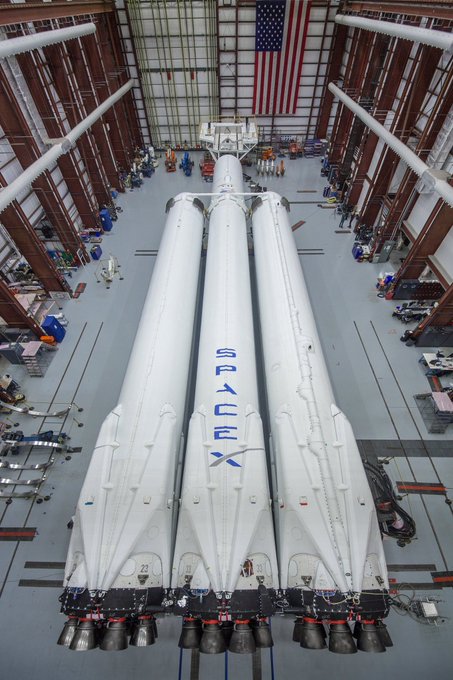
Falcon Heavy in hanger

Capitalism in space: Elon Musk today tweeted several pictures of the Falcon Heavy rocket, assembled in its hanger at Cape Canaveral and awaiting roll out for its first static fire tests on the launchpad.

As I will have nothing to do with Twitter, I must thank reader Michael Phillips for emailing me the photos. The one of the right I think shows the most detail. Note that the two side stages are previously flown Falcon 9 first stages. Only the central core has not flown before. According to previous reports, it required significant redesign to work in this configuration.

There is as yet no word on exactly when the roll out and launchpad static fire tests will take place, but all indications suggest it will be very soon. Whether the launch itself will follow several weeks later, as the link above says and has been stated many times by SpaceX, is more questionable. Remember, they have never fired all 27 engines of the threefold first stage at the same time. I am expecting that they will need time to review the data from that static fire test. I would be very surprised if their analysis and any changes it calls for will be doable in only a few weeks.

7 comments

Local Florida officials battle over $8 million grant to Blue Origin

Local county officials in Florida are involved in a court fight over the decision by the county to borrow $8 million in order to pay a grant to Blue Origin for locating its factory there.

Brevard County commissioners narrowly approved a plan that would allow the county to borrow money to pay for an $8 million economic incentive to rocket manufacturer Blue Origin. The vote was 3-2, with Chair Rita Prichett and Commissioners Jim Barfield and Curt Smith supporting the proposal. Vice Chair Kristine Isnardi and Commissioner John Tobia voted against the plan.

Brevard County Clerk of Courts Scott Ellis told commissioners he plans to go to court to challenge the legality of the county borrowing money to pay for the grant to Blue Origin.

Isnardi is quoted in the article as saying “I don’t think it’s a great policy to give $8 million to a billionaire.” The opposition to this grant also questions the legality of borrowing money to pay it.

3 comments

World View balloon explodes

Capitalism in space: A World View balloon exploded at its launch facility in Tucson yesterday.

No injuries were caused when a large, tethered test balloon ruptured as crews deconstructed it after a successful ground test to fill the balloon, World View spokesman Andrew Antonio said. The rupture resulted in a loud sound heard in the area, and a small fire on the balloon, he said. “We have reached out to reassure our immediate neighbors,” Antonio said. “There were no injuries and only superficial facility damage at the site.”

World View says it can use either helium or hydrogen gas to fill its stratospheric balloons but has initially been using hydrogen, which company officials have said is safe when handled properly.

World View also released its first images from a Stratollite balloon flight yesterday.

I think the second link demonstrates clearly that Stratollite is a good concept for high altitude reconnaissance. I think the first link demonstrates that hydrogen is still problematic for high altitude balloons.

1 comment

Smallsat industry considering standardized “launch unit”

Capitalism in space: The emerging smallsat industry is considering establishing a standard “launch unit,” similar in concept to the standardized container system used by the shipping industry on Earth, to ease payload scheduling and installation on rockets.

“Developing a standard Launch Unit, or Launch-U, for mid-sized smallsats — approximately the size between a toaster and a small refrigerator — will enable rideshares to be configured more quickly and efficiently, resulting in more launch opportunities at a lower cost,” Aerospace representatives said in a statement. “Aerospace [Corporation] is driving the Launch-U conversation by assembling representatives from industry, academia and government to set the mid-size smallsats standard.”

For example, this standardized container concept would make it easier for a smallsat to switch launch rockets should its initial ride get delayed.

The industry has already attempted some standardization with the cubesat idea, which universities have been using now for several decades, a standard-sized satellite structure that is ten centimeters to a side. This launch unit concept would add the standardization to the launch vehicle, creating a standard slot within rockets that could easily take on new satellites.

3 comments

Blue Origin still a year away from launch humans on New Shepard

Capitalism in space: Blue Origin revealed yesterday that it will still be a year at least before they start flying humans on their suborbital New Shepard spacecraft.

The company plans to later fly humans, both as payload specialists for human-tended experiments as well as on tourist flights. Those flights, though, are still at least a year away. “We’re probably a year and a half, two years out from when we’re actually able to fly tended payloads,” Ashby said. “We’re about roughly a year out from human flights, depending on how the test program goes. We have a bunch more tests to do, and we’re going to fly some human test flights before we put paying people in the rocket.”

Previously they had suggested they would be flying humans much sooner, possibly this year. Despite this new delay, last week’s test flight did include Blue Origin’s first paying customers, and the company indicated that they have sold space on all their upcoming unmanned test flights, and that their manifest for those upcoming flights is essentially full.

Though I know many disagree with me, I am increasingly doubtful there will ever be a viable suborbital tourist business. Once commercial orbital manned flights become available, I don’t see there being much profitable interest in such short suborbital experiences. The cost will be too high in comparison with the payoff. And it appears that those commercial orbital manned flights are going to be arriving at about the same time as New Shepard’s first manned flight.

5 comments

Giant Stratolaunch plane conducts first taxi test

Capitalism in space: The giant Stratolaunch plane built out of two 747s completed its first taxi test yesterday.

Stratolaunch’s plane, nicknamed Roc, has the widest wingspan in the aviation world at 385 feet. That’s 50 percent wider than the wings of a Boeing 747 — which probably shouldn’t be surprising, considering that parts from two 747s went into building the plane. Mojave-based Scaled Composites aided in the fabrication of the plane’s carbon composite components.

I think a better way to illustrate the size of the wingspan is to note that if you laid a Saturn 5 rocket along those wings, it would not reach the tips at either end, being “only” 363 feet long.

Several experienced engineers at Behind the Black have previously wondered at whether the plane’s central structure holding its two fuselages together would be strong enough to provide a stable flight. Looking at the picture at the link, I must wonder the same thing.

3 comments

XCOR bankruptcy revelations

XCOR’s bankruptcy has revealed how far the company was from actually building and flying its Lynx suborbital spacecraft.

In original financial filings, XCOR reported having $1,424.66 in cash.

No value was given to the Lynx MK1, a spaceplane in development that would take off and land horizontally. Between $15 million and $20 million would be required to finish the Lynx, according to documents. An estimated $25 million to $30 million was invested.

It is hard to say whether XCOR was a scam, or a good idea that simply never could get the investment capital to fly. In the end, however, it essentially turned out to be both. According the article, local government agencies in both Florida and Texas have lost millions from investments they made in the company in the hope it would produce jobs in their communities.

11 comments

SpaceX launches Dragon and lands 1st stage

Capitalism in space: SpaceX this morning successfully launched a previously used Dragon cargo freighter to ISS as well as once again successfully landing the previously used first stage.

This was the first time NASA agreed to the use of a previously launched first stage. With the first stage and capsule both reused, only the second stage and one out of 10 Merlin engines was new and will not be available for further reuse.

I have embedded the launch video below the fold.

The standings for the most launches in 2017, as of today:

28 United States
18 Russia
17 SpaceX
15 China

Note that I am counting Soyuz launches for Arianespace out of French Guiana under Arianespace, not Russia. Also, the U.S. total includes SpaceX. I have separated SpaceX out to show how a single American company is competing aggressively with whole nations.
» Read more

6 comments

India to build a smallsat rocket

Capitalism in space: India’s space agency ISRO has announced that it developing a smallsat rocket expressly designed to launch cubesats and thus compete with the new smallsat rocket companies now about to become operational.

ISRO has been very successful in providing a launch platform for smallsats on its PSLV rocket, but in this case the smallsats fly as secondary payloads, dependent on the needs of the larger primary satellite. It appears that the space agency has realized that their market share in this area is now threatened by the small rockets being developed by Rocket Lab and Vector, and is therefore moving to compete.

This announcement also provides more evidence that the space industry is splitting between smaller unmanned payloads and larger manned payloads. I predict that in ten years most unmanned satellites launched to circle the Earth will be tiny and launched on tiny rockets, while simultaneously we will see a new generation of giant rockets putting manned spacecraft into orbit and beyond.

3 comments

Arizona’s Court of Appeals sides with Pima County on space balloon deal

Arizona’s second highest court has agreed with Pima County and approved a deal the county made, without competitive bidding, with the space balloon company World View.

In a unanimous ruling, the three-judge panel acknowledged the purpose of competitive bids is to ensure that the county — and, by extension, the taxpayers — gets the most money for the property. But Judge Peter Eckerstrom, writing for the court, said that does not apply when the real goal is not immediate income but longer-term economic development.

The Goldwater Institute, which brought the suit that claimed that the deal violated the state constitution because the lease was signed without competitive bidding, has said it will appeal to Arizona’s Supreme Court.

1 comment

Vector gets launch contract

Capitalism in space: The smallsat rocket company Vector has signed a launch contract with Astro Digital.

Vector, a nanosatellite launch company comprised of new-space and enterprise software industry veterans from SpaceX, Virgin Galactic, McDonnell Douglas, Boeing, Sea Launch and VMware, today announced that it will join forces with Astro Digital, a leader in real-time satellite imagery data, to conduct a dedicated launch in 2018 featuring one of Astro Digital’s satellites for remote sensing applications. Astro Digital plans to engage Vector to launch at least twelve such satellites as part of a larger constellation, with an option to then continue operations at a pace of two to four dedicated satellite launches per year.

The press release notes that Astro Digital flew a test payload on Vector’s suborbital test flight on one of Vector’s two test flights, and that experience convinced the company to sign this new contract.

0 comments
1 444 445 446 447 448 684